
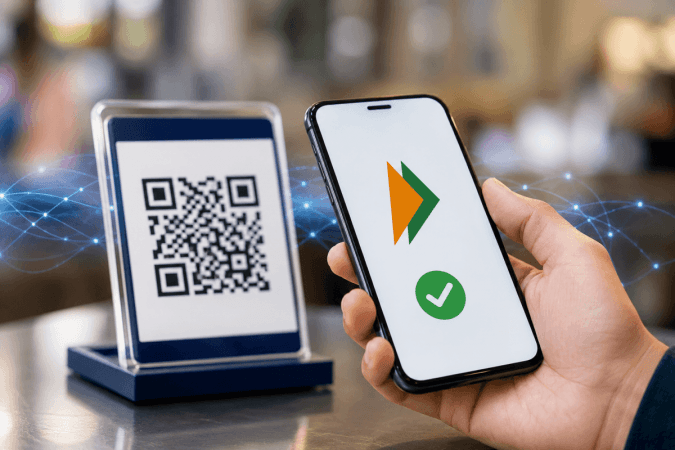
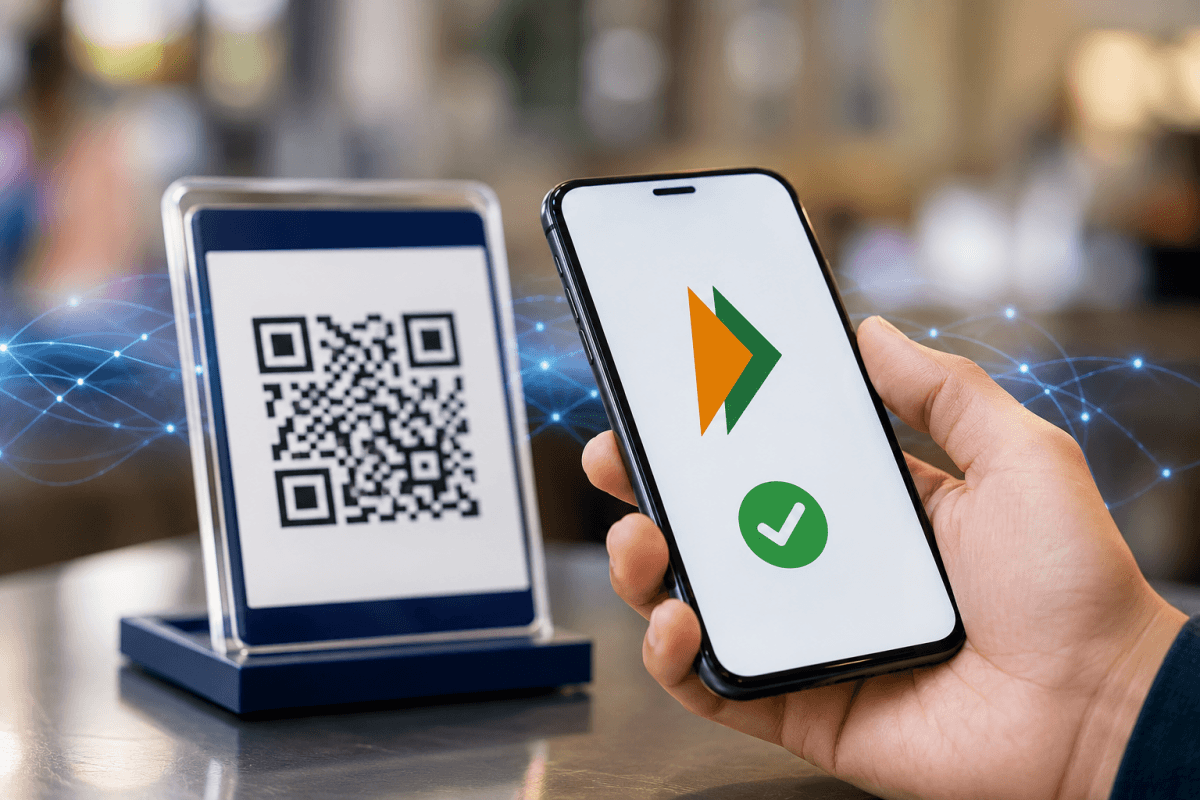
On September 21, 2026, The Hindu captured a defining moment in the evolution of the world's largest real-time payment system. India's Unified Payments Interface, it noted, is accelerating into a "code-less era." The observation rested on the September 10 unveiling at the Global Fintech Fest in Mumbai of UPI Tap & Pay. Users unlock an NFC-enabled smartphone and simply tap it against a compatible point-of-sale terminal. The transaction travels over the terminal's internet connection, functions even when the phone itself has no network, supports RuPay credit cards linked to UPI, and remains PIN-less up to ₹5,000. Larger amounts require a PIN entered on the terminal. This capability builds directly on biometric authentication, which by the end of August 2026 had already powered more than 6.29 billion transactions. At the same event NPCI introduced MyUPI, an AI-powered support and control platform built on its domain-specific small language model FiMI. The system consolidates transaction histories and AutoPay mandates across banks and third-party applications into a single interface, adds a safety switch that can freeze further debits if compromise is suspected, enables mobile-number delinking, and supports natural-language complaint resolution. Together these launches mark a decisive move away from QR codes and one-time passwords toward ambient, device-native authentication and intelligent user control.
The scale that underpins this transformation is extraordinary. In FY2025-26 UPI processed approximately 24,162 crore transactions 241.62 billion valued at ₹314 lakh crore, delivering compound annual growth rates of roughly 188 percent in volume and 155 percent in value since its first full year of operation. August 2026 alone recorded 24.51 billion transactions worth ₹29.82 lakh crore, an average of nearly 791 million transactions every day. Earlier in the year daily averages stood near 66 crore. UPI now accounts for about 85 percent of India's digital retail payments by volume and nearly 49 percent of global real-time payment volume. High-frequency, low-ticket person-to-merchant payments form a substantial share of activity; groceries and supermarkets alone represent more than a quarter of P2M volume at an average ticket size of around ₹217. Third-party application providers the non-bank apps that serve as the primary consumer interface continue to dominate. PhonePe and Google Pay together process roughly 78 percent of volume, a concentration that has kept the 30 percent single-TPAP volume-cap deadline of 31 December 2026 firmly in focus. From 15 October 2026 a carefully structured merchant discount rate of 0.4 percent will apply to select person-to-merchant transactions above ₹2,000, capped at ₹300, with lower or flat rates for essential categories and continued free status for person-to-person and most low-value payments. Analysts estimate the resulting annual revenue pool at ₹15,000–22,000 crore, a meaningful portion of which is expected to accrue to TPAPs and help underwrite cybersecurity, infrastructure resilience, and further innovation.
These Indian advances form part of a worldwide reconfiguration of payment infrastructure. Contactless NFC and biometric authentication have become the expected retail experience across leading markets. In the United States more than 65 percent of in-person card transactions are already contactless, with digital wallets continuing to expand their share. Several European countries have seen mobile wallets overtake physical cards, while passkey deployments and planned public-transport expansions further reduce dependence on one-time passwords. Singapore treats NFC acceptance of cards and major wallets as the default. Offline resilience is receiving explicit attention in World Bank guidance on fast-payment systems and in national roadmaps seeking reliability in low-connectivity environments. Passkeys and device-bound biometrics, advanced by Visa, Mastercard, and major platform providers, are steadily displacing SMS-based credentials and creating a shared foundation usable by both human users and software agents.
The more transformative frontier is agentic commerce the capacity for artificial-intelligence agents to discover, negotiate, and execute payments on behalf of users or other agents. In the United States and across global card networks, Visa's Trusted Agent Protocol and Mastercard's Agent Pay suite, including the June 2026 launch of Agent Pay for Machines, have progressed from pilots into production environments capable of high-frequency, low-latency, machine-to-machine settlement. These systems emphasize cryptographic agent identity, verifiable intent, tokenized credentials, and support for micro-transactions. OpenAI and Stripe have demonstrated conversational checkout inside large language models. Research projections place agent-mediated commerce at roughly $8 billion in 2026 and rising toward $3.5 trillion by 2031, with the United States alone potentially reaching $300-500 billion by 2030. Singapore has already processed live authenticated agent transactions through major banks on Mastercard rails and has published the SAFR framework, Safeguards for Agentic Finance at Runtime a voluntary model that inserts identity verification, a controls repository, a disposition engine for automatic approval or human review, and an immutable audit log between an agent's decision and its execution. Ant International, operating across the Alipay+ network that connects dozens of wallets and hundreds of millions of users, has deployed an Agentic Mobile Protocol enabling end-to-end agent journeys, nano-scale agent-to-agent settlement down to fractions of a cent, and a 100 percent fund guarantee against prompt-injection or intent-misinterpretation failures. It is simultaneously collaborating with Visa and Mastercard on interoperable Know-Your-Agent standards. China's e-CNY continues to expand integration into private wallets while testing cross-border tourism use and wholesale corridors such as mBridge. Europe is advancing live agent-to-agent tests, refining third-party provider rules under the forthcoming PSD3, and designing a digital euro that will require banks and fintechs to deliver wallet and acceptance capabilities under holding limits and privacy constraints. Brazil's Pix illustrates how a central-bank-operated instant system can foster non-bank competition while preserving low costs for users and merchants.
India's trajectory both mirrors and uniquely positions these global currents. NPCI's Unified Agent Protocol, intended to allow registered AI agents to initiate UPI payments within pre-authorized limits by leveraging existing tools such as UPI Circle and Reserve Pay, remains under active development. A national registry for agent identity and monitoring is being constructed, yet the full launch has been deliberately paced pending further work on liability frameworks, user-protection safeguards, and regulatory alignment with the Reserve Bank. Parallel efforts continue on deeper offline NFC capabilities and on CBDC interoperability so that programmable digital rupees can flow across familiar UPI interfaces. Newer TPAPs are already exploring Credit Line on UPI, financial-wellness features, and specialized vertical experiences that convert transaction data into higher-value services under consent regimes.
"AI will be used very effectively when we look at the next wave of UPI," NPCI Managing Director and CEO Dilip Asbe has stated, highlighting its potential to reach new users, detect fraud and mule accounts, and extend credit on the basis of digital footprints, while urging the ecosystem to build sharp, domain-specific small language models. RBI Governor Sanjay Malhotra, in launching Tap & Pay and MyUPI, underscored the twin objectives of greater speed and greater trust. Mastercard's leadership has described Agent Pay for Machines as creating "the conditions for a superbloom of AI business models." Designers of Singapore's SAFR framework insist that runtime safeguards must sit between decision and execution if trust is to scale at population level.
The converging trends are now unmistakable. Authentication is becoming ambient and device-native. Settlement is becoming multi-rail, spanning account-to-account systems, cards, stablecoins, and central-bank digital currencies. Agency is shifting from purely human-initiated actions to goal-oriented software agents that require robust identity, bounded authority, real-time monitoring, and clear liability mechanisms. For third-party providers everywhere the non-bank apps that dominate consumer interfaces in India, the open-banking third-party providers of Europe, the wallet operators of Asia, and the fintech issuers of the United States the strategic imperative is identical. They must master NFC and biometric flows, prepare for agent registration and multi-rail orchestration, integrate liability and monitoring tools, and convert consented transaction data into differentiated services. Those that treat payments merely as a cost center will struggle. Those that become trusted orchestrators of autonomous financial intent will help define the next decade of digital commerce. The simple act of unlocking a phone and tapping a terminal is only the visible surface. Beneath it an architecture is emerging in which human goals, machine agency, and sovereign rails interact at population scale. The systems that successfully balance speed with accountability, inclusion with resilience, and innovation with deterministic settlement will shape not only how money moves, but how economic agency itself is distributed in the years ahead.