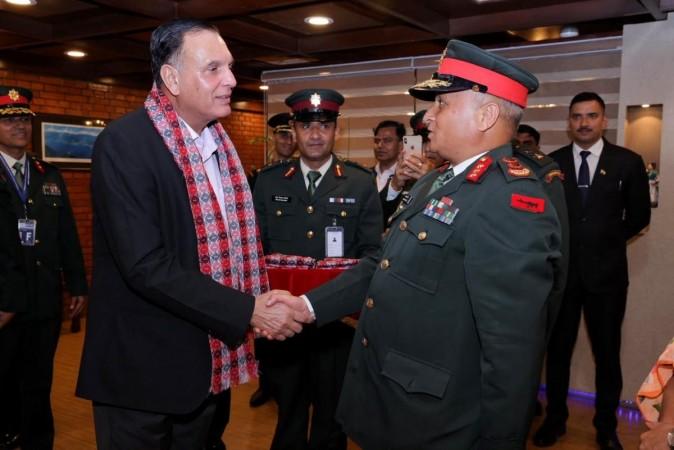
Indian army chief General Dhiraj Seth's visit to Nepal from 17 to 19 August 2026 was presented as a reaffirmation of the longstanding military relationship between India and Nepal. The description is accurate, but inadequate. The visit was, in reality, a strategically timed intervention at the highest military level in a relationship entering a new and uncertain phase. Seth, who assumed command of the Indian Army only on 30 June, chose Nepal as his first foreign destination.
Gen Seth travelled at the invitation of Nepal Army Chief General Ashok Raj Sigdel, was conferred the honorary rank of General of the Nepali Army by President Ramchandra Paudel, held substantive discussions with General Sigdel, engaged Nepal's military leadership and professional military education establishment, met Prime Minister and Defence Minister Balendra Shah, and reached out to the Gorkha veteran community. This was not simply ceremonial diplomacy. It was a carefully calibrated demonstration that the military relationship remains one of India's most consequential strategic assets in Nepal, even as Kathmandu's political relationship with New Delhi is being renegotiated.
The choice of Nepal for Seth's first foreign visit is itself a strategic signal. It places Nepal ahead of the conventional hierarchy of military diplomacy and indicates that New Delhi assigns unusual importance to the relationship at this juncture. The context makes that choice even more significant. Balendra Shah's government came to power with a distinctly new political vocabulary, greater emphasis on sovereignty and national self-interest, and a determination to expand Nepal's room for manoeuvre between India and China. The early months were marked by diplomatic caution towards New Delhi, including the postponement of the proposed visit of Foreign Secretary Vikram Misri. That posture has subsequently softened. Shah met India's Ambassador Naveen Srivastava shortly before Seth's visit, India renewed its invitation to Shah to visit New Delhi, and the Army Chief then became the first senior Indian official to engage the new government at the highest security level. The sequence is too precise to be accidental. New Delhi is reopening the relationship layer by layer, with Seth's visit providing the strategic and institutional anchor.
The presence of Ambassador Naveen Srivastava at Seth's meeting with Shah is especially important. It brought India's political-diplomatic and military channels together in the same room. The Ambassador provides the continuous political interface; the Defence Wing of the Embassy provides the permanent military link; Seth provides the authority of the Indian Army's highest professional office. The Defence Attaché and the Defence Wing also sit at the centre of India's extensive Gorkha veteran and pension architecture. In other words, Seth's visit was the visible apex of a much deeper institutional structure. This matters because political relationships can fluctuate, while military institutions preserve memory, professional familiarity and personal networks across governments. India's strategic advantage in Nepal is not simply proximity. It is accumulated institutional depth.
The honorary rank conferred upon Seth by President Paudel consequently deserves more than ceremonial treatment. The reciprocal tradition, established in 1950, has considerable symbolic value, but its contemporary significance lies in the fact that it survives political turbulence. General Sigdel had received the corresponding honorary rank in India in December 2024. Kathmandu's decision to confer the honour on Seth now effectively separates the military relationship from the more contentious political questions between the two countries. That distinction is vital. Nepal can assert its territorial claims without dismantling military cooperation; India can maintain its position on the boundary without allowing disagreement to consume the entire relationship. Seth's meeting with General Sigdel and his engagement with Nepal's Command and Staff College reinforced precisely this institutional continuity.
But the real weight of Seth's visit lies in the military relationship he represents. Seth is not a ceremonial figurehead. His career spans armoured warfare, counter-insurgency, operational command, capability development, higher military planning and command of two major operational commands. He has been associated with the Indian Army's modernisation agenda and now leads an Army adapting to technology-driven, multi-domain warfare. His presence in Kathmandu therefore creates an opportunity to redefine India-Nepal military cooperation for the next generation. The agenda should move decisively beyond ceremonial exchanges and historical symbolism towards high-altitude operations, humanitarian assistance and disaster relief, military medicine, UN peacekeeping, cyber security, drones and counter-drone capabilities, intelligence and information sharing, professional military education and emerging technologies. Nepal's terrain and location make such cooperation strategically valuable, not merely diplomatically desirable.
The Gorkha relationship gives this military partnership an extraordinary human dimension. For generations, recruitment into the Indian Army has represented employment, dignity, social mobility and long-term security for Nepali families. The suspension of recruitment following Agnipath has consequently created a problem far larger than a military manpower issue. It has affected a historic social compact. Yet the emerging pressure from Gorkha veterans inside Nepal is noteworthy. Veterans have been urging Kathmandu to resolve the impasse and restore recruitment, demonstrating that the constituency for preserving the relationship is not confined to New Delhi. This is precisely why Seth's engagement with veterans and Veer Naris in Pokhara matters. It reconnects the Indian Army with a community that has been one of the relationship's most durable bridges. The fact that no public Agnipath breakthrough emerged during the visit should not be read as a setback. A sensitive issue involving sovereignty, employment and military policy is more likely to be solved through quiet political accommodation than public negotiation under the glare of a visiting Army Chief.
200-years-old tradition with Nepal
Former Indian Ambassador to Nepal Ranjit Rae has argued that India should do "everything possible to retain the 200-year-old tradition with Nepal" and explore ways of giving Nepali recruits a viable post-service future. That observation captures the strategic importance of the issue. The Gorkha relationship is not merely about recruiting soldiers. It is about retaining a living institutional connection between two societies.
The hardest challenge, however, is Lipulekh. Nepal continues to assert its claim over Lipulekh, Limpiyadhura and Kalapani, while India rejects Kathmandu's territorial interpretation. The recent resumption of India-China trade through Lipulekh has added another layer of sensitivity because Kathmandu sees two larger powers conducting activity in an area Nepal claims. For Shah, sovereignty is politically non-negotiable. India should understand that rather than treating every Nepalese assertion as evidence of anti-India alignment. The objective should be to prevent a territorial disagreement from becoming the organising principle of the entire bilateral relationship.
This creates an opening. The strategic wisdom for India is not to expect Nepal to immediately abandon its claim, but to prevent the dispute from becoming the organising principle of the entire bilateral relationship. The relationship must learn to accommodate differences without surrendering its strategic depth, while managing desired outcomes gradually.
Strategic patience, not strategic retreat
The Chinese dimension cannot be ignored, but neither should it become an obsession. Nepal is increasingly pursuing what might best be described as strategic autonomy rather than strategic alignment. It will engage China. It will engage India. It will seek American, European and multilateral partnerships. The appropriate Indian response is not to demand that Nepal choose. It is to ensure that, when Nepal has choices, India remains the most trusted and consequential strategic partner.
Former Nepal Army Major General Binoj Basnyat has observed that Balen Shah is "not the conventional Nepali politician" and should not be expected simply to follow established diplomatic patterns. That is an important warning for New Delhi. Shah's Nepal is less deferential, more nationally assertive and considerably more conscious of its ability to diversify external relationships. India's strength will therefore depend less on hierarchy and more on relevance.
Former Indian Ambassador Manjeev Singh Puri has gone further, describing Nepal as "the most important relationship" for India in terms of what it says about India's place in the world. The formulation deserves attention. Nepal is not merely another neighbouring country in India's strategic calculus. It is a test of whether India can exercise influence through trust rather than dependence, partnership rather than patronage, and patience rather than pressure.
That is precisely why Seth's visit matters.
The Army Chief's engagement with General Sigdel protects the institutional core. His meeting with Shah opens the political-security channel. Ambassador Srivastava connects the military engagement to diplomacy. The Defence Wing sustains the permanent relationship. The Gorkha outreach reconnects the human constituency. The Command and Staff College engagement reaches the officers who will shape Nepal's security establishment in the future. And the honorary rank conferred by President Paudel publicly reaffirms the exceptional character of the military relationship.
Taken together, these are not isolated courtesies. They form a multi-layered reset architecture.
The immediate outcome is not a treaty, a border settlement or an Agnipath agreement. Nor should it have been. The immediate achievement is more fundamental: India has regained strategic access at the highest level of Nepal's new political and military establishment without demanding political alignment in return.
The next test is Prime Minister Shah's eventual visit to New Delhi. India should use that opportunity to move from reassurance to substance: Gorkha recruitment, energy, cross-border connectivity, disaster management, digital infrastructure, economic integration and a modernised defence partnership should form the core agenda. The boundary dispute should be handled separately, patiently and at the political-diplomatic level.
General Seth's visit should therefore not be judged by what it settled. It should be judged by what it made possible.
It has demonstrated that even in a Nepal determined to exercise greater strategic autonomy, the India-Nepal military relationship retains exceptional depth. It has shown that Kathmandu can disagree with New Delhi without closing the door. And it has given India an opportunity to redesign a historic relationship rather than merely defend it.
The quiet reset behind General Seth's ceremonial visit is therefore real. Its success will depend on whether India now converts military goodwill into a broader strategic partnership that is resilient enough to absorb disagreement, patient enough to pursue desired outcomes gradually, and contemporary enough to remain indispensable to the Nepal of the future.
[Major General Dr. Dilawar Singh, IAV, is a distinguished strategist having held senior positions in technology, defence, and corporate governance. He serves on global boards and advises on leadership, emerging technologies, and strategic affairs, with a focus on aligning India's interests in the evolving global technological order.]