

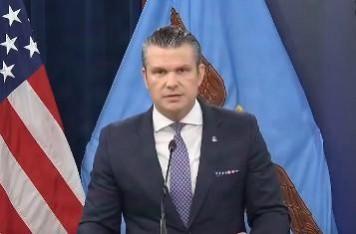
The abrupt directive from Secretary of Defense Pete Hegseth to Army Chief of Staff General Randy George on April 2, 2026 delivered by phone, accepted without public explanation, and confirmed by the Pentagon within hours marks more than a personnel shake-up. It is a case study in the erosion of institutional guardrails that have, for generations, tempered the exercise of civilian supremacy over the armed forces.
At issue are two interlocking risks: the non-rule-based restructuring of the military's senior leadership, conducted without following any transparent or codified procedure, and the politically driven, unilateral acceleration toward forms of force employment that are unprecedented in scale, unexpected in timing, and potentially unacceptable in their strategic and human consequences. Both demand rigorous scrutiny not as partisan grievance but as threats to the coherence of American grand strategy.
Civilian control of the military is not a slogan; it is a constitutional axiom. The President, as commander in chief, and the Secretary of Defense, as his agent, possess plenary authority to select and relieve senior officers. History records salutary exercises of that power Lincoln cycling through commanders until Grant, Truman relieving MacArthur when policy and ego collided. Yet those decisions were accompanied by articulated rationale, often public, and occurred within a culture that prized professional candor. What distinguishes the present moment is the vacuum: no charge of misconduct, no operational failure, no documented policy rift placed on the record. A four-star officer with combat command credentials in Iraq and Afghanistan, serving in a role whose occupant signs the orders that commit divisions to contact, is simply told his service is no longer required mid-war, mid-campaign, with the 82nd Airborne deploying, Marine expeditionary units staged, and special operations forces forward-postured across multiple theaters. The replacement, Vice Chief General Christopher LaNeve, formerly the Secretary's senior military assistant, completes a compression of the advisory chain that is as operationally tidy as it is politically revealing.
Insulated High Command from Electoral Politics
This is not how the American system has historically insulated high command from the vicissitudes of electoral cycles or media cycles. The Goldwater-Nichols Act of 1986, the 1986 Defense Reorganization, and the informal norms codified in service regulations and the Uniform Code of Military Justice presuppose a deliberate rhythm: fitness reports, selection boards, congressional oversight hearings, and, when necessary, formal relief for cause. None of these were invoked. The absence of procedure is itself procedural innovation rule by fiat, justified ex post by the imperatives of "leadership change." When such fiat occurs in peacetime it corrodes morale; in wartime it risks something graver: the substitution of loyalty for professional judgment precisely when friction, uncertainty, and second-order effects multiply.
Clausewitz reminds us that war is the realm of uncertainty and chance; the commander's coup d'œil must contend with fog and the enemy's independent will. The Chief of Staff of the Army is not a political commissar but the senior uniformed officer responsible for translating presidential intent into feasible campaign design assessing lift requirements, sustainment pipelines, casualty projections, escalation ladders, and the irreducible differences between a punitive strike package and sustained ground commitment. Removing him without explanation at the cusp of decisions involving Kharg Island, power-generation targets, or potential littoral operations signals that the next phase of the Iran campaign requires an advisor who will not introduce friction. The strategic logic is clear: a principal-agent problem solved by installing an agent whose career trajectory aligns with the principal's preferences. The cost is the loss of the very institutional memory and institutional skepticism that prevents strategic overstretch.
Consider the precedent in reverse. During the 1991 Gulf War, General Colin Powell and General Norman Schwarzkopf pushed back against premature ground commitments and overly optimistic timelines; their counsel, rooted in professional assessment rather than political fealty, shaped a campaign that achieved rapid victory with minimal U.S. casualties. In 2003, the absence of comparable internal dissent contributed to the underestimation of post-invasion stabilization requirements. History does not repeat, but it does rhyme: when senior military voices are curated for ideological alignment rather than operational realism, the probability of miscalculation rises. The current theater high-intensity conflict against a peer-adjacent regional power with ballistic missiles, proxy networks, and oil-chokepoint vulnerabilities amplifies every error. A raid on Kharg that severs 90 percent of Iranian exports is not a limited kinetic demonstration; it is an act of economic warfare whose second- and third-order effects (energy shock, refugee flows, Chinese and Russian countermoves) require the unvarnished counsel of officers whose careers do not depend on pleasing the chain above them.
No Process, No Protocol to Remove Top Generals
The deeper hazard is normative. Once the precedent is set that a Secretary of Defense can purge the service chief mid-conflict without process, the incentive structure for future officers shifts. Candor becomes career-limiting. The military profession, already strained by two decades of counterinsurgency followed by great-power competition, risks becoming an instrument rather than a partner in strategy formulation. Civilian supremacy is preserved; professional autonomy is hollowed out. The result is not stronger command but brittle command orders that travel faster because fewer experienced voices have been allowed to interrogate them.

None of this disputes the right of the elected government to set national objectives or to reshape the Pentagon's leadership culture. Secretary Hegseth was confirmed precisely to enact a vision of reform. Yet reform conducted by telephone call, without explanation, during active hostilities, is not reform; it is centralization by other means. The Republic has endured worse McCarthy-era loyalty tests, Vietnam-era micromanagement but never without paying a strategic price measured in blood and treasure. The question now is not whether the administration possesses the legal authority to act as it has; it clearly does. The question is whether the republic can afford the long-term corrosion of the civil-military compact that has, for eighty years, kept strategy tethered to reality even when politics pulled in the opposite direction.
The war will continue. New orders will issue. The 41st Chief of Staff of the Army will execute them with the loyalty demanded of the uniform. But the republic should mark the moment: when the distance between television studio and combat order collapses to zero unmediated intermediaries, the margin for strategic error narrows to the width of a single judgment. History judges not only the courage of those who issue orders but the wisdom of those who ensure the orders are grounded in fact rather than fervor. In the absence of procedure, that wisdom now rests solely on the character of the civilians who wield the power and on the electorate that ultimately holds them accountable.
Silence Follows Firing Army Chief
The real climax arrives not in the firing itself, but in the silence that follows. When the senior uniformed officer whose entire professional life has been calibrated to weigh the feasible against the desirable is removed without explanation, the Republic crosses a threshold. The chain of command remains intact, yet its intellectual ballast has been deliberately lightened. What was once a dialogue between elected authority and professional judgment has become a monologue. The orders that will now flow whether to seize Kharg Island under fire, to strike hardened Iranian command nodes with effects that ripple through global energy markets, or to commit ground forces into terrain where every meter is contested by proxies and precision munitions, or go that unexpected mile of using a WMD, will carry the full weight of presidential intent unmediated by the one voice institutionally charged with saying, when necessary, "This is militarily possible, Mr. Secretary, but here is why it is strategically ruinous."That silence is the climax. It is the moment when civilian supremacy, long celebrated as the safeguard of democracy, is tested not by whether it can issue orders but by whether it can tolerate the friction required to make those orders wise. In the next fourteen days, the character of American power will be revealed less by the bravery of its soldiers than by the quality of the counsel that shaped their mission. If the new Chief of Staff, forged in the Secretary's inner circle, proves as capable of dissent as his predecessor, the innovation will have been harmless. If he does not, if the next phase proceeds without the institutional pushback that has historically prevented overreach then the Republic will have traded resilience for velocity at the exact hour when velocity without resilience courts catastrophe.
Looking forward, this precedent will not fade when the present campaign ends. Future Secretaries, of either party, will inherit a normalized practice: the mid-conflict relief of service chiefs by telephone, the installation of personally vetted successors, the compression of advisory distance until the only filter between political desire and combat execution is loyalty. The armed forces, already navigating the transition from counterinsurgency to high-intensity peer conflict, will internalize the lesson that professional candor is optional and career-ending. Congress, whose oversight role was already attenuated, will find its formal hearings increasingly ceremonial. And the electorate distracted by the spectacle of decisive leadership will discover, perhaps too late, that the long-term safeguard of American strategy is not the charisma of any one administration but the procedural humility that forces power to listen before it strikes.
The Republic has endured far greater tests of civil-military trust. It will endure this one. Yet endurance is not the same as wisdom. The true measure of this moment will be taken not in the coming weeks of combat but in the decades that follow: whether the next generation of officers still believes their oath requires them to speak truth to power, or whether they learn instead that survival demands silence. If the latter, the United States will have preserved the letter of civilian control while quietly surrendering the spirit that made it enduringly superior to every authoritarian alternative. History does not forgive nations that mistake speed for strength or loyalty for competence. The war will end; the precedent will not. The question the Republic must now answer is whether it still values the difficult conversation that keeps its sword sharp rather than merely swift. It will be important to see whether the national interest prevails, the political interest prevails or the personal concerns overshadow both.
[Major General Dr. Dilawar Singh, IAV, is a distinguished strategist having held senior positions in technology, defence, and corporate governance. He serves on global boards and advises on leadership, emerging technologies, and strategic affairs, with a focus on aligning India's interests in the evolving global technological order.]