

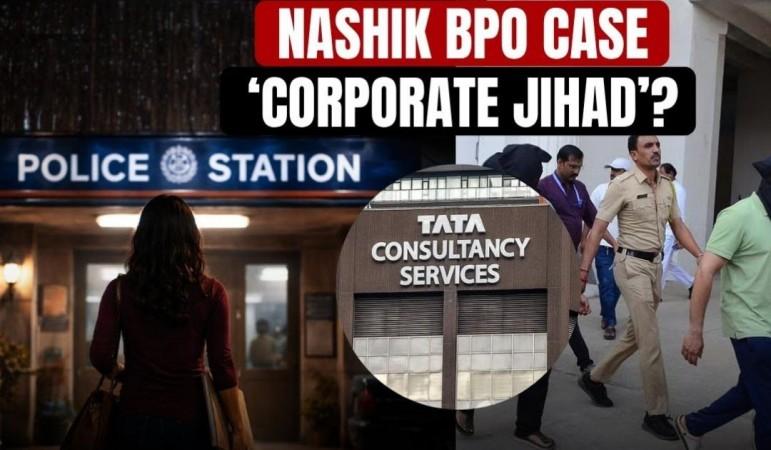
Allegations of religious coercion and workplace harassment have surfaced in a TCS-linked BPO unit in Nashik, with multiple employees accusing senior staff of forcing them to follow specific religious practices and creating a hostile work environment.
A male employee alleged that staff were pressured to wear skullcaps, offer namaz, and recite the Kalma, with claims that refusal led to intimidation, isolation, and excessive workload. He also alleged instances of verbal abuse and inappropriate remarks, including being told to "send his wife" during a period when the couple was undergoing fertility treatment.
Women employees have also come forward with complaints, alleging they were pressured to observe fasts during Ramzan, cover their heads, and in some cases subjected to sexual exploitation. The complaints suggest a coordinated pattern of misconduct targeting younger employees.
Police have registered at least nine FIRs in the case, including allegations of religious coercion, sexual harassment, verbal abuse, and attempts to force dietary or religious practices. Investigators are also examining digital evidence, including call records, emails, chats, and possible financial transactions.
One of the accused, Nida Khan, has been named in an FIR and described by police as a key figure in the case. However, her family has strongly denied the allegations, stating that she is not absconding, does not hold an HR position, and was working as a telecaller in a BPO unit. They have also said she is currently pregnant and preparing to seek anticipatory bail.
The family further claimed that Khan has been wrongly portrayed in media reports and that she has been under severe mental stress due to the accusations. Her lawyer has confirmed plans to file for anticipatory bail, citing her pregnancy and role clarification.
According to the family, Khan moved to Mumbai after her marriage and was working at the company's Malad office until her suspension on April 9. They maintain that she was not part of senior management and had no authority over HR decisions.
Nashik, Maharashtra: On the Nashik IT company case, father of accused Tausif Attar, Bilal Fakir Mohammad Attar says, "We are well-educated. I am a graduate myself, and my son is also a graduate. He has completed his BCA. Our entire family is educated. Whatever is happening is… pic.twitter.com/7T3BYlYeQc
— IANS (@ians_india) April 16, 2026
The broader case originated from a complaint by a 23-year-old employee alleging sexual harassment and exploitation under false promises of marriage. It has since expanded into multiple FIRs involving several accused individuals.
So far, several people have been arrested, while Tata Consultancy Services has initiated an internal probe and reiterated its zero-tolerance policy toward misconduct. Tata Sons Chairman N Chandrasekaran has also termed the allegations "gravely concerning."
The National Human Rights Commission (NHRC) has issued notices to authorities in Maharashtra and the management of Tata Consultancy Services (TCS) over allegations of an organised racket involving alleged religious conversion and sexual exploitation at the company's Nashik office.
A Bench presided by NHRC Member Priyank Kanoongo took cognisance of a complaint filed by the Legal Rights Observatory, alleging that such activities were being carried out within the TCS branch in Nashik, with purported involvement or protection from senior human resources officials.
According to the complaint, top-level executives were allegedly aware of the activities and failed to take corrective action, thereby indicating a serious lapse in corporate governance.
It was further alleged that compliance with the Vishaka Guidelines was not ensured at the Nashik branch, leaving employees without an effective Internal Complaints Committee (ICC) or a safe mechanism to report grievances.
Observing that the allegations, if true, prima facie indicate violations of the human rights of the victims, the apex human rights body issued notices under Section 12 of the Protection of Human Rights Act, 1993.
The NHRC has directed the Director General of Police (DGP), Maharashtra, the Commissioner of Police, Nashik, the Labour Commissioner of Maharashtra, and the CEO & MD of TCS to conduct a thorough enquiry into the allegations.
It has asked the DGP to submit details of FIRs registered in the matter, including the names of the accused and whether any senior officials or operational heads of the company have been named in the cases.
The NHRC has also directed the Labour Commissioner to furnish comprehensive details of all TCS branches across India, including registration and licencing status under applicable labour laws.
Further, the TCS management has been asked to provide detailed information regarding its POSH (Prevention of Sexual Harassment) mechanisms, including the constitution and functioning of Internal Committees, criteria for membership, records of complaints received over the past three years, and Action Taken Reports.
The apex human rights body has sought copies of statements of employees, former staff, and committee members, as referenced in the complaint, along with documentation of measures undertaken to address workplace grievances.
The NHRC has sought an Action Taken Report from all authorities concerned within seven days and directed that a copy of the report be submitted via email for its perusal.
Meanwhile, the controversy has reached the Supreme Court, where a fresh application has been filed in the pending matter titled, "In Re: The Issue of Religious Conversion", citing the Nashik incident as evidence of alleged organised religious conversion.
The application, moved by advocate Ashwini Kumar Upadhyay, contends that the allegations at TCS's Nashik office demonstrate the need for stricter legal measures to curb conversions carried out through force, fraud, coercion or inducement.
"The organised religious conversion in Nashik has shaken the conscience of citizens throughout the country," the plea said, adding that such acts pose a serious threat to constitutional values including secularism, equality, and national integration.
The application further argues that Article 25 of the Constitution does not protect forced conversions and that the right to propagate religion does not include the right to convert others against their free will.
It has urged the apex court to consider framing stricter legal provisions to regulate unlawful religious conversions and to examine whether organised forced conversions could fall within the ambit of serious criminal offences under existing laws.
The applicant has sought directions to the Union government to frame stricter laws to regulate and prevent unlawful religious conversions across the country.