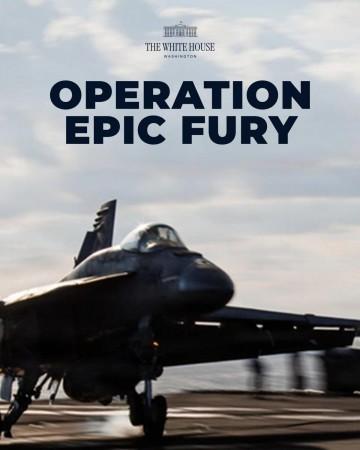
When Donald Trump declared that "hostilities have terminated" following Operation Epic Fury, the phrase offered the reassurance of closure. Yet the strategic reality is more complex and more consequential. What has ended is not the conflict, but its kinetic phase. What has begun is a deeper, more enduring condition: a state of continuous, multi-domain contestation that defies traditional definitions of war and peace.
As Carl von Clausewitz observed, "War is merely the continuation of policy by other means." In the present era, the proposition has evolved. Policy is now conducted through persistent, low-intensity warfare across domains, punctuated by short bursts of high-intensity violence. Epic Fury is not an aberration; it is a signal event a compressed demonstration of how modern conflicts begin, pause, and persist without resolution.
The Doctrine of Continuum Conflict
What emerges from this episode is a definable and enduring framework one that merits doctrinal recognition:
> The Doctrine of Continuum Conflict:
Modern conflict operates across a continuous spectrum of kinetic, economic, cyber, and informational engagement, without formal declaration or definitive termination, and with strategic effects distributed across time and domains.
This doctrine rests on four structural pillars:
Phase Compression: High-intensity war cycles unfold in weeks, not years
Domain Fluidity: Conflict shifts seamlessly across military, economic, and cyber theatres
Legal Ambiguity: Actions outpace the frameworks designed to govern them
Economic Weaponisation: Financial systems and energy flows become primary instruments of coercion
The consequence is profound. Wars no longer end; they mutate.
Tactical Brilliance, Strategic Suspension
The operational performance of the United States during Epic Fury was formidable. Precision strikes degraded critical infrastructure, neutralized high-value targets, and reasserted immediate deterrence. Yet, as Henry Kissinger cautioned, "The conventional army loses if it does not win. The guerrilla wins if he does not lose." Iran, leveraging dispersion, redundancy, and asymmetric retaliation, ensured precisely that outcome it did not lose.
This has produced a condition best described as strategic suspension. The nuclear question remains unresolved. Proxy networks remain intact. Maritime vulnerabilities persist. The declaration of "terminated hostilities" thus reflects a political narrative of closure imposed upon a strategic reality of continuation.
As Thucydides wrote, "The strong do what they can and the weak suffer what they must." Yet the asymmetries of modern warfare invert this logic: the "weak," through drones, missiles, and networked proxies, can impose costs that prevent decisive victory by the "strong."
The Quiet Erosion of Legal Order
If the battlefield revealed the limits of force, the legal domain revealed the limits of governance. The reliance on executive authority in Washington without sustained congressional sanction raises fundamental questions about the future of democratic war powers. By suggesting that a ceasefire pauses the legal clock, the administration introduces a precedent of episodic warfare, potentially bypassing legislative oversight.
At the international level, the implications are equally stark. Preemptive strikes, targeted eliminations, and maritime coercion operate in a grey zone where legal norms are increasingly contested. As Kofi Annan warned, "When the use of force is not anchored in legitimacy, it risks eroding the very order it seeks to defend."
What is emerging is a shift from a rules-based order to a capabilities-based order, where legitimacy is inferred from power rather than conferred by law. This transition, if sustained, will redefine the behavior of states, alliances, and institutions.
Industrial Fragility and the Limits of Power
Beneath the surface of operational success lies a structural vulnerability: industrial constraint. Advanced munitions precision-guided missiles, interceptors, and long-range strike systems were expended at rates that challenge replenishment cycles. Assessments by CSIS and RAND Corporation have repeatedly warned that Western stockpiles are insufficient for sustained, high-intensity peer conflict.
This reality echoes the caution of Dwight D. Eisenhower, who urged vigilance regarding the military-industrial complex. Today, the concern is not excess, but insufficiency a mismatch between the velocity of modern warfare and the capacity of industrial systems to sustain it.
In strategic terms, this reintroduces an old truth in a new form: wars are won not only by weapons, but by the ability to produce them at scale and speed.
Economic Warfare: The Primary Theatre
If kinetic conflict is episodic, economic warfare is continuous. The Strait of Hormuz through which roughly one-fifth of global oil supply transits has once again demonstrated its centrality. Even partial disruption can trigger disproportionate volatility in global markets. The International Energy Agency has consistently highlighted the systemic sensitivity of energy flows through this corridor.
The result is a dual-containment dynamic:
The United States employs sanctions, financial surveillance, and maritime presence
Iran leverages geography, proxies, and asymmetric capabilities to threaten flows
As Sun Tzu observed, "The supreme art of war is to subdue the enemy without fighting." In this context, energy and finance become instruments of coercion more enduring than missiles.
The economic costs are already significant. Estimates suggest that U.S. operational expenditure in the conflict has reached $25–30 billion within weeks, while global energy price fluctuations impose far broader systemic costs amplified through inflation, currency pressures, and supply chain disruptions. The International Monetary Fund has repeatedly warned that such shocks can have cascading effects across emerging and advanced economies alike.
Geopolitical Rebalancing: Power in Motion
Every conflict redistributes influence. In the wake of Epic Fury, China has positioned itself as a stabilizing actor, leveraging economic engagement and diplomatic continuity. Xi Jinping's emphasis on "win-win cooperation" offers a strategic contrast to American interventionism.
Russia, though constrained, benefits from the diffusion of U.S. focus, gaining relative flexibility in other theatres. The Middle East itself moves toward a multipolar equilibrium, defined less by stability than by a dynamic balance of competing influences.
As Zbigniew Brzezinski noted, "Stability is often an illusion sustained by temporary alignments." The current alignment is fluid, contingent, and susceptible to rapid disruption.
Technology and the Compression of Conflict
Technological innovation has not only enhanced capability it has compressed time. Drone swarms, AI-enabled targeting, and cyber operations enable rapid escalation and equally rapid stabilization. The cycle from initiation to pause now unfolds in weeks.
This creates a structural tension. Decision-making systems legal, political, and institutional operate at human speed, while conflict evolves at machine speed. The result is a widening gap between action and oversight, with profound implications for accountability and control.
India: Between Vulnerability and Strategic Opportunity
For India, the implications are immediate and strategic. With approximately 85% dependence on imported crude, and a significant portion transiting the Strait of Hormuz, India is acutely exposed to disruptions. Energy security is not merely an economic issue; it is a national security imperative.
At the same time, the evolving nature of conflict highlights capability gaps:
Limited scale in autonomous and drone warfare deployment
Need for accelerated indigenous defence manufacturing
Imperative to strengthen maritime domain awareness and naval reach
India must move beyond a reactive posture. As Jawaharlal Nehru observed, "Foreign policy is the outcome of economic policy." Today, it is equally the outcome of technological capability and strategic foresight.
India cannot remain a passive balancer in an era of continuous conflict. It must evolve into a proactive shaper of regional stability architectures, integrating economic resilience, military capability, and diplomatic agility.
Implications for Boards and Global Capital
The shift from episodic war to continuous contestation has profound implications for corporate governance and capital allocation. As Larry Fink has noted, "Geopolitics is now a defining driver of long-term investment risk."
Boards must internalize several realities:
Geopolitical risk is persistent, not episodic
Supply chains must be stress-tested against conflict scenarios
Energy exposure constitutes a strategic vulnerability
Regulatory and sanctions environments can shift rapidly and unpredictably
In this context, governance must evolve from compliance-oriented frameworks to strategic resilience architectures.
The Five Strategic Realities of Modern Conflict
1. Wars no longer end they transform
2. Economic systems are primary battlefields
3. Legal frameworks lag behind power realities
4. Industrial capacity defines endurance
5. Technology compresses decision timelines
These are not temporary conditions. They are the structural characteristics of the emerging global order.
The End of Endings
The most dangerous illusion of the present moment is the belief that escalation has been contained. In reality, it has been redistributed across domains, across geographies, and across time.
As Peter Drucker warned, "The greatest danger in times of turbulence is not the turbulence, it is to act with yesterday's logic." The persistence of conflict is not the failure; the failure would be the persistence of institutions designed for a world in which conflict ended.
Operation Epic Fury is not a conclusion. It is a transition point, a demonstration that strategy must now operate within a continuum, integrating military, economic, legal, and technological dimensions at unprecedented speed.
The defining challenge of our time is clear: to align governance with the velocity of conflict, and strategy with the permanence of contestation. Those who succeed will shape the emerging order. Those who do not will be shaped by it.
The question, therefore, is not whether hostilities have terminated. It is whether we are prepared for a world in which they no longer need to.
[Major General Dr. Dilawar Singh, IAV, is a distinguished strategist having held senior positions in technology, defence, and corporate governance. He serves on global boards and advises on leadership, emerging technologies, and strategic affairs, with a focus on aligning India's interests in the evolving global technological order.]