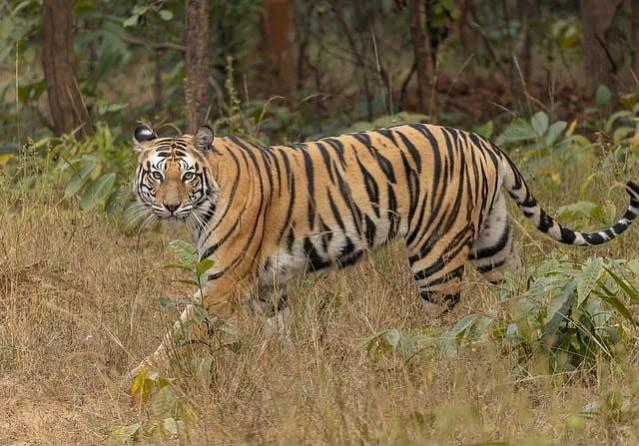
British magazine The Economist has faced criticism on social media after referring to India as a "relatively poor country" in an article praising the country's success in wildlife conservation.
The article, published on October 4, highlighted India's efforts to protect tigers, lions, rhinos and elephants and said the country's conservation success could offer lessons for other environmental efforts. However, a reference to India's economic status while discussing its conservation efforts sparked a backlash.
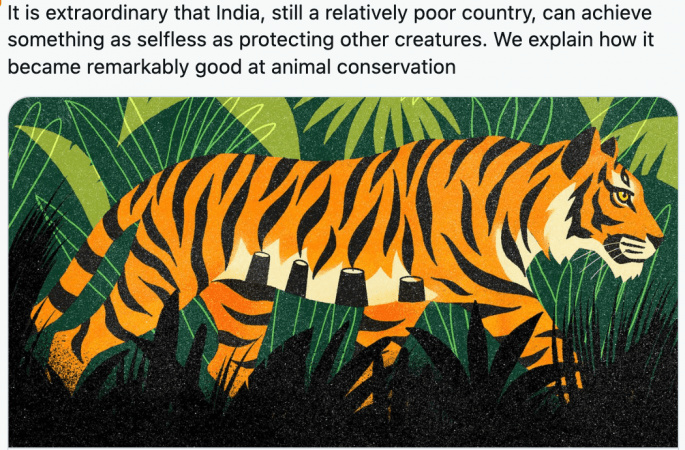
The article described it as "extraordinary" that India, which it called a relatively poor country, could achieve something as selfless as protecting other creatures. The comment drew sharp reactions from several Indian social media users, who accused the magazine of adopting a patronising attitude towards India.
Communications expert Smita Deshmukh criticised the publication on X, alleging that it lacked an understanding of India's history and civilisation in relation to wildlife conservation.
Another social media user, Niveditha Panda, questioned the reference to India's economic condition and pointed to the country's history of wildlife conservation and the launch of Project Tiger.
Indian Forest Service officer Parveen Kaswan also reacted to the article. While acknowledging India's conservation achievements, he said it was "telling" that the narrative still included criticism unrelated to the conservation success.
What The Economist article said
The article itself largely praised India's wildlife conservation efforts and examined why the country has been successful in protecting several species.
It highlighted public sentiment towards animals, India's animal-protection laws and the role of political leadership in conservation. It also cited programmes such as Project Tiger, Project Elephant, Project Snow Leopard, Project Dolphin and Project Rhino as examples of India's "mission mode" approach to conservation.
The article also noted that India's conservation efforts are not without challenges, particularly the increasing instances of human-animal conflict. Despite these challenges, it described India's wildlife conservation as an example of the country at its finest.
India's wildlife conservation success
India's conservation efforts have included several long-running programmes aimed at protecting endangered species and their habitats. Project Tiger, launched in 1973, became one of the country's most prominent wildlife conservation initiatives.
The Economist article noted that India's approach has expanded over the years to include programmes focused on elephants, snow leopards, dolphins and rhinos. It also highlighted the role of forest officials, conservation organisations, scientists and researchers in supporting these efforts.
The controversy surrounding the article has therefore centred not on its assessment of India's wildlife conservation achievements, which was largely positive, but on its decision to link those achievements with India's economic status.
The remarks have since triggered a wider debate online over how India's development and conservation efforts are portrayed by international media.

![Angry Jaya Bachchan pushes journalist's mic away during INDIA bloc protest [watch]](https://data1.ibtimes.co.in/en/full/839178/angry-jaya-bachchan-pushes-journalists-mic-away-during-india-bloc-protest-watch.jpg?w=220&h=135&l=50&t=40 "Angry Jaya Bachchan pushes journalist's mic away during INDIA bloc protest [watch]")







![Angry Jaya Bachchan pushes journalist's mic away during INDIA bloc protest [watch]](https://data1.ibtimes.co.in/en/full/839178/angry-jaya-bachchan-pushes-journalists-mic-away-during-india-bloc-protest-watch.jpg?w=220&h=138)


![Angry Jaya Bachchan pushes journalist's mic away during INDIA bloc protest [watch]](https://data1.ibtimes.co.in/en/full/839178/angry-jaya-bachchan-pushes-journalists-mic-away-during-india-bloc-protest-watch.jpg?w=220&h=135)