
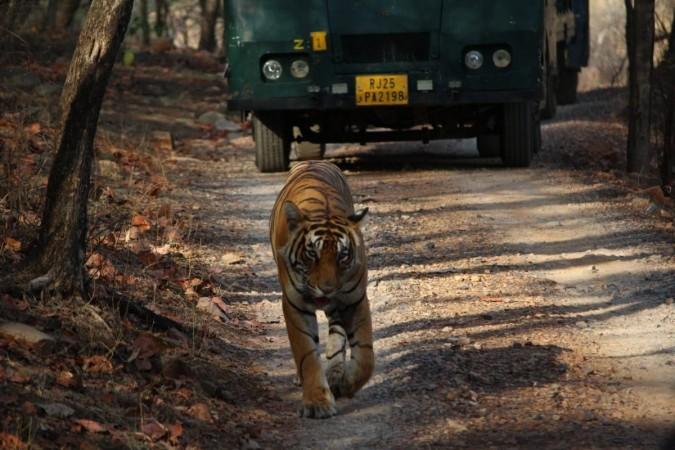
From Ranthambore to Masai Mara, wildlife tourism calls for some rethinking. The crowding of jeeps around tigers and lions or wildebeest has led to some unfortunate incidents. In 2025, the late celebrated tigress Arrowhead's cubs were moved to enclosures following fatal attack on humans by one of them.
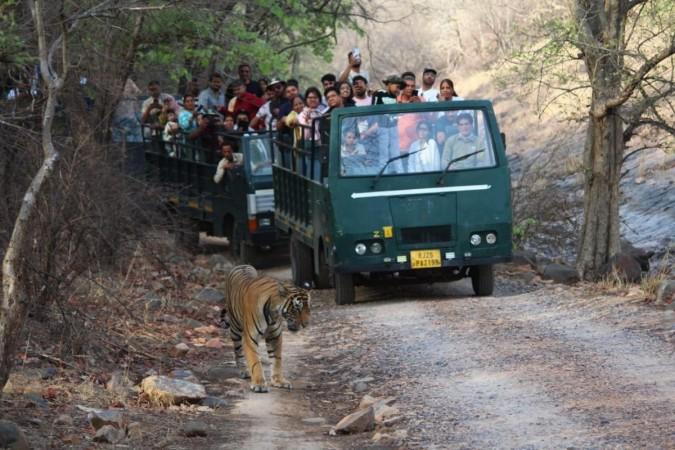
As is well known, Ranthambore sees heavy tourist footfall with vehicle loads of noisy people crowding around tigers. Tigers there have lost fear of humans. With the practice of live baiting tigers, there was increasing aggression seen in the tigers towards humans. Sadly human life was lost and the cub paid with its freedom.
In Masai Mara I happened to witness the frenzy with which a 100 Land Cruisers raced to watch a wildebeest crossing, in the process knocking down a couple of the antelopes! Having paid a fat lot of money, no one wanted to miss out on the historic crossing where the animal plunges into a crocodile laden Mara river. Elsewhere, a leopard sighting had vehicles racing to the spot and circling the tree.
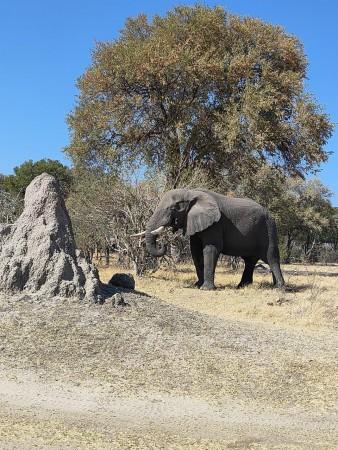
Can this be called education or is it more of an entertainment? Do we need to see to believe the need for conservation? An elephant will remain an animal to be feared rather than appreciated or admired, as one operator told me, unless people go to a forest and see it in its surroundings, watch its behaviour, etc.
But often the safari operator, in order to gain popularity, will take the tourists closer to the animal than advocated and in some cases allow them to disembark to pose for a photo! If an attack then ensues and a human life is lost, can we call the elephant or the tiger a 'killer' when it merely acted on natural instincts? We are uninvited guests in their domain and we still cannot predict how wild animals react.
Sanctuaries have carrying capacity but this is mostly on paper and new routes get opened to cater to burgeoning tourist numbers. Last year Ranthambore saw 7 lakh tourists, generating Rs 72 crore in revenue. There is double the number of vehicles inside the park at a time, than advocated by its carrying capacity, according to a TOI report.
Social Media Popularising Wildlife Wonders
Social media has helped spread the wonder of wildlife as also popularising individual tigers or elephants. The masses then want to see these stars 'live'. For many it is an adrenalin rush from a close encounter, much like a bungee jump. The parks and tour operators meanwhile stand to gain from the revenue.
A pertinent question is whether love for wildlife should stop at a few clicks and reels. How many of the tourists would join a campaign protesting against a road cutting through a wildlife area? How many care to understand implications of a 20 percent drop in elephant numbers down five years? How many would even appreciate the fact that human population, hunting and poaching has brought down tiger numbers from around 80,000 in the 19th century to a mere 1411 in 2006 and presently to 3682?
How many of these enthusiastic tourists care to understand the pathetic situation of wildlife on the planet today? Of all land based mammals, they comprise a mere 2 percent (by biomass) as against a 61 pc of livestock and 37 pc of humans! About 150 years ago, wildlife made up half of all mammal biomass.
A few decades ago, it was poaching that was the main concern of wildlife conservationists. But today, our parks and sanctuaries that comprise less than 5 percent of our geographical area, face different challenges. Encroachment by farmlands, loss and fragmentation of habitat by various development projects, etc. threaten the survival of wildlife.
Lalitpur-Singrauli rail corridor
Take for instance the poor planning by Indian Railways in the execution of the Lalitpur-Singrauli rail corridor which saw around 315 hectares disturbed and over 50,000 trees cut in the Panna Tiger Reserve. Now the railways has decided to change the route, reports Dainik Bhaskar. The move calls for another 50,000 trees to be cut and some seven tunnels to be dug through the hills. So also the Varanasi-Kolkata expressway that has been cleared by the environment ministry will see deforestation in around 108 ha of forest as well as fragmentation of an elephant corridor.
Wildlife underpasses are planned but their effectiveness will have to be seen.
Similarly, encroachment by farmlands in the Udanti-Sitanadi tiger reserve in Chattisgarh has resulted in a lakh trees in the core areas cut to make way for cultivation. Satellite imagery showed this.
Special Provisions Paving the Way
The Wildlife Protection Act, Sec 35(6) clearly states that damaging or diverting the habitat of wildlife inside a park is illegal except when under special circumstances. Roads, railway lines and mines seem to find their way through that window!
Now, a CSIR-CCMB study has found that wildlife tourism also is affecting tigers in Indian reserves. Studying tiger populations in five Indian reserves the study notes that stress markers were high in tigers living close to safari routes and tigresses were going deeper into the core area to find quiet breeding areas. Disturbances near water bodies and breeding zones could affect tiger reproduction, and overcrowding of tigers in core areas may lead to more conflicts. Stricter regulations like limiting tourist numbers, strictly avoiding crowding around tigers and reducing safari durations are some recommendations.
Wildlife tourism in India fetched $11,246 million in 2023 and is set to double by 2030. This is money that cannot be wished away. But as the study noted, there is need to bring in some regulations if we care to nurture the last of the wild.


![Apple Watch Series 12, Ultra 4 launched in India: Price starts at Rs 56,900 [Details]](https://data1.ibtimes.co.in/en/full/837338/apple-watch-series-12-ultra-4-launched-india-price-starts-rs-56900-details.jpg?w=220&h=138)