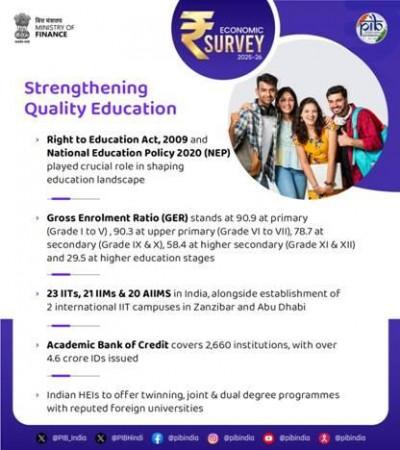
India has made notable progress in school enrolment and higher education institutions, the government stated in the Economic Survey 2025-26, tabled in Parliament by Finance Minister Nirmala Sitharaman on Thursday. The achievements are credited to strengthened infrastructure, enhanced teacher capacity, and policies such as the Right to Education Act 2009 and the National Education Policy (NEP) 2020.
Other measures include updated UGC guidelines, academic collaboration regulations, mutual recognition of qualifications, and permissions for foreign branch campuses, including in GIFT City. The Survey highlighted enhanced literacy rates, increased enrolment, vocational education initiatives, and improved access and equity through schemes like Poshan Shakti Nirman and Samagra Shiksha Abhiyan.
The Gross Enrolment Ratio (GER) stands at 90.9% at the primary stage, 90.3% at upper primary, 78.7% at secondary, and 58.4% at higher secondary levels. The number of higher education institutions (HEIs) increased from 51,534 in 2014-15 to 70,018 as of June 2025, including 23 IITs, 21 IIMs, and 20 AIIMS, with two international IIT campuses in Zanzibar and Abu Dhabi. Student enrolment also rose from 4.33 crore in 2021-22 to 4.46 crore in 2022-23.
The Survey emphasized a holistic, lifecycle approach to education, raising Expected Years of Schooling (EYS) to 15 years under NEP's 5+3+3+4 structure and integrating early childhood education, foundational literacy and numeracy, universal secondary schooling, and vocational and digital skills to convert India's human resource base into high-quality human capital.
MSMEs: Backbone of India's Industrial Economy
The Economic Survey also highlighted the role of Micro, Small and Medium Enterprises (MSMEs) in India's economy. MSMEs account for 35.4% of manufacturing, 48.58% of exports, and 31.1% of GDP. India's MSME sector comprises over 7.47 crore enterprises employing more than 32.82 crore people, making it the second-largest employer after agriculture.
The Self‑Reliant India (SRI) Fund, launched to provide Rs 50,000 crore as equity funding for MSMEs, has supported 682 MSMEs with Rs 15,442 crore as of November 30, 2025. The fund includes Rs 10,000 crore from the government and Rs 40,000 crore via private equity and venture capital, aiming to provide growth capital through equity, quasi-equity, and debt.
MSME credit growth has outpaced that for large industries, driven by government interventions, while SME public markets have expanded with digital retail participation. The Survey noted that globally, MSMEs account for 90% of businesses and over 50% of total employment.
Innovation is being institutionalized through MSME-Innovative components, including incubation, design interventions, and IPR protection. India currently accounts for an estimated 2.9% of global manufacturing GVA and 1.8% of global merchandise exports in 2024, highlighting significant potential for further global integration.
(With inputs from IANS)





![Lock Upp 2 drama: Harshad Chopda shows middle finger to Shreya Kalra; Ram Kapoor forcibly kisses Shreya [Watch]](https://data1.ibtimes.co.in/en/full/835004/lock-upp-2-drama-harshad-chopda-shows-middle-finger-shreya-kalra-ram-kapoor-forcibly-kisses.jpg?w=220&h=138)