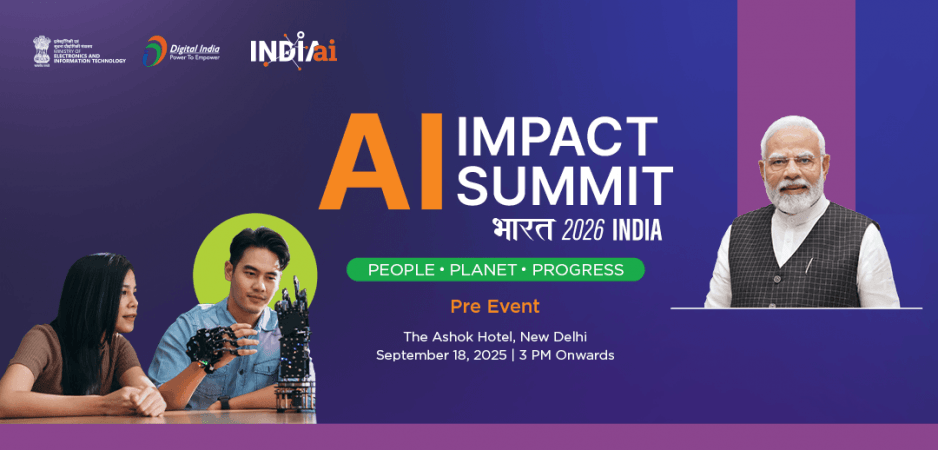
In the grand expanse of Bharat Mandapam, where history's weight meets the pulse of unprecedented technological convergence, the India AI Impact Summit 2026 reached its crescendo today. This five-day gathering (February 16–20), the first global AI summit convened in the Global South, drew leaders from more than 45 countries, over 300 exhibitors spanning 30+ nations, and thousands of delegates into a shared resolve: artificial intelligence must advance as a force for universal welfare, never as an instrument of unchecked power or exclusion.
Prime Minister Narendra Modi inaugurated and anchored the proceedings with unflinching clarity, joined by French President Emmanuel Macron, UN Secretary-General António Guterres, Google CEO Sundar Pichai, OpenAI CEO Sam Altman, Anthropic CEO Dario Amodei, Reliance Chairman Mukesh Ambani, Tata Sons Chairman N. Chandrasekaran, IT Minister Ashwini Vaishnaw, and a constellation of global visionaries. The summit unfolded across plenary halls, thematic pavilions, research symposia, sectoral deep-dives, and the vast India AI Impact Expo, crystallizing 100 precise imperatives spoken directly from the stage, imperatives that span governance architectures, ethical foundations, inclusive empowerment, economic metamorphosis, infrastructural sovereignty, sectoral revolutions, planetary stewardship, and transcendent calls to collective action.
Rooted in the theme "People, Planet, and Progress" and India's enduring ideal of "Sarvajan Hitaya, Sarvajan Sukhaya" (welfare and happiness for all), the event activated the Seven Chakras framework: Human Capital, Inclusion for Social Empowerment, Safe & Trusted AI, Science, Resilience/Innovation/Efficiency, Democratizing AI Resources, and AI for Economic Development & Social Good. Six sectoral AI Impact Casebooks (healthcare, agriculture, energy, education, gender empowerment, accessibility for persons with disabilities) were released alongside the AI For All Global Impact Challenge, AI By Her initiative, and YUVAI youth program.
Governance, Regulation & Global Frameworks
Prime Minister Narendra Modi, in his Leaders' Plenary address, called for the creation of a global roadmap for responsible AI impact, declaring that right action flows from right understanding. He proposed an IAEA-like international body for AI oversight and rapid response, a vision OpenAI CEO Sam Altman reinforced by stating the world urgently needs such regulation to manage evolving risks. Modi demanded global standards for AI authenticity, watermarking, and content labeling to combat deepfakes, which he described as destabilizing open societies. Leaders converged on voluntary multi-stakeholder frameworks encompassing governments, industry, academia, and civil society, eschewing binding treaties in favor of collaborative progress. Stanford-affiliated researcher Surya Ganguli and Research Symposium participants advocated sensible, not overly heavy early regulation to preserve scientific advancement while embedding reliability. Anticipation centered on alignment toward non-binding commitments to be formalized in a Leaders' Declaration on the summit's final day. A global AI knowledge-sharing platform for equitable access to compute, datasets, and research gained strong endorsement. IT Minister Ashwini Vaishnaw and Modi affirmed India's pivotal role in shaping global AI norms as the host drawing participation from 118 countries. French President Emmanuel Macron emphasized synergies through BRICS and G7 presidencies to drive inclusive cooperation. UN Secretary-General António Guterres cautioned against AI power concentration in few countries or billionaires, insisting the future cannot be decided by a handful of nations or the whims of a few billionaires. Modi's MANAV Vision - M for moral and ethical systems, A for accountable governance, N for national sovereignty ("whose data, his right"), A for accessible and inclusive AI, V for valid and legitimate AI that is lawful and verifiable, provided the ethical anchor. Day 2 enterprise panels highlighted the parallel evolution of enterprise deployment and policy oversight. GPAI Council meetings underscored ongoing progress on responsible and inclusive AI governance.
Ethics, Safety & Trust
Modi placed human dignity at the forefront, insisting on human-centric AI over machine-centric approaches. MANAV Vision opened with moral and ethical systems as foundation and anchored the Safe & Trusted AI chakra as a core pillar. Anthropic CEO Dario Amodei detailed risks of autonomous AI behavior and misalignment, as well as misuse risks by individuals or governments. French President Emmanuel Macron advocated child safety and protection from AI/digital abuse, proposing a social media ban for those under 15. Modi condemned deepfake destabilization of open societies and asserted AI must never reduce humans to raw material or mere data points. Sam Altman and fellow leaders pressed for model safety standards and international regulation cooperation. Day 3 witnessed a Guinness World Record attempt for responsible AI pledges, galvanizing collective commitment. Enterprise discussions mandated transparency in models and governance. Modi warned that ethical norms expansion remains urgent because the unethical scope in AI is limitless. Reliability in governance received priority emphasis from Ganguli and peers. Modi positioned AI for humanity, not power, framing technology as a tool of service and citing India Stack's proven impact. He mandated trust built into technology from the start through watermarking and source standards.
Inclusion, Equity & Global South
Google CEO Sundar Pichai warned against allowing the digital divide to become an AI divide, calling for substantial investment in compute and connectivity. Modi and Altman championed democratizing AI as a multiplier for inclusion and empowerment, especially across the Global South. MANAV Vision promised accessible and inclusive AI. Amodei envisioned AI lifting billions out of poverty in the Global South. Modi declared inclusive technology for everyone as our goal. The AI By Her challenge and dedicated gender compendium advanced women-led innovation and gender equity. The YUVAI youth challenge celebrated young creators, with Modi praising their enthusiasm and ownership of AI's future. An accessibility compendium addressed the needs of persons with disabilities. Macron and Modi celebrated India Stack as a sovereign, interoperable model encompassing 1.4 billion digital IDs, UPI handling 20 billion transactions monthly, and 500 million digital health IDs positioned as an exportable blueprint for the world. Modi emphasized that AI solutions proven successful in India's unparalleled diversity can deploy globally. The summit's status as the first major global AI event in the Global South underscored equitable benefits for all. Macron rejected any country being reduced to a mere market for foreign models or data extraction. The Inclusion for Social Empowerment chakra resonated profoundly. Jeet Adani urged AI as a force multiplier for citizens first. Vaishnaw and Macron promoted democratized access via small, task-specific models capable of running on smartphones, covering 90 percent of use cases.
Economic Impact, Jobs & Skills
Pichai described AI reshaping the workforce through automation of certain roles, evolution of others, and creation of entirely new careers, drawing parallels to the emergence of professional YouTubers. Altman reassured that while AI will impact jobs, humans will discover better and new pursuits. Day 2 panels stressed urgent upskilling to bridge the AI ambition-skills gap. The Human Capital development chakra mobilized comprehensive response. Altman observed AI making coding and software creation far easier and faster, creating disruption for some companies. Amodei predicted massive economic pie growth provided disruption is managed wisely. The AI for economic development and social good chakra guided sectoral deliberations. Emerging opportunities surfaced in AI infrastructure, data labeling, governance, and domain-specific applications. Guterres proposed a global fund targeting $3 billion for skills, data, and compute in developing countries. Modi celebrated India's youth as the world's largest tech talent pool, a source of immense pride for the Global South. Pichai embraced responsibility for workforce transformation. Panels showcased AI boosting productivity across services, manufacturing, and finance. Enterprises demanded measurable ROI and production-grade deployment at scale. Partnerships such as Infosys with Anthropic illustrated agentic AI systems integration. Altman concluded that AI is changing the nature of the software industry entirely.
Investments, Infrastructure & Innovation
Chandrasekaran and Vaishnaw outlined full AI stack development in India, encompassing chips to systems, energy infrastructure to applications. The India AI Mission, funded at over ₹10,300 crore, alongside Semicon India, advanced sovereign capability. Major commitments included Google investments and hub establishment in India, subsea cables under America-India Connect, Tata-OpenAI collaboration on 100MW+ green data centers scalable to 1GW, and Reliance/Jio's renewable-powered expansions. Macron praised cheap GPU access with over 38,000 units deployed for startups. Clean energy imperatives for data centers gained momentum through the Shanti Act and nuclear emphasis. Jeet Adani defined compute, cloud, and energy sovereignty as foundational pillars. The Innovation and Efficiency chakra propelled forward momentum. The Research Symposium, partnered with IIIT-Hyderabad, showcased cutting-edge methodologies and policy insights. Modi announced three Indian companies launching indigenous AI models and apps at the summit. He extended an open invitation to design and develop in India, deliver to the world and humanity. Vaishnaw promoted sovereign small language models for low-cost, task-specific deployment. Subsea fiber infrastructure expansion accelerated. AI infrastructure solidified as a national strategic capability aligning the full stack. The Expo, featuring 300+ exhibitors and 10+ thematic pavilions, displayed deployable real-world solutions. Google DeepMind and Sarvam AI advanced systems-level innovation.
Sectoral Applications & Social Good
Launched casebooks and compendiums illuminated AI in healthcare through diagnostics, disease curing pathways, and digital health IDs, with vivid examples from Pichai and Amodei. AI in agriculture encompassed farmer tools and monsoon/flood prediction capabilities. AI in education and skilling received dedicated focus. AI in energy and climate resilience tied directly to the Planet pillar. AI in public services and governance efficiency promised streamlined delivery. AI in manufacturing and finance automation highlighted productivity leaps. Workshops explored climate modeling and sustainability applications. AI for gender empowerment advanced via AI By Her. Real-world pilots emerged through the AI For All Global Impact Challenge. Day 2 emphasized the applied AI shift from pilots to execution at scale. Pichai highlighted solving big problems, citing AlphaFold's Nobel-recognized protein structure breakthroughs and affordable diagnostic tools. Sectoral deep dives and knowledge compendiums were formally released. Public services transformation extended India Stack's reach. Measurable social impact captivated Expo audiences. Pre-summit efforts advanced AI for Sustainable Economic Growth.
Sustainability, Planet & Resilience
The Planet pillar championed environmental stewardship and green AI innovation. The Resilience chakra fortified systems against economic, climatic, and technological disruptions. Macron and Indian leaders stressed decarbonized energy for AI infrastructure through nuclear advancement and clean energy reforms. AI for climate action and resource management featured prominently across sessions. Every initiative aligned toward a sustainable future.Broader Visions & Calls to Action (96–100)Modi captured the civilizational inflection point, stating humans and intelligent systems will co-create, co-work, and co-evolve. Global consensus affirmed the future belongs to nations that combine innovation with responsibility and technology with humanity. India emerged as the bridge between Global North and South, innovation and equity. Modi urged pledging AI as a global common good with open sky but human command, likening it to GPS. The summit's overarching vision demanded transition from dialogue to demonstrable, measurable impact, realizing People, Planet, Progress through resolute action.As Day 4 closed amid historic commitments exceeding $200 billion, group photographs symbolizing unity (and occasional fist-raised nuances), and Modi's resonant declaration that we must give AI an open sky while keeping command in human hands, Delhi etched itself into the annals of technological governance. The Global South has not merely hosted history; it has shaped it. The imperatives are spoken. The path forward is illuminated.
[Major General Dr. Dilawar Singh, IAV, is a distinguished strategist having held senior positions in technology, defence, and corporate governance. He serves on global boards and advises on leadership, emerging technologies, and strategic affairs, with a focus on aligning India's interests in the evolving global technological order.]