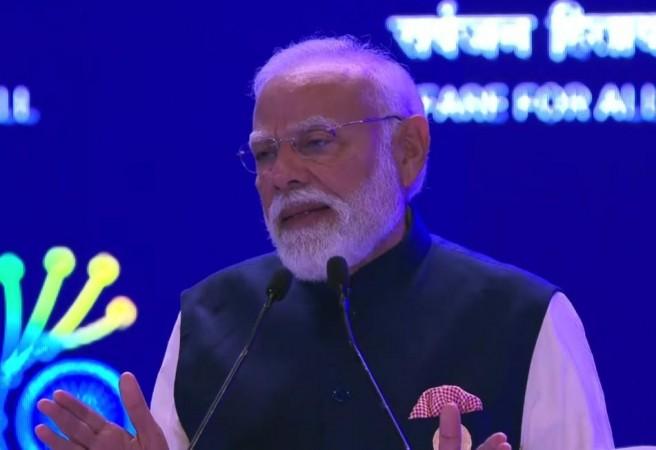
Narendra Modi addressed the India AI Impact Summit 2026 in New Delhi, speaking before representatives from 118 nations and global technology leaders, including Sundar Pichai, Sam Altman, Dario Amodei and Emmanuel Macron. In his keynote, Modi outlined India's vision for governing and democratising artificial intelligence in the decades ahead.
He described AI as a civilisational turning point rather than merely a technological shift. "AI is a transformative power," he said, adding that without direction it can disrupt, but with the right guidance it can become a solution.
The MANAV Vision
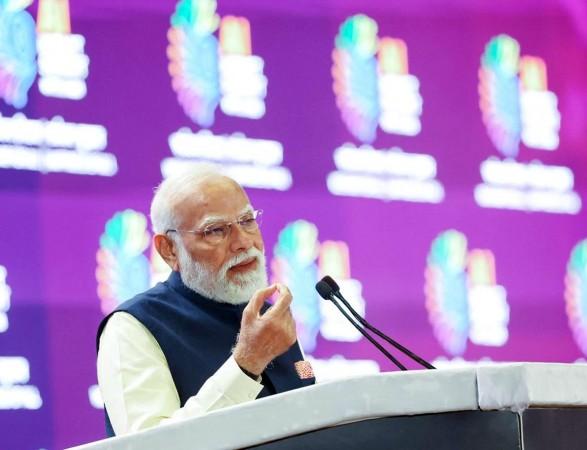
The highlight of his speech was the unveiling of the MANAV Vision, a five-point framework for ethical and inclusive AI governance. "MANAV," meaning human, reflects India's emphasis on keeping people at the centre of AI development.
M – Moral and Ethical Systems: AI must be guided by ethical principles.
A – Accountable Governance: Transparent rules and strong oversight are essential.
N – National Sovereignty: Data ownership must be respected — "whose data, his right."
A – Accessible and Inclusive: AI should empower, not monopolise.
V – Valid and Legitimate: AI systems must be lawful and verifiable.
Modi said the framework is India's contribution to the evolving global dialogue on AI governance, stressing that technological progress must not sideline human values.
Democratising AI
Calling for equitable access to AI, Modi said humans should not be reduced to "mere data points." He urged that AI must serve as a tool for empowerment, particularly in the Global South. Using a GPS analogy, he said AI can show the way, but humans must retain control over direction and decision-making.
Drawing a parallel with nuclear power, he noted that transformative technologies can both create and destroy, and the real question is how humanity chooses to use AI today.
Child Safety and Deepfakes
Modi also highlighted urgent concerns, including child safety online and the growing threat of deepfakes. He called for global standards, authenticity labels, watermarking and clear-source protocols to prevent misuse of AI-generated content. Building trust into AI systems from the outset, he said, is critical for safeguarding open societies.
PM Narendra Modi: 'AI must be curated for children, like a school syllabus'
The Prime Minister acknowledged the polarising psychology surrounding AI but was clear about where India stands. "Today there are two kinds of people - those who see fear in AI and those who see fortune," he said. "India sees fortune and future in AI, backed by talent, energy capacity, and policy clarity." But that optimism, he made plain, cannot come at the cost of the young.
If Modi set the philosophical frame, Macron brought the legislative urgency. The French President, who greeted the audience with a warm "Namaste" and spoke with evident affection for India, issued one of the summit's most quotable challenges - directed, with a smile, squarely at the Prime Minister sitting beside him.
"I hope PM Modi will take action to ban social media for children," Macron said. "Protecting children is not regulation - it is civilisation."
He then laid out France's own journey on the issue. "There is no reason our children should be exposed online to what is legally forbidden in the real world," he said. "Our platforms, governments and regulators should be working together to make the internet and social media a safe space. This is why, in France, we are embarking on a process to ban social networks for children under 15 years old."
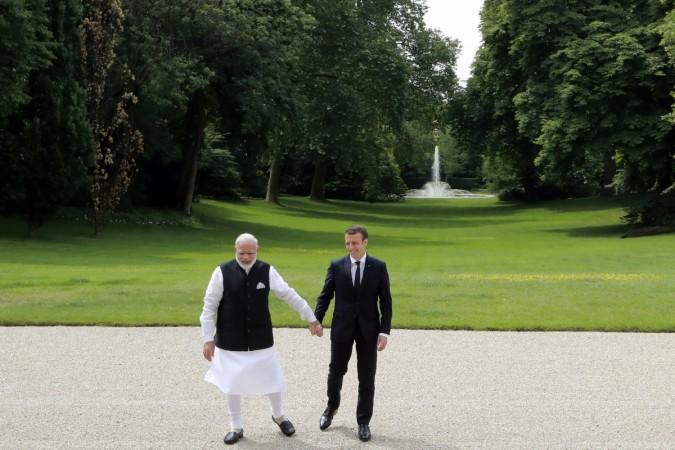
Macron named the growing coalition of nations committed to this path - Greece, Spain, and several other European countries represented at the summit - before turning directly to Modi with what appeared to be a pre-arranged announcement. "I know, Prime Minister Modi, you will join this club. This is great news that India will join such an approach in order to protect children and teenagers."
The moment drew considerable attention in the hall - an implicit signal that India, with its 140 billion population and 750 million internet users, may be moving toward formal restrictions on children's access to social media platforms, a move that would have enormous global consequences given the country's scale.
IT Minister Ashwini Vaishnaw had earlier said that dialogues with social media organisations had already begun, regarding social media guardrails for children.