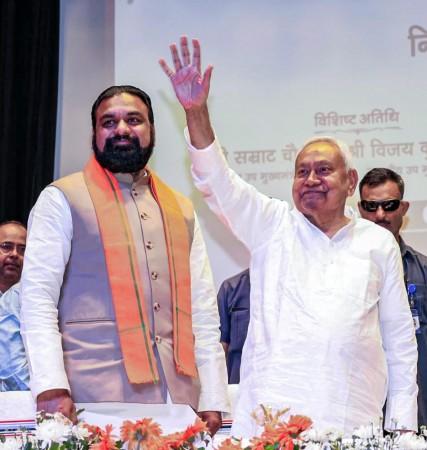
Senior Samrat Choudhary on Wednesday took oath as the 21st Chief Minister of Bihar, marking a decisive political reset in the state. His appointment signals the installation of the BJP's first-ever government in Bihar and brings to an end Nitish Kumar's two-decade-long dominance in the Hindi heartland.
Choudhary was administered the oath of office by Governor Syed Ata Hasnain at a ceremony held at Raj Bhavan, attended by top BJP leaders and alliance partners.
Nitish Kumar, now a Rajya Sabha MP, stepped down as Chief Minister on Tuesday after dissolving his Cabinet. In the outgoing government, Choudhary had served as Deputy Chief Minister and held the crucial Home portfolio, establishing himself as a key figure in the administration.
Choudhary, who joined the BJP in 2017, was elected leader of the party's legislative wing on Tuesday. The BJP is currently the single largest party in the 243-member Assembly, with 89 MLAs.
Caste and political significance
His elevation also carries caste significance in Bihar's complex political landscape. Choudhary becomes only the second leader from the influential Koeri community to serve as Chief Minister. The first was Satish Prasad Singh, whose tenure in 1968 lasted just five days after his coalition government collapsed.
Choudhary also joins the ranks of Bharat Ratna awardee Karpoori Thakur as one of the few leaders in Bihar to have held both the posts of Deputy Chief Minister and Chief Minister.
Political journey
The 57-year-old leader's rise marks a full-circle moment nearly three decades after his brief and controversial debut as a minister. He first entered the spotlight in 1999 when then Chief Minister Rabri Devi inducted him into her cabinet, reportedly as a political reward after his parents switched parties.
#WATCH | Patna, Bihar: Samrat Choudhary takes oath as the Chief Minister of Bihar
— ANI (@ANI) April 15, 2026
He becomes the first Bharatiya Janata Party (BJP) Chief Minister of Bihar following the resignation of Nitish Kumar. pic.twitter.com/ObDBH2RxJr
However, his stint ended abruptly after questions were raised about his eligibility due to age, leading then Governor Suraj Bhan to remove him from office.
Choudhary returned to politics soon after, winning an election in 2000 and completing a full term. He later rose to become the RJD's chief whip. After parting ways with the party in 2014, he briefly served under Jitan Ram Manjhi before exiting when Nitish Kumar returned to power.
His 2017 switch to the BJP proved to be a turning point. Backed by his Koeri OBC base, he rose rapidly through the ranks—from state vice president to party chief—emerging as a key face in Bihar politics.
Rise within BJP
Once a vocal critic of Nitish Kumar, Choudhary later became a trusted ally within the NDA. His symbolic vow to remove his trademark turban only after unseating Nitish Kumar has now taken on political significance.
Appointed Deputy Chief Minister in 2024, he quickly consolidated power, taking charge of the Home portfolio. His electoral victory from Tarapur and backing from Amit Shah further strengthened his position.
Nitish Kumar's transition
Nitish Kumar, known for his shifting alliances, moved to the Rajya Sabha earlier this year and backed Choudhary's elevation as Chief Minister.
Before the final decision, several BJP leaders—including Vijay Kumar Sinha, Nityanand Rai, and Sanjay Jaiswal—were considered for the top post. However, Choudhary emerged as the clear frontrunner, largely due to his rapport with Nitish Kumar and his broader social appeal.
#WATCH Patna, Bihar: Janata Dal (United) leader Bijendra Prasad Yadav takes oath as Deputy CM of Bihar pic.twitter.com/OhgshLUgbW
— ANI (@ANI) April 15, 2026
Strategic political choice
Analysts suggest that Choudhary's selection reflects a calculated move by the BJP. Choosing an upper-caste leader could have alienated certain voter bases, while selecting someone from an extremely backward caste may not have generated widespread enthusiasm.
Choudhary's Koeri background offers a balance, helping the BJP expand its social coalition and counter rivals like the RJD.
End of an era
Nitish Kumar's political legacy remains significant. As a Union minister under Atal Bihari Vajpayee, he earned recognition for railway reforms. His early tenure as Chief Minister from 2005 was credited with improving law and order and reshaping Bihar's image.
However, the latter part of his career was marked by frequent alliance shifts, drawing criticism from political opponents.
Despite these shifts, Kumar remained a central figure in Bihar politics, supported by a loyal social base of Kurmis, EBCs, Maha Dalits, and other backward communities.