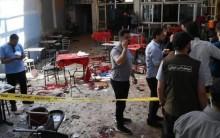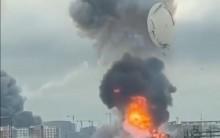
The ongoing 2026 Iran War has decisively moved beyond a limited punitive strike into a multi-domain, multi-theatre regional war with global spillovers. What began as a calibrated demonstration of force designed to impose costs, degrade capabilities, and compel behavioural adjustment has instead precipitated a far more consequential outcome: the collapse of managed conflict as a governing framework. The assumptions underpinning such a framework bounded escalation, geographic containment, and economic insulation have not merely been stretched; they have fractured under the pressure of unfolding dynamics. The conflict has escaped its initial design logic, evolving into a condition where control is no longer exercised by design, but contested through interaction across actors, domains, and systems.
"This is no longer a war being managed by its initiators the United States and Israel; it is a system under stress, where initial control has eroded, escalation is increasingly shaped by Iran's widening strategy, and outcomes are determined less by design and intent than by the interaction of competing offensives."
From Tactical Superiority to Strategic Dislocation
The opening phase of the war reflected the apex of precision-led modern warfare. Coordinated US–Israel strikes, executed at scale and with technological sophistication, targeted Iran's missile infrastructure, air defence systems, and command architecture, achieving rapid operational dominance across critical zones. Early assessments indicated substantial degradation—estimates in strategic circles suggest that a significant proportion of fixed missile sites were neutralised within the initial strike cycles. Yet, as Sir Lawrence Freedman has observed, "strategy is not judged by operational success alone, but by the ability to shape outcomes."
That ability has proven elusive. Iran's retention of mobile launch capabilities, proliferated drone systems, and a deeply networked proxy architecture across Lebanon, Yemen, Iraq, and Syria has ensured that tactical success has not translated into strategic closure. Instead, the conflict has entered a phase defined by strategic dislocation where battlefield dominance coexists with diminishing control over escalation pathways. The paradox is stark: superiority in force has not yielded superiority in control.
"Air superiority has delivered tactical dominance but not strategic closure."
The Structural Collapse of Managed Conflict
The defining feature of this war is the structural collapse of escalation management. What was conceived as a bounded engagement has expanded into a distributed, multi-theatre conflict system, spanning the Levant, the Gulf, and critical maritime corridors. Hezbollah's calibrated pressure along Israel's northern frontier, Houthi operations in the Red Sea, and militia activity across Iraq and Syria are not peripheral they are integral components of a widening conflict architecture.
More significantly, escalation is no longer sequential; it is simultaneous and cross-domain. Military operations, proxy engagements, maritime disruption, cyber signalling, and economic coercion now unfold in parallel, interacting in ways that amplify their collective impact. The traditional escalation ladder has given way to an escalation matrix, where intensity is determined not by the scale of force alone, but by the number of domains activated and the speed at which they interact.
This shift has profound implications. It means that no single actor retains the capacity to regulate escalation across the entire system. Actions taken in one domain generate second-order and third-order effects in others, often beyond the control or even the anticipation of the initiating actor.
"Managed conflict collapses when escalation can no longer be sequenced, contained, or reversed."
Economic Systems as Battlespace: The Energy-Trade Shock
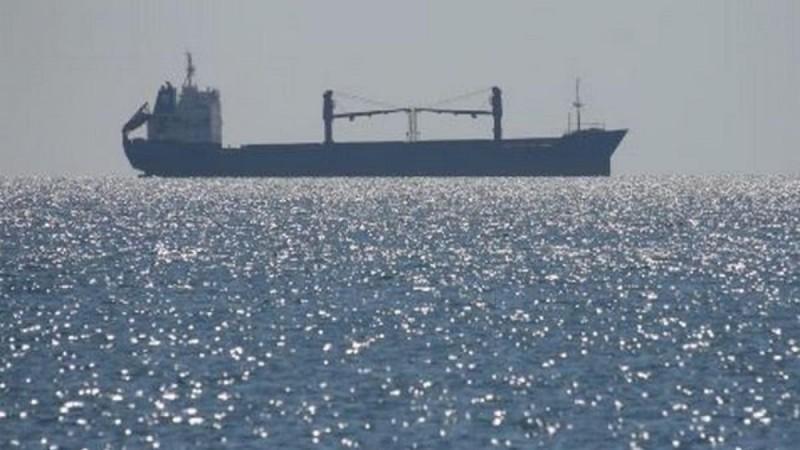
Nowhere is this transformation more visible than in the economic domain, which has emerged as a central theatre of conflict. The Strait of Hormuz through which approximately 20% of global oil supply transits has shifted from being a strategic vulnerability to an active instrument of coercion. Even partial disruption has driven oil prices into the $110–$116 per barrel range, triggering volatility across global markets. Simultaneously, instability in the Red Sea corridor, particularly around the Bab-el-Mandeb strait through which nearly 12% of global trade flows has disrupted shipping routes, increased transit times, and elevated insurance costs.
The combined effect is a dual-chokepoint stress scenario unprecedented in modern geopolitics. The International Monetary Fund has warned that sustained disruption could add up to 2 percentage points to global inflation while dampening growth across vulnerable economies. Energy-importing nations, particularly in Asia, face compounded risks of fiscal strain, currency pressure, and industrial cost escalation.
Fatih Birol, Executive Director of the International Energy Agency, has characterised the situation as one of the most severe tests of global energy security in decades. Yet the deeper reality is structural: economic systems are no longer external to conflict they are embedded within it, targeted, and manipulated as instruments of war.
"The battlefield now extends through oil flows, shipping lanes, and financial systems where disruption travels faster than missiles."
The Rise of Systemic Warfare
Out of this collapse has emerged a new paradigm: systemic warfare. Unlike conventional war, which seeks to degrade military capability or seize territory, systemic warfare operates across interconnected domains, targeting the functioning of systems themselves energy networks, trade routes, financial stability, and strategic perception.
Iran's approach exemplifies this shift with striking clarity. Confronted with conventional asymmetry, it has adopted a distributed, network-centric strategy, leveraging proxies and asymmetric capabilities to expand the battlespace horizontally. Hezbollah's actions in the north, Houthi disruptions in the Red Sea, and militia pressures across the Iraq–Syria axis form a synchronised web of pressure points. Each node operates with relative autonomy, yet contributes to a coherent strategic effect: sustained, multi-domain disruption.
This is not merely adaptation it is doctrinal evolution. Power, in this context, is no longer concentrated but diffused, adaptive, and resilient, complicating efforts at decisive neutralisation.
"In systemic warfare, the battlefield is not a place it is a network."
Denial at Scale: Strategy Beyond Victory
At the core of this paradigm lies a shift from victory to denial. Iran's objective is not to defeat its adversaries in a conventional sense, but to deny them the ability to achieve stable, favourable outcomes. This denial operates across multiple layers: preserving retaliatory capability, disrupting global energy flows, and injecting persistent uncertainty into markets and strategic calculations.
Henry Kissinger's observation that "the ultimate test of strategy is the condition it creates" is particularly instructive. The condition being created is one of prolonged systemic instability, where resolution becomes progressively more complex and costly. In such an environment, success is measured not by territorial gains, but by the ability to impose and sustain disruption.
"If decisive victory is unattainable, systemic disruption becomes the strategy."
The Imminent Trajectory: Between Coercive Equilibrium and Systemic Shock
The near-term trajectory of the conflict is unlikely to produce decisive resolution. The most plausible outcome is a coercive equilibrium a negotiated pause shaped by mutual recognition of escalating systemic costs. Such an equilibrium would not restore stability; it would institutionalise a condition of managed instability, where latent capabilities and unresolved tensions persist beneath a fragile surface.
Yet, the risk of escalation into a full-scale energy war remains significant. A complete closure of the Strait of Hormuz, combined with targeted attacks on Gulf energy infrastructure, could push oil prices beyond $150 per barrel, triggering cascading effects across inflation, supply chains, and financial markets. Global asset managers and economic institutions have already warned that such a scenario could reshape growth trajectories for years to come.
"The most likely outcome is not peace but a recalibrated instability defined by systemic risk."
Global Reordering: From Efficiency to Resilience
The implications of this conflict extend far beyond the immediate theatre. It is accelerating a structural transition in the global order from efficiency-driven interdependence to security-driven resilience. Energy systems are being reassessed not for cost optimisation, but for supply security. Supply chains are being reconfigured to reduce exposure to chokepoints and geopolitical risk.
The International Monetary Fund has highlighted that prolonged conflict could significantly elevate inflation while suppressing growth across major economies. Emerging markets, particularly those dependent on imported energy, face heightened vulnerability. This is not a transient disruption it is the beginning of a systemic reordering of global economic structures.
In military doctrine, the conflict reinforces several emerging realities: that airpower alone is insufficient for strategic control; that drones and missile saturation can offset technological superiority; and that non-state actors can exert influence disproportionate to their scale.
"Globalisation optimised for efficiency; systemic warfare exposes and exploits that optimisation as vulnerability."
India: Exposure, Constraint, and Strategic Opportunity
For India, the conflict presents a complex interplay of vulnerability and opportunity. With approximately 85% of its oil imported, much of it transiting through vulnerable maritime corridors, India is acutely exposed to disruptions in energy flows and price volatility. Even modest increases in oil prices translate into significant fiscal pressure, inflationary impact, and industrial cost escalation.
At the same time, India must navigate a delicate strategic balance. Its deepening partnership with the United States, longstanding engagement with Iran particularly through the Chabahar port and critical ties with Gulf states create a triangular diplomatic equation of high complexity. Misalignment along any axis carries economic, political, and strategic risks.
Yet, within this constraint lies opportunity. As a stable and increasingly influential power, India is uniquely positioned to emerge as a stabilising force in the Indian Ocean–West Asia continuum, shaping frameworks for energy security, maritime resilience, and Global South cooperation.
"India's vulnerability lies in exposure but its strategic advantage lies in its capacity to stabilise."
The Deeper Transformation: Systems as the New Centre of Gravity
The 2026 Iran War marks a decisive shift in the nature of conflict. Territory, while still relevant, is no longer the primary determinant of strategic outcomes. The true centre of gravity now lies in systems energy, trade, finance, and information networks.
As Martin van Creveld argued, "war reflects the structure of the societies that wage it." In an interconnected global system, conflict itself becomes interconnected. Disruption in one domain cascades into others, creating feedback loops that amplify impact far beyond the point of origin.
Iran's strategy reflects this reality with precision. It does not seek to defeat its adversaries outright; it seeks to reshape the cost calculus of the global system, demonstrating that vulnerability is systemic and that power lies in the ability to exploit that vulnerability.
"The objective is no longer to win territory but to shape the functioning of systems."
A War Without Decisive Victory
The 2026 Iran War will not culminate in decisive military victory. Its trajectory points instead toward a negotiated pause, driven not by resolution but by the accumulation of systemic cost. What has collapsed is not merely a phase of conflict, but a framework the assumption that war can be bounded, controlled, and insulated from the systems that sustain global order.
In its place has emerged a new paradigm systemic warfare where conflict is multi-domain, network-driven, and system-targeting, and where outcomes are shaped not by intent alone, but by the interaction of competing strategies within an interconnected environment.
"The collapse of managed conflict has not eliminated control it has fragmented it, dispersing it across actors, domains, and systems."
In this emerging paradigm, the decisive question is no longer who wins, but who can endure, impose, and navigate systemic disruption more effectively.
[Major General Dr. Dilawar Singh, IAV, is a distinguished strategist having held senior positions in technology, defence, and corporate governance. He serves on global boards and advises on leadership, emerging technologies, and strategic affairs, with a focus on aligning India's interests in the evolving global technological order.]