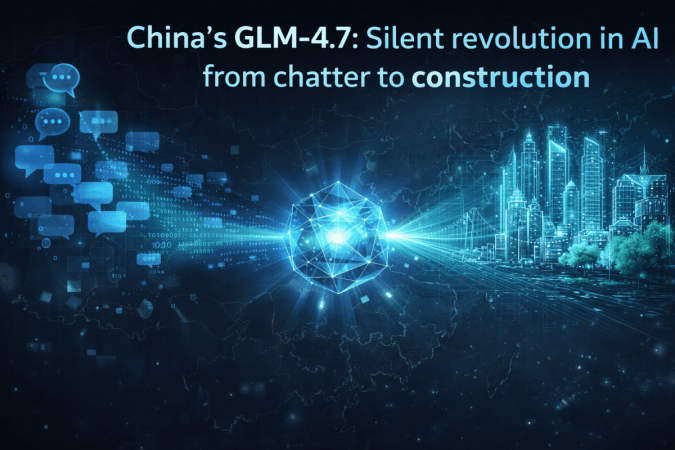
In the ever-accelerating arena of artificial intelligence, where Western giants like OpenAI and Anthropic have long dominated the narrative with their eloquent, personality-infused chatbots, a quieter contender has emerged from the East. Enter GLM-4.7, the latest iteration of Zhipu AI's flagship model, released on December 22, 2025. This isn't just another large language model (LLM) vying for benchmark supremacy; it's a deliberate pivot toward AI as a digital labor force, prioritizing execution over exposition. While ChatGPT might wax poetic about building a Pokédex app, GLM-4.7 simply delivers the code: functional, efficient, and ready to deploy. This shift isn't mere technical tweaking; it's a philosophical realignment that could redefine global AI expectations, undercutting premium pricing models and democratizing automation for developers worldwide.
To grasp the significance, let's rewind to the model's origins. Zhipu AI, often dubbed one of China's "Six Tigers" in the AI domain, traces its roots to Tsinghua University's Knowledge Engineering Group. Founded amid China's push for technological self-reliance, Zhipu has evolved from academic experimentation, evident in early models like GLM-130B, which outperformed GPT-3 on select benchmarks in 2022, to a commercial powerhouse. By 2025, the company had secured billions in funding and partnerships with domestic chipmakers, enabling it to train frontier models without reliance on NVIDIA hardware. GLM-4.7 builds on this foundation, incorporating a Mixture-of-Experts (MoE) architecture with 355 billion total parameters (32 billion active), a staggering 200,000-token context window, and a 128,000-token output capacity. These specs aren't just numbers; they enable handling vast codebases, multi-step workflows, and real-time adaptations that make Western counterparts seem verbose and sluggish.
What sets GLM-4.7 apart is its "execution-first" ethos. Traditional Western models, trained heavily on conversational datasets, often produce essay-length preludes before getting to the point: "Certainly, let me explain how I'd approach this..." rings familiar to any GPT user. In contrast, GLM-4.7's training emphasizes task completion, drawing from 15 trillion tokens of high-quality data, including synthetic reasoning and code-heavy mixtures. The result? Concise outputs that prioritize results. Demos showcase this vividly: a single prompt yields a fully functional Pokédex prototype with interactive elements; another generates an interactive 3D galaxy visualization, complete with scientifically accurate rotations and data overlays; professional slide decks emerge polished and presentation-ready, blending text and visuals seamlessly. On X, developers rave about its agentic prowess: one user highlighted its 73.8% success on SWE-Bench Verified, edging out competitors like DeepSeek-V3.2, for resolving real GitHub issues.
Benchmarking paints an even clearer picture. GLM-4.7 scores 42.8% on the Human Last Exam (HLE), a 38% leap from its predecessor GLM-4.6, surpassing GPT-5.1 in complex reasoning. In mathematical prowess, it hits 95.7% on AIME 2025, leading open-weight models. Coding benchmarks like LiveCodeBench-v6 yield 84.9%, outpacing DeepSeek-V3.2 and Kimi K2 Thinking. Agentic tasks shine too: Terminal-Bench scores rival Claude 4 Opus, with robust multi-tool orchestration. These aren't cherry-picked; independent evaluations on platforms like Artificial Analysis rank it as the top open-source model, blending reasoning, coding, and multimodal capabilities.Comparisons with Western AI reveal stark philosophical divides.
OpenAI's GPT series and Anthropic's Claude are engineered as "conversational partners," optimized for engaging dialogue, ethical alignments, and user-friendly chit-chat. This stems from datasets rich in forum discussions, books, and human interactions, fostering verbosity that can frustrate task-oriented users. GLM-4.7, however, embodies a "digital worker" paradigm, honed for instruction-following, structured outputs, and tool integration. Features like "Preserved Thinking", maintaining reasoning chains across sessions, and "Interleaved Thinking", sanity-checking code before output, address real-world dev pain points, such as debugging long codebases or toggling depth per request. One X post likened it to "what Gemini 3 could have been," praising its one-shot efficiency but noting inconsistencies in agent orchestration. Efficiency metrics bolster this: GLM-4.7 uses 30% fewer tokens than peers like DeepSeek-V3.1-Terminus on coding trajectories, slashing costs.
This isn't accidental; it's a reflection of broader training philosophies. Western firms, under scrutiny for biases and safety, layer on extensive RLHF (Reinforcement Learning from Human Feedback) to polish personalities, sometimes at the expense of raw utility. Chinese models like GLM-4.7 leverage vast domestic data pools, bolstered by state support, and focus on practical applications, from enterprise automation to scientific simulations. Zhipu's ecosystem extends beyond the model: AutoGLM handles 50+ step tasks across apps, GLM Slide/Poster Agent crafts visuals, and GLM-PC interprets screen screenshots for agentic computing. Multimodality is native, with GLM-4.6V leading 100B-class visual reasoning.
Strategically, China's approach is a masterstroke. GLM-4.7 is open-weight under MIT license, freely downloadable from Hugging Face and ModelScope, with API access at rock-bottom prices: $3/month for unlimited tokens via the GLM Coding Plan, or free for local runs. This undercuts Western APIs, where OpenAI charges $20/month for GPT-4o access, and enterprise tiers soar to $200+. The goal? Seed global developer ecosystems, normalize "work AI" over "chat AI," and erode market share. As one analyst noted, it's "cementing Zhipu as China's OpenAI," compatible with 40+ domestic chips to sidestep U.S. export controls. Geopolitically, this escalates the AI arms race. While the U.S. focuses on innovation through private capital, China's state-backed strategy accelerates diffusion, potentially accelerating AGI pursuits while addressing global challenges like climate modeling or drug discovery.
For developers and businesses, the implications are profound. Startups can now automate workflows without prohibitive costs: imagine prototyping apps at 2% of Western prices. Solo coders, priced out of premium tiers, gain access to SOTA tools for multi-language coding, UI generation, and agentic tasks. Enterprises benefit from MaaS (Model-as-a-Service) for trustworthy, customizable deployments. Yet, challenges loom. Critics on Reddit and X point to inconsistencies in Chinese responses and frontend handling, suggesting it's not yet flawless for orchestration. Data privacy concerns persist, given China's regulatory environment, and potential biases from training data could surface in global use. Moreover, while open-source fosters innovation, it risks misuse without Western-style safety layers.
Looking ahead, GLM-4.7 widens the chasm between "talk AI" and "work AI." As Zhipu iterates, evidenced by rapid releases like GLM-4.6 and 4.5V, the West must adapt or risk obsolescence. Models like Llama 4 and Grok's evolutions show promise, but the execution gap persists. Ultimately, in a world craving productivity, the AI that builds will outpace the one that banters. GLM-4.7 isn't just a model; it's a manifesto for AI's future, as indispensable workers, not witty companions. The global race isn't about who talks best; it's about who delivers first.
[Major General Dr. Dilawar Singh, IAV, is a distinguished strategist having held senior positions in technology, defence, and corporate governance. He serves on global boards and advises on leadership, emerging technologies, and strategic affairs, with a focus on aligning India's interests in the evolving global technological order.]