
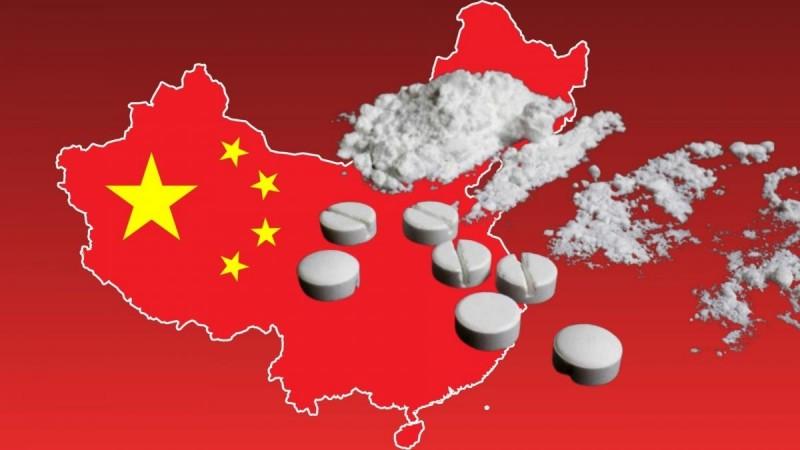
The contemporary narcotics economy is best understood not through the lens of traditional drug cultivation but through the political economy of synthetic production. At the centre of this shift is China's role as the dominant supplier of precursor chemicals and technical inputs that sustains the global manufacture of synthetic drugs. Southeast Asia, particularly the Golden Triangle region, has emerged as a proxy zone for production, absorbing the coercive and social costs of narcotics manufacture while remaining structurally dependent on upstream chemical and financial networks originating in China. This configuration raises difficult questions about responsibility, enforcement, and state tolerance in transnational illicit economies.
Supply Chains, Regulatory Gaps and Structural Enablement
China's chemical industry occupies a unique position in the global economy. It produces the overwhelming majority of the world's active pharmaceutical ingredients and industrial precursors, many of which have legitimate commercial uses but can be repurposed for synthetic drug production with minimal modification. International indictments and investigative reporting have repeatedly demonstrated that Chinese chemical suppliers and brokers have knowingly marketed, sold and shipped fentanyl and methamphetamine precursors to overseas criminal networks. The U.S. Department of Justice's prosecutions of Chinese nationals and firms for fentanyl precursor trafficking illustrate that these transactions were not incidental or accidental but embedded in organised commercial practices involving encrypted communications, mislabelled shipments and cryptocurrency-based payments.
Beijing has formally rejected claims of state involvement and has pointed to domestic regulatory measures introduced since 2019 to control fentanyl-related substances. Yet these interventions have been reactive and incomplete. Suppliers have consistently adapted by shifting to pre precursors or chemically adjacent compounds not yet subject to controls. This cat-and-mouse dynamic suggests a regulatory environment that prioritises industrial flexibility and export volume over proactive harm prevention. Enforcement against chemical suppliers has remained uneven, particularly at the provincial and municipal levels where export-oriented firms contribute to local economic performance.
This pattern is analytically significant. The narco trade linked to China is not sustained by overt state sponsorship but by institutional permissiveness. The absence of consistent enforcement, combined with fragmented oversight of chemical exports and limited transparency in cross-border financial flows, creates predictable opportunities for criminal exploitation. In this sense, China's role is best described as one of structural enablement rather than direct orchestration.
The relocation of synthetic drug production to Southeast Asia reflects rational adaptation by transnational criminal networks to this upstream permissiveness. The Golden Triangle offers armed protection, weak governance, and logistical proximity to Chinese supply routes.
Chinese nationals have appeared with notable frequency as financiers, chemical specialists, and logistical coordinators in drug-related arrests across Thailand, Laos and Myanmar. While such involvement does not establish central state direction, it points towards the transnational continuity of the supply chain.

The political economy of this arrangement is therefore revealing in many ways. Southeast Asian borderlands bear the violence, environmental degradation, and public health consequences of drug production. China, by contrast, externalises these costs while maintaining plausible deniability. Cross-border infrastructure projects, special economic zones, and semi formal investment enclaves further complicate enforcement by creating jurisdictions where regulatory authority is contested or intentionally diluted.
Such activities reflect a governance model in which economic expansion proceeds faster than regulatory coordination and where political sensitivities constrain cooperation with foreign law enforcement. The result is a durable proxy system in which illicit production is tolerated as long as it remains offshore and politically deniable.
Responsibility Without Conspiracy
A central analytical mistake in discussions of China and the narco trade is the search for definitive evidence of top-level state direction. Such evidence is neither necessary nor likely. Modern illicit economies rarely function through direct command structures. They operate through incentives, omissions, and selective enforcement. China's role in the synthetic drug trade fits this pattern. The state does not need to order chemical firms to supply traffickers if regulatory ambiguity and weak oversight already make such behaviour profitable and low risk.
From an international perspective, this distinction matters. Responsibility in transnational harm does not require intent in the narrow legal sense. It arises from the foreseeable consequences of policy choices. China's continued centrality in precursor supply chains, combined with its limited willingness to accept external scrutiny of chemical exports and financial flows, sustains a narcotics economy that destabilises neighbouring regions. Southeast Asia's transformation into a synthetic drug hub is therefore not merely a regional failure of governance but a manifestation of global supply chain politics anchored in China's industrial and regulatory ecosystem.
Any meaningful response must move beyond moral accusations and towards structural accountability. This includes transparent precursor controls, verifiable enforcement against exporting firms, and genuine cooperation with regional and international law enforcement. Without such shifts, Southeast Asia will continue to function as a proxy zone for a trade whose upstream drivers lie elsewhere, and the gap between China's formal commitments and its practical impact on the global narcotics economy will continue to widen.
[Disclaimer: This is an authored article. Ratish Mehta is Senior Research Associate at the Organization for Research on China and Asia (ORCA). His research focuses on political narratives in state and non-state interactions and on India and China's strategic interests in the Global South and South Asia. Views expressed are author's own.]
This article was first published in International Business Times, Singapore Edition.