Yesterday's loss for the National Democratic Alliance (NDA) in the Lok Sabha in its bid to push an amendment legislation on women's quota and two other bills will not deter the government from pursuing the matter, people with direct knowledge of the matter said.
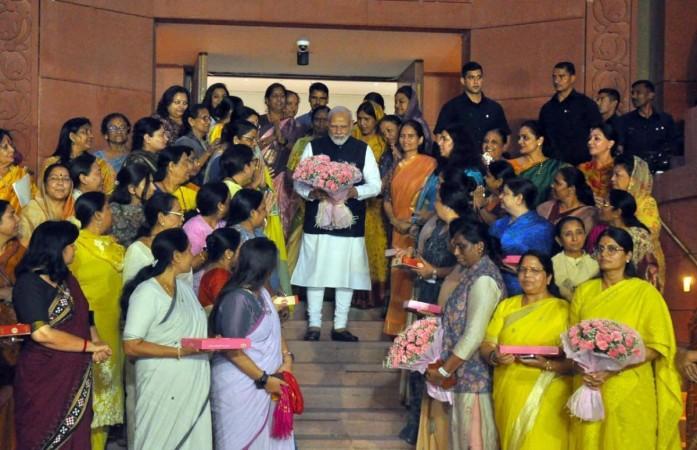
The NDA is speaking to stakeholders on finding another way to get the bill pass a second test in parliament, sources told NDTV today, amid a massive protest led by BJP leaders including Hema Malini outside Congress MP Rahul Gandhi's house in Delhi.
The government wants to empower women, who form at least half of the country's population, and no amount of Opposition tactics can stop the march of "Nari Shakti", sources said, without giving details about the ways the NDA is exploring to bring back the legislation for the ultimate test.
The NDA needed to shore up support from other parties or make some of them abstain from voting to have its way. The NDA has the support of 293 members in the Lok Sabha, which is 54 per cent of the House; the Opposition has 233 MPs. In the upper house, however, the NDA has 141 members in their favour, which is 58 per cent of the Upper House, and the Opposition has 83 MPs in support.
The Constitution (131st Amendment) Bill, 2026, had proposed 33 per cent reservation for women in Parliament and assemblies along with an increase in the strength of the Lok Sabha. It failed to get the required two-thirds majority in the Lower House despite an extensive debate.
The bill received 298 votes in favour and 230 against in the Lok Sabha, falling short of the constitutional threshold required for passage. A Constitution amendment bill can be passed only by a two-thirds majority of those present in the House at the time of voting. Going by current strength, the NDA did not have the required numbers for getting the Constitution amendment bill passed.
Had the amendment to the Nari Shakti Vandan Adhiniyam sailed through, it would have been brought for implementation in 2029.
Here is a clear summary of all you need to know about the Women's Reservation Bill and the recent developments:
Q1. What were the three Bills introduced by the Central government in the Lok Sabha on April 16?
A. The Central government introduced three key Bills in the Lok Sabha: the Constitution (131st Amendment) Bill, 2026, the Delimitation Bill, 2026, and the Union Territories Laws (Amendment) Bill, 2026.
Q2. Why were these three Bills tabled in the Lok Sabha?
A. The Nari Shakti Vandan Adhiniyam provides that reservation for women will be implemented based on delimitation after the Census conducted post-2026. Waiting for the full Census and delimitation would have delayed the benefit of 33 per cent reservation even for the 2029 general elections. Therefore, to ensure timely benefits for half the population, the government decided to delink the implementation of the Act from this condition.
Q3. What benefits could these Bills have produced if they had been passed?
A. If passed and approved, these Bills would have enabled women to receive 33 per cent reservation in the Lok Sabha as early as the 2029 general elections.
Q4. Why was delimitation linked with the Nari Shakti Vandan Adhiniyam, and why was there a proposal to increase seats?
A. Delimitation means finalising the boundary of a constituency and is essential for implementing women's reservation. The limit on seats in the Lok Sabha was set at 550 in 1976 when India's population was 54 crore. Today, the population is about 140 crore. Therefore, it is important to increase the number of seats to provide fair representation of people in Parliament.
Q5. Was there any attempt to modify the Delimitation Commission Act for political advantage? Would ongoing state elections be impacted?
A. The government proposed no change to the Delimitation Commission Act. The existing legal framework remains intact, and any recommendations of the Commission would require parliamentary approval and Presidential assent. Ongoing elections, including those in states like Tamil Nadu or West Bengal, would not be affected as elections up to 2029 will be conducted under the current system.
Q6. What was the rationale behind increasing Lok Sabha seats to 850?
A. The proposal was based on a proportional expansion approach. A uniform 50 per cent increase in seats would maintain the proportion for all states and union territories. Applying this principle to the current 543 seats would lead to approximately 816 seats. Therefore, the upper limit on seats was increased from 550 to 850 seats.
Q7. Would southern or smaller states have been adversely affected by the new delimitation proposal?
A. All states would see a uniform 50 per cent increase in seats. Southern states would not face any reduction in representation; rather, their overall share would remain stable. Their proportional representation would stay almost the same, protecting their influence in Parliament while giving every region more voices overall.
Q8. Would states that have controlled population growth face any disadvantage?
A. No, their proportional representation would remain unchanged or slightly improve.
Q9. Would the representation of Scheduled Castes and Scheduled Tribes be affected?
A. The process of delimitation ensures proportional reservation for Scheduled Castes and Scheduled Tribes. With an expanded House, their representation would increase significantly.
Q10. Was this Constitutional Amendment Bill introduced to delay the caste census?
A. No, the government has already started a time-bound programme for the caste census, and data will be recorded during the population count phase.
Q11. Why was there no separate quota for Muslim women?
A. The Constitution does not provide reservation based on religion; it is based on social and economic backwardness.
Q12. Why was women's reservation not implemented in the 2024 elections?
A. Delimitation is required before implementation, which is a lengthy process taking about two years.
Q13. Why was the Bill introduced in 2023 if not implemented immediately?
A. It was introduced to establish the constitutional framework for women's reservation and reflected broad political consensus.
Q14. Why was a separate Union Territories Bill required?
A. Union Territories have separate legislative structures, requiring separate amendments for implementation.