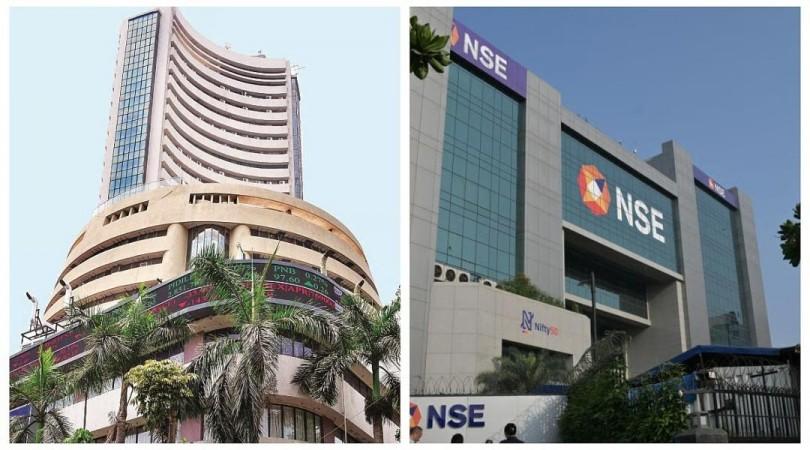
India's leading stock exchanges, BSE and NSE, have taken a strong surveillance action to control unusual price movements in select stocks. The exchanges have reduced circuit filters for 19 stocks, and these changes will come into effect from April 15, 2026.
This step is mainly aimed at controlling excessive volatility and preventing sudden sharp movements in stock prices.
What has changed in circuit filters?
Circuit filters decide how much a stock can move in a day. The exchanges have reduced these limits in multiple stocks from higher levels like 20 percent and 10 percent to lower bands such as 5 percent and 2 percent.
For example, if a stock earlier had a 10 percent limit, it can now move only 5 percent in a day. This reduces both sharp gains and steep falls, making price movement more controlled.
List of stocks affected
Some of the key stocks where circuit limits have been reduced include Atlas Cycles (Haryana), Parsvnath Developers, PAN HR Solution, Prudential Sugar Corporation, Ramgopal Polytex, Zodiac Ventures, Zenith Steel Pipes & Industries, and Welcure Drugs & Pharmaceuticals, among others.
In total, 19 stocks are part of this action.
Why exchanges take such steps
According to BSE and NSE, such actions are taken when stocks show:
- Low liquidity
- High volatility
- Unusual price movements
Reducing circuit limits helps prevent operator-driven or speculative trading and protects retail investors from sudden risks.
What is the T2T segment and why it matters?
The exchanges have also warned investors about possible movement of such stocks into the Trade-to-Trade (T2T) segment.
In T2T:
- Intraday trading is not allowed
- Every trade must result in delivery
- Same-day buying and selling is not possible
This makes short-term or speculative trading more difficult.
Impact on investors
This move can directly affect trading strategies. Lower circuit limits reduce liquidity and restrict daily price movement. If a stock moves to T2T, traders must hold shares instead of exiting quickly.
Investors should always check the surveillance status of stocks before trading, especially in highly volatile counters.
Market holiday update
Indian stock markets remained closed on Tuesday on account of Dr. B.R. Ambedkar Jayanti — the second trading holiday in the current financial year (FY27) and in April.
Both NSE and BSE suspended trading across equity, equity derivatives and currency segments for the day.
In the commodities segment, the Multi Commodity Exchange of India (MCX) remained shut in the morning session but will resume trading in the evening session between 5 pm and 11:30 pm. Meanwhile, the National Commodity and Derivatives Exchange (NCDEX) remained closed for both sessions.
Trading across exchanges will resume on Wednesday (April 15).
In the previous session, domestic benchmark indices ended in the negative territory, with the Sensex declining 0.91 per cent to close at 76,847, while the Nifty fell 0.86 per cent to settle at 23,842.
As per the 2026 holiday calendar, the next stock market holiday will be on May 1 for Maharashtra Day, followed by closure on May 28 for Eid al-Adha (Bakri Eid). Earlier this year, markets were closed for Holi, Ram Navami, and Mahavir Jayanti in March.
Globally, markets traded in the green — Asian indices like Japan's Nikkei, Hong Kong's Hang Seng, and South Korea's KOSPI gained over 2 per cent, 0.5 per cent, and 3 per cent respectively. In the US, both the S&P 500 and Nasdaq closed over 1 per cent higher.
In contrast, Brent crude futures were down about 1 per cent at $98.27 per barrel, while US WTI crude fell nearly 2 per cent to $97.24.