The 77th Republic Day parade on Monday was marked by a spectacular fly-past featuring the Varuna, Vajraang, Arjan and Vijay formations, showcasing the Indian Air Force's operational prowess and technological strength.
A wide range of frontline aircraft, including Rafale, Su-30, P-8i, MiG-29 and Apache helicopters, participated in the display.
One of the most eagerly awaited segments of the parade, the aerial fly-past comprised 29 aircraft — 16 fighter jets, four transport aircraft and nine helicopters — flying in meticulously coordinated formations over Kartavya Path.
The participating aircraft included Rafale, Su-30 MKI, MiG-29 and Jaguar fighter jets, along with strategic transport assets such as the C-130 and C-295. The fly-past also featured the Indian Navy's P-8i maritime patrol aircraft, highlighting joint operational synergy among the armed forces.
The Varuna formation consisted of one P-8i aircraft accompanied by two Su-30 fighters flying in a 'Vic' formation. The Arjan formation featured one C-130 aircraft in the lead, followed by two C-295 aircraft flying in echelon in a 'Vic' formation.
In a Vic formation, aircraft fly in a single V-shaped pattern at the same altitude. The aircraft positioned on the wings maintain alignment by using the leader's horizontal stabiliser as a reference point, ensuring precision formation flying.
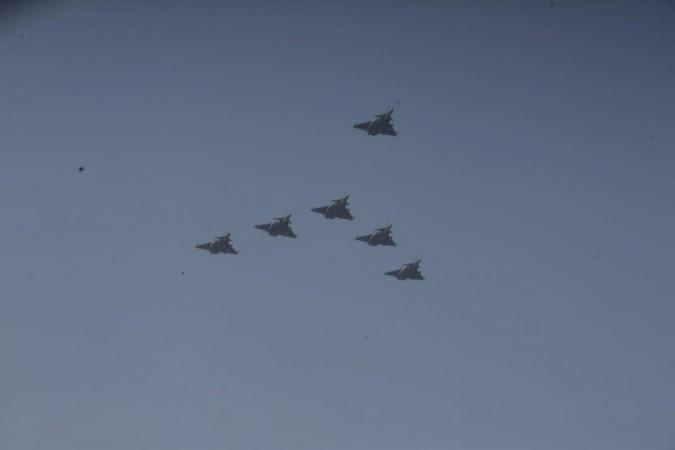
Six Rafale fighter jets formed the Vajraang formation and flew past Kartavya Path as part of the celebrations. The Vajraang formation is regarded as a specialised, high-precision aerial display that demonstrates air dominance and the Indian Air Force's strategic strike capabilities.
The Vijay formation emerged as a major highlight of the fly-past, drawing loud applause from spectators.
During this segment, a Rafale aircraft flew at a speed of around 900 kmph while maintaining a height of 300 metres AOL (Above Obstruction Level) over the water channel north of Rajpath, before climbing sharply to execute a Vertical Charlie manoeuvre.
In the Vertical Charlie manoeuvre, the aircraft flies low and fast before pulling up into a near-vertical climb, performing multiple rolls in quick succession. The manoeuvre showcased the fighter jet's exceptional thrust and power, as well as the high level of skill and precision of the pilot.
Earlier in the day, ahead of the commencement of the parade, a Dhruv Advanced Light Helicopter carrying the Operation Sindoor flag of the Indian Army flew in the Prahar formation. It was accompanied by the Army's Rudra ALH-WSI and the Indian Air Force's ALH Mark IV, setting the tone for the air display and reinforcing the message of jointness and operational readiness.
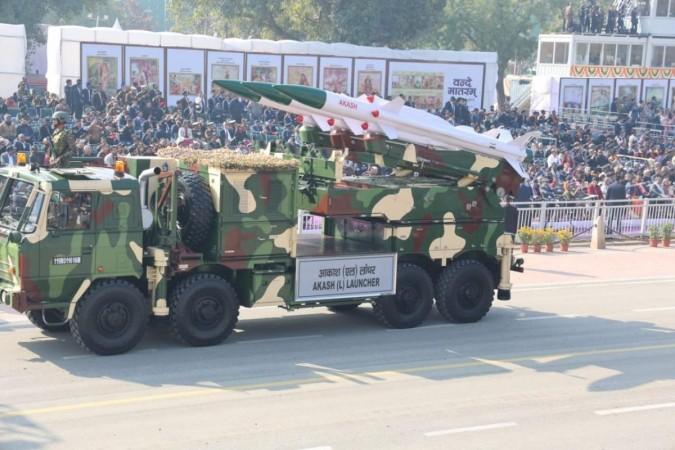
For the first time, the Indian Army presented the 'Battle Array' format at the Republic Day parade, offering a comprehensive visual representation of battlefield formations and the sequence of operations undertaken during wartime.
The display illustrated how forces advance, how offensive actions are initiated, and how enemy threats are neutralised — all at a single location along Kartavya Path. It also offered a glimpse of Operation Sindoor, serving as a tribute to the success of the mission.
A specially designed Army tableau highlighted the Integrated Operations Centre (IOC), where strategic planning and battlefield coordination take place. The display demonstrated how targets are identified in real time, how strikes are executed, and how the nation is defended through layered air defence systems such as the 'Sudarshan Chakra'.
The air component of operations was also prominently showcased. The reconnaissance segment featured the 61 Cavalry in active combat uniform, underscoring its frontline role. This was followed by the High Mobility Reconnaissance Vehicle, India's first indigenously developed armoured light specialist vehicle.
Air support elements included the indigenous Dhruv Advanced Light Helicopter and its armed variant, Rudra, flying in a strike formation to symbolise swift and decisive battlefield action.
The combat phase of the battle array was led by tanks, which form the backbone of ground offensives. The T-90 Bhishma and the indigenous Main Battle Tank Arjun rolled past the saluting dais, supported from the air by Apache AH-64E attack helicopters and the Prachand Light Combat Helicopter.
Other mechanised columns included the BMP-2 Infantry Combat Vehicle and the Nag Missile System (Tracked) Mk-2.
Traditionally, marching contingents and military hardware have been displayed separately during the parade. This year, however, the Army presented a sequence mirroring actual combat operations — beginning with surveillance and reconnaissance, followed by tanks and infantry, artillery and missile systems, aerial assets, and finally logistics and security elements.
The display underlined the Army's preparedness, operational strength and agility, while highlighting its emphasis on advanced technology and indigenous capability.
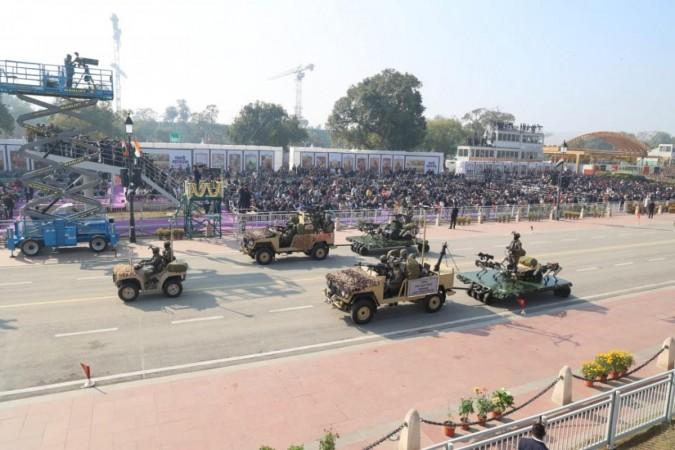
This was followed by a Special Forces contingent moving down Kartavya Path, featuring platforms such as the Ajayketu All-Terrain Vehicle, the Randhwaj Rugged Terrain Tactical Transport System and the Dhvanshak Light Strike Vehicle.
The procession also included robotic dogs mounted on vehicles, unmanned ground vehicles, and four autonomous unmanned ground platforms named Nigrah, Bhairav, Bhuviraksha and Krishna.
The Combat Support Element showcased India's new-generation unmanned warhead systems — Shaktibaan and Divyastra — mounted on specialised high-mobility vehicles. Equipped with advanced technologies, these platforms demonstrated enhanced surveillance and targeting capabilities through swarming drones, tethered drone systems and the indigenously developed Tactical Hybrid UAV 'Jolt', used for artillery target designation.
The battle array presentation underscored that modern warfare extends beyond conventional guns and tanks, with data, drones and cutting-edge technology now central to military operations. The Army illustrated how threats are monitored from long distances, decisions are taken swiftly, and precision strikes are executed using entirely indigenous weapons and systems.
This year's Republic Day parade also marked the first public appearance of several new units and weapon systems, including the Bhairav Battalion, Shaktibaan Regiments and the Divyastra Battery.
The 155mm ATAGS gun, long-range Universal Rocket Launcher System Suryastra, drones, robotic dogs, unmanned vehicles and loitering munitions were also displayed for the first time, offering a glimpse into the Indian Army's future-ready combat capabilities.
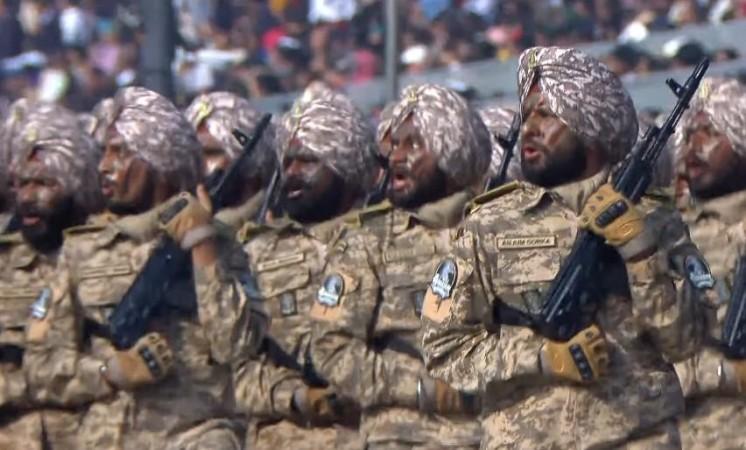
Meanwhile, the Bhairav light commando battalion, raised in October 2025, marked its first public appearance during the 77th Republic Day celebrations, reflecting the Indian Army's evolving combat doctrine and future-ready force structure.
Alongside this debut, the Universal Rocket Launcher System (URLS) 'Suryastra' was showcased for the first time. The 4 Bhairav Battalion of the Sikh Light Infantry Regiment has been raised to bridge the operational gap between conventional infantry units and special forces, strengthening India's capability for swift, agile and high-intensity combat missions.
Suryastra was presented as India's first indigenous universal multi-calibre long-range rocket launcher system, capable of delivering precision surface-to-surface strikes at ranges of 150 km and 300 km. Unlike traditional rocket artillery platforms, it is designed to integrate multiple rocket and missile variants on a single platform, offering enhanced operational flexibility.
A mixed scouts contingent wearing heavy thermal combat gear also made its maiden appearance. Led by Lieutenant Amit Choudhary of the 2 Arunachal Scouts, the contingent symbolised India's elite infantry units specialised in high-altitude surveillance and frontier reconnaissance roles.
The mounted contingent of the 61 Cavalry, clad in battle gear, rolled down Kartavya Path for the first time in a phased battle array formation. Under this concept, forces advanced along the ceremonial boulevard replicating real battlefield movement — beginning with reconnaissance elements and followed by logistics units and personnel accompanying combat platforms.
Traditionally known for leading the parade in ceremonial uniform and distinctive headgear, the 61 Cavalry appeared this time in combat attire, marking a departure from tradition and reinforcing the operational theme.
The Republic Day celebrations commenced with a cultural performance by 100 artists, setting the tone around the theme "Vishwaguru Bharat – Ek Bharat Shreshtha Bharat".
President Droupadi Murmu presided over the celebrations by unfurling the National Flag and leading the nation in commemorating the historic occasion. The unfurling of the Tricolour was followed by the playing of the National Anthem and a thunderous 21-gun salute using indigenous 105-mm Light Field Guns.
European Council President Antonio Costa and European Commission President Ursula von der Leyen witnessed the celebrations as Chief Guests, adding global significance to the event.
(With inputs from IANS)