
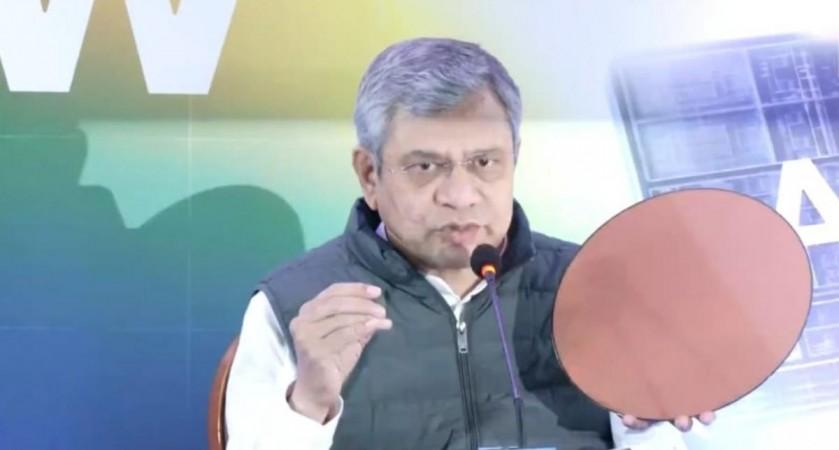
Union Minister for Railways, Electronics and Information Technology Ashwini Vaishnaw on Saturday released Qualcomm's new two-nanometre chip in Bengaluru, calling it a major milestone for India's semiconductor journey and a significant leap towards making the country a global hub for advanced chip design and manufacturing.
Speaking at the inauguration of Texas Instruments' new product research and development facility in Bengaluru, the minister said the unveiling of the 2-nm wafer and chip marks a shift from India being a back-office destination to an end-to-end semiconductor product design and development centre.
"I am very happy to share that today we unveiled the 2 nanometre wafer and 2 nanometre chip at Qualcomm. Companies are now designing end-to-end products in India — from customer product definition to design, final silicon, tape-out and validation," Vaishnaw said.
Describing the technical achievement, the minister said each die on the wafer contains nearly 20 to 30 billion transistors. "To put it in perspective, 20 billion equals 2,000 crore or 20 lakh crore transistors on a single die," he said, adding that the tiny silicon chip integrates both GPU and CPU capabilities.
He explained that the technology would power AI-enabled devices, including desktop computers, cameras, Wi-Fi routers, automobiles and trains, enabling advanced edge computing solutions. The breakthrough, he said, places India among countries working on cutting-edge chip design, alongside global leaders such as AMD.
Vaishnaw noted that while the semiconductor sector is relatively new in India, the ecosystem is rapidly taking shape and preparing for large-scale growth. He thanked Qualcomm's India team for taking up the challenge of working on the most advanced chip designs within the country.
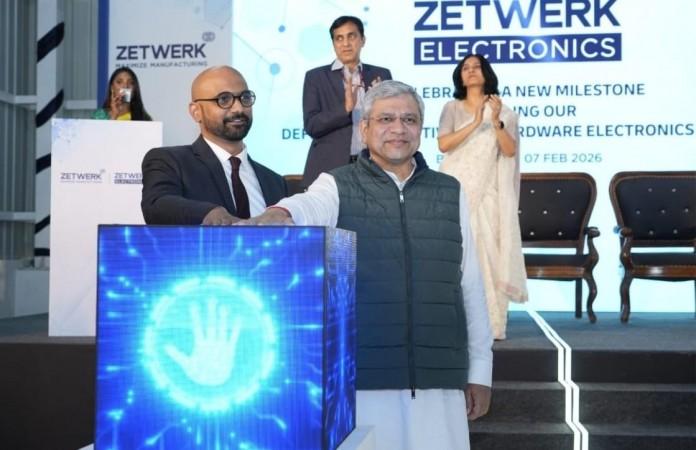
Later in the day, the Union Minister also inaugurated the Zetwerk Electronics manufacturing facility at the KIADB Hi-Tech Hardware Park in Bengaluru and appealed to the Congress-led Karnataka government to work in coordination with the Centre for the vision of a 'Viksit Bharat' by 2047.
Emphasising cooperative federalism, Vaishnaw said, "When all states grow, the country grows. The Union Budget is ultimately implemented in the states. I appeal to everyone not to have a narrow outlook but to adopt a broad vision."
He highlighted the rapid growth of the electronics component manufacturing sector after the government shifted focus from finished products to components. "We already have 46 approvals, and investments worth over Rs 10,000 crore are coming to Karnataka," he said, adding that the Union Budget allocation for the electronics component manufacturing scheme has been increased from Rs 22,000 crore to Rs 40,000 crore.
The minister reiterated Prime Minister Narendra Modi's target of achieving $500 billion in electronics production by 2030–31 and said the government remains open to policy changes that benefit the industry.
Calling recent developments encouraging, Vaishnaw said end-to-end two-nanometre chip designs being developed in India mark a major achievement. He also noted that global equipment manufacturers such as Applied Materials and Lam Research have begun operations in India, with efforts underway to attract ASML, the world's leading photolithography equipment maker.
He announced that commercial chip production would begin this year, with the first commercially produced chip expected from an Indian semiconductor plant within weeks. Under the Semicon 2.0 programme, the focus will expand to include design, equipment manufacturing, chemicals, gases, validation, yield improvement and talent development.
Vaishnaw said India aims to train 85,000 semiconductor engineers over the next decade, noting that 67,000 engineers have already been trained in the past four years. "A large part of global chip design work will happen in India in the coming years," he said.
The minister added that a roadmap has been laid out to move from 28 nanometres to 7 nanometres under Semicon 2.0, followed by advanced nodes of 2 to 3 nanometres, marking a decisive step towards building a sustainable and globally competitive semiconductor ecosystem in India.
(With inputs from IANS)