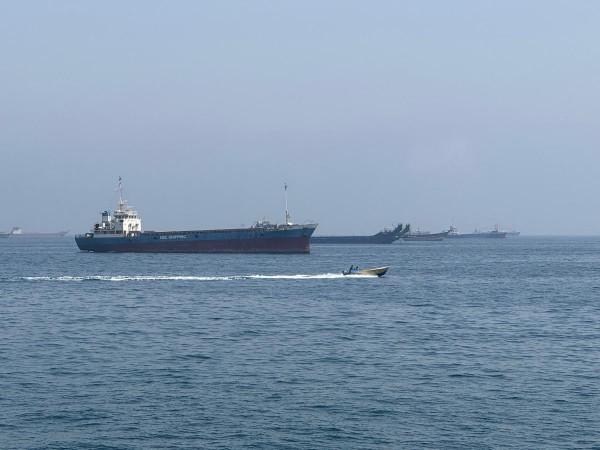
Two vessels belonging to Abu Dhabi National Oil Company (ADNOC) of the United Arab Emirates (UAE) were attacked while transiting the Strait of Hormuz on Thursday evening, local authorities and media reported early Friday, as the US said oil flows through the vital waterway remained higher than commercial tracking estimates.
In a statement posted on social media, the UAE Ministry of Foreign Affairs condemned what it described as Iranian attacks and called on Iran to cease such actions. The ministry said the attack was a flagrant violation of UN Security Council Resolution 2817, which affirmed the importance of freedom of navigation, and rejected the targeting of commercial vessels or obstruction of international maritime routes.
The UAE Ministry also said that targeting commercial shipping and using the Strait of Hormuz as a tool of economic coercion or blackmail represented acts of piracy by Iran's Revolutionary Guard Corps and posed a direct threat to regional stability and global energy security.
The ministry stressed the need for Iran to halt what it called unprovoked attacks, commit to an immediate cessation of hostilities and ensure the complete and unconditional reopening of the Strait of Hormuz.
ADNOC confirmed that no injuries were reported and that the situation had been brought under control, Xinhua reported, quoting the official Emirates News Agency. The company stressed the importance of protecting the safety and well-being of seafarers while safeguarding freedom of navigation and maritime security. No further details were provided on the vessels involved or the extent of damage.

Meanwhile, US Energy Secretary Chris Wright said between eight million and nine million barrels of oil were moving through the Strait of Hormuz each day, disputing estimates that traffic through the key waterway had fallen sharply during the conflict with Iran.
Wright told Fox News that commercial tracking services were unable to provide a complete picture because most vessels were travelling with their transponders switched off and under military escort. He said US authorities were coordinating directly with vessels and receiving daily reports on traffic through both northern and southern routes.
Commercial tracking company Kpler had estimated that more than 100 vessels crossed the strait daily before the conflict, but recorded only 14 crossings on Monday and the same number on Tuesday. Wright rejected those figures as incomplete, saying most ships had their AIS transponders switched off and were travelling under escort.
Wright said eight million to nine million barrels of oil were passing through the strait on a running average, while another six million barrels were being diverted through pipelines. He estimated that around 14 million to 15 million barrels a day were leaving the Arabian Gulf region, compared with about 20 million barrels a day before the conflict.
The resulting shortfall was therefore around five million to six million barrels a day, though Wright said the disruption was smaller than widely believed. He also said Iran's ability to disrupt shipping was declining as US escort operations expanded.
Wright acknowledged that US petrol prices remained elevated at around $4 a gallon and said the administration wanted to bring them closer to $3, although he did not provide a timeline. He said the immediate pressure was now greater in refining than in crude oil supplies and also cited Ukrainian attacks on Russian refineries as a factor affecting global supplies of refined petroleum products.
The Strait of Hormuz links the Persian Gulf with the Gulf of Oman and the Arabian Sea. It is the principal maritime outlet for energy exports from several Gulf producers and one of the world's most important oil transit routes.