There was a time when a summit between the leaders of the United States and the Soviet Union could bring much of the world to a standstill.
From Kennedy and Khrushchev to Nixon and Brezhnev, and finally Reagan and Gorbachev, these encounters were watched with extraordinary attention because something consequential could emerge from them: an easing of nuclear tensions, an arms-control agreement, or at least a clearer understanding between two superpowers capable of destroying each other.
The Reagan-Gorbachev summits were perhaps the culmination of that tradition. Their four meetings between 1985 and 1988 eventually produced the Intermediate-Range Nuclear Forces Treaty, eliminating an entire class of nuclear missiles.
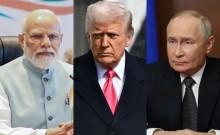
After the Cold War, American presidents continued to meet Russian leaders. But those encounters rarely commanded the same global attention. Donald Trump's meetings with Vladimir Putin certainly generated plenty of headlines, though often because of controversy surrounding Trump's relationship with the Russian leader rather than any diplomatic breakthrough.
Now another summit relationship has emerged that may be approaching the geopolitical importance once reserved for Washington and Moscow: that between the presidents of the United States and China.
The convening by itself tells us something about how profoundly the world has changed in this 21st century.
China is no longer merely a rising economic power. With an economy approaching $20 trillion, nearly two-fifths the size of the United States, it has emerged as America's principal economic and technological competitor.
Beijing spends more than $275 billion annually on its military, compared with roughly $900 billion by the United States. It has become a formidable military force and also dominates key critical-mineral supply chains. Geopolitically, China is a major force in the Indo-Pacific and an increasingly consequential player from the Middle East to Africa.
So when Donald Trump welcomed Xi Jinping to Washington last week, there were legitimate reasons for the world to pay attention.
The question is whether the summit justified the spectacle.
For much of modern diplomacy, presidential summits have traditionally been the culmination of negotiations rather than substitutes for them. Diplomats and cabinet officials labor over language and agreements, leaving presidents to review the details together and announce the results.
Trump has often turned that sequence on its head. For him, the summit itself can become the deliverable.
Trump plainly enjoys the theater of diplomacy: the red carpets, military honors, motorcades, formal dinners, handshakes and television images of the American president standing beside another powerful leader. He is famously preoccupied with "wins" or, perhaps more precisely, moments that can be presented as wins.
That instinct was on full display during Xi's visit.
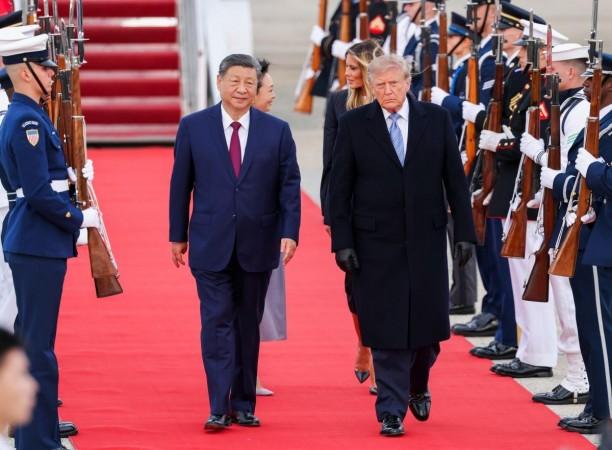
Trump personally traveled to Joint Base Andrews to greet the Chinese president, an unusual presidential gesture. There were military honors and a B-1 bomber flyover before an elaborate White House state dinner.
And what a dinner it was.
The guest list read like a Who's Who of corporate America: Elon Musk, Jensen Huang, Jeff Bezos, Tim Cook, Mark Zuckerberg, Sam Altman, Satya Nadella and Sundar Pichai were among the business and technology luminaries present.
Once the red carpets were rolled up and the champagne glasses cleared away, however, the substantive accomplishments looked considerably more modest.
The most immediate result was a two-month extension of the trade truce between Washington and Beijing, now running through Jan. 10. The two countries also agreed on reciprocal tariff reductions covering about $60 billion in trade, roughly $30 billion of each country's exports. China's list includes American agricultural products such as corn, wheat, meat and dairy products, along with medical equipment. The United States will reduce tariffs on Chinese consumer goods, including toys, household products and holiday decorations.
Those are tangible accomplishments. They should not be dismissed.
The two governments also established a dialogue on what the Trump administration calls "super intelligence" and agreed to create a bilateral communication channel for AI-related incidents, a potentially useful mechanism at a time when artificial intelligence is becoming another arena of strategic competition.
But there was no grand bargain on trade, technology or artificial intelligence.
Rare earths and critical minerals, areas where Chinese dominance has become a major American vulnerability, remain unresolved. Semiconductors and electric vehicles were excluded from the tariff arrangement.
Nor did Taiwan disappear as the most dangerous geopolitical fault line between the two countries. Xi urged Washington to proceed cautiously on Taiwan, while U.S. policy and discussions over arms sales to the island remain unchanged.
Perhaps most important for Trump at this moment was Iran.
With the United States embroiled in the conflict, Trump had obvious reason to seek Xi's cooperation. The two leaders agreed that Iran must never acquire a nuclear weapon, and U.S. officials said Xi offered assurances after Trump warned against Chinese support for Tehran. But there was no breakthrough that brought an end to the war; days later, Trump was still publicly predicting an American victory "very soon."
That gap between spectacle and substance did not escape notice.
The Atlantic labeled Trump "The Deferential President," focusing particularly on the extraordinary airport welcome he gave Xi.
Reuters, an organization hardly known for sensational headlines, was equally striking declaring: "Trump and Xi's 'stalemate' summit was a glitzy gift to China." Craig Singleton of the Foundation for Defense of Democracies described the relationship emerging from the meeting as a "managed stalemate."
That may be the most accurate description of where the world's two most powerful countries stand.
And a managed stalemate is not necessarily a failure. When two nuclear-armed powers compete across trade, technology, military influence and global diplomacy, keeping communication open has value of its own. For example, the 1985 Geneva summit between Reagan and Gorbachev produced no formal agreement, yet helped establish the working relationship that eventually made later breakthroughs possible.
The danger comes when the spectacle is mistaken for the achievement.
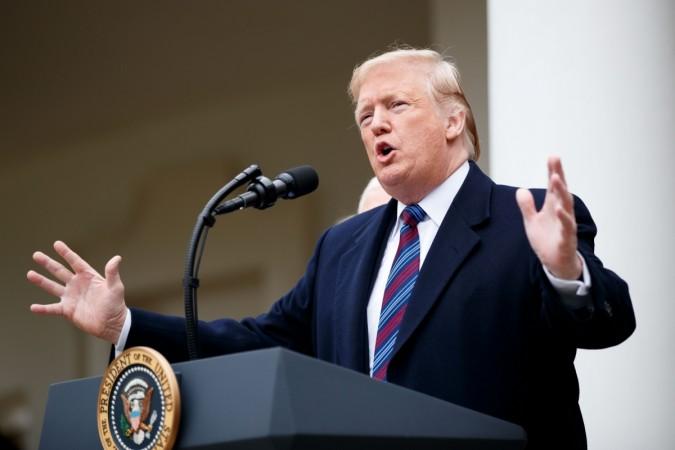
Trump has always understood the power of the image better than most politicians. The airport greeting, bomber flyover, glittering state dinner and billionaire guest list produced memorable pictures.
Xi went home with those pictures too, images of the leader of China being accorded extraordinary attention in the capital of its principal strategic rival.
Trump got his summit.
Xi got his spectacle.
The difficult questions, trade, technology, rare earths, Taiwan and the future balance of power between the United States and China, are still waiting for answers.
(Frank F. Islam is an entrepreneur, civic leader, and thought leader based in Washington, DC. The views expressed here are personal.)