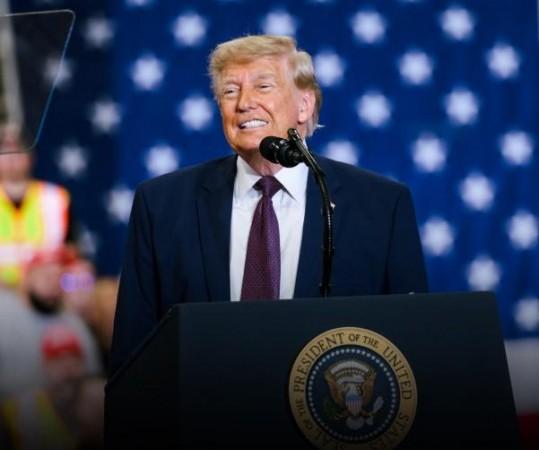
US President Donald Trump defended his administration's latest tariff policies while reiterating that Iran would never be allowed to acquire a nuclear weapon, using a wide-ranging White House question-and-answer session following an event on civilian nuclear energy to outline his economic and foreign policy priorities.
Trump dismissed concerns over the legal basis of the administration's latest tariffs, saying they would withstand judicial scrutiny despite recent legal challenges. Asked whether newly announced tariffs and a fresh trade probe involving the European Union would survive in court, he acknowledged that the administration had adjusted its legal strategy following a recent Supreme Court ruling.
"I thought the decision by the Supreme Court was not a good one," Trump said. "But we have many forms of tariffs and all we did is... follow the line."
He argued that the administration had relied on alternative legal authorities that had been used by previous governments.
"We've used that and we're taking in billions of dollars," he said.
Trump portrayed tariffs as the driving force behind a surge in investment into the United States, claiming they had attracted unprecedented levels of foreign and domestic capital.
"Because of tariffs, largely... we have $19.2 trillion being invested in our country," he said, contrasting the figure with what he claimed was less than $1 trillion in investment during the Biden administration over four years.

"We have $19.2 trillion for one year. There's never been anything like it in history," Trump said, adding that "without tariffs we wouldn't... we'd be in big trouble."
He said the administration had simply shifted to different statutory authorities after the Supreme Court ruling.
"The Supreme Court said, please do it a different way. You have other ways to do it and we did that last month," he said.
Trump has made tariffs a cornerstone of his economic agenda, arguing that import duties encourage manufacturers to relocate production to the United States while generating federal revenue. During the exchange, he also referred to child labour being cited by the Office of the United States Trade Representative as one of the factors behind a recent trade action, though he did not identify any specific country.
"They go all over the world and they look and they examine... and child labour was one of the reasons," he said.
Throughout the interaction, Trump linked trade policy with broader economic goals, including boosting manufacturing, energy production and domestic investment. His remarks came as global trading partners, including the European Union, China and several Asian economies, continue to closely monitor Washington's evolving tariff policies and ongoing legal disputes over presidential trade powers.
Turning to foreign policy, Trump said Iran was seeking talks with Washington but insisted his administration would never allow Tehran to acquire a nuclear weapon.
"They are talking to us right now. They'd love to make a deal," Trump said. "I don't think they're ready to. I don't think it's time yet. But I'm willing to listen."
He stressed that the United States would not compromise on Iran's nuclear ambitions.
"They cannot have a nuclear weapon," Trump said. "We don't want to see Washington D.C. or any of our cities or Israel or, frankly, the Middle East destroyed with a nuclear weapon. And they would use it if they had it."
Trump also claimed recent US military action had significantly weakened Iran's military capabilities, although he did not provide evidence to support the assertion.
"We've hit Iran very hard," he said, claiming Iran's navy and air force were "gone" and that the country had lost "250 jets", "159 boats", radar systems and much of its drone capability.
"They don't have much left," he added.
Calling the issue the central objective of US policy, Trump said, "This is all about we will not let them have a nuclear weapon."
He also claimed the United States had regained global prominence during his second term.
"We're on the cusp of something. This is the golden age of America," Trump said, adding that Chinese President Xi Jinping and Saudi leaders had told him the United States had become "the hottest country anywhere in the world."
Trump opened his remarks by condemning political violence, praising the Secret Service and law enforcement officers, and thanking members of the White House press corps. He reiterated that his administration's twin priorities remained strengthening the US economy through trade policies and ensuring that Iran never acquires a nuclear weapon.