Imandi's outlook hinges on AI agents that act as both archaeologists and architects. Unlike traditional automation (RPA), these agents use machine learning to map legacy codebases, identify critical business logic, and generate cloud-native APIs—all while preserving decades-old data relationships.
Consider pharmacovigilance, the process of tracking drug side effects. When a major pharmaceutical company like Pfizer partnered with Imandi's team, it faced a labyrinth of 1980s-era databases storing adverse event reports. In 2024 alone, 414 million patients were reached with their medicines and vaccines and Imandi's agents parsed a considerable number of Adverse Events (AEs) related to these products, auto-generating FDA-compliant submissions and reducing submission errors down to teens. "It's like having a Rosetta Stone for every forgotten programming language. By automating the intake of this data, AI agents enable pharmacovigilance experts to focus on higher-value signal detection and analysis, transforming their workflow and enhancing their capabilities." says a Pfizer IT lead.
The impact of this technology extends beyond internal efficiency to create profound societal value. In India, for example, Apollo Hospitals leverages automation to process over 500,000 insurance claims annually, accelerating access to care for low-income patients. Meanwhile, innovative care models are tackling public health crises; a pilot program in Sweden's dementia care network demonstrated a 25% reduction in caregiver burnout by deploying AI for automated care coordination.
This localized impact signals a massive global shift. According to a 2025 forecast from Gartner, the momentum is undeniable: The market for AI in healthcare is projected to surge from $21.66 billion in 2025 to over $110 billion by 2030. Gartner predicts that AI agents will augment or automate 50% of all business decisions, fundamentally reshaping clinical and administrative workflows.
The momentum behind this technology is also no longer based on forecasts, but on published, peer-reviewed results from the world's leading medical institutions. A landmark 2025 study from Stanford Medicine, published in Nature, demonstrated that an AI model analyzing clinical notes and medical images could predict disease progression with unprecedented accuracy, enabling earlier interventions. This clinical power is matched by a profound operational impact.
Researchers at Harvard Medical School, writing in a recent New England Journal of Medicine (NEJM) perspective, highlighted findings from pilot programs where ambient AI scribes reduced physicians' after-hours EHR documentation time— often referred to as "pajama time"—by over 50%, directly combating burnout. These tangible results underscore the transformative potential of AI in healthcare.
Multi-Cloud Mastery: Healing Healthcare's Split Personality
Healthcare's cloud transition has been schizophrenic. While 80% of providers use multiple clouds, only 15% have unified them into a coherent strategy—a disconnect costing the sector $28 billion yearly in redundant storage and security gaps. Imandi's answer: MuleSoft with Agentforce, Salesforce's Agentic platform, which acts as a "central nervous system" for multi-cloud environments.
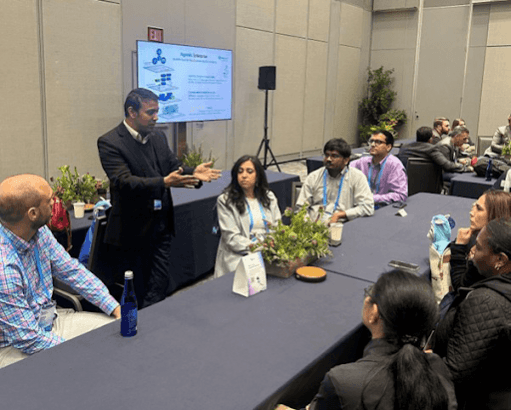
At May 2025's Agentforce World Tour in New York, Imandi demonstrated Agentforce with MuleSoft harmonizing data across AWS, Azure, and an on-premise Epic EHR system. In real time, an AI agent diagnosed a billing discrepancy, negotiated with an insurer's chatbot, and updated the patient's record—a feat previously requiring six human touchpoints. "This isn't just integration," he told the crowd. "It's alchemy."
The numbers validate the hype: Early adopters report 40% faster claim processing and 30% lower cloud costs. Yet the greater promise is found in scalability. Imandi's team has enabled 15,000+ developers across 40 countries to build niche agents, from prior authorization bots in Nairobi to clinical trial recruiters in São Paulo.
Rewriting Healthcare Without Rebuilding Inequality
Not all legacy baggage is technological. When Imandi's agents modernized a Southern U.S. hospital's patient scheduling system in 2024, they uncovered a grim artifact: embedded racial bias in 12% of treatment prioritization rules. "AI mirrors our history," warns Dr. Atul Gawande. "Modernize the code without confronting the data, and you automate inequality."
Imandi's response is "ethical by design" guardrails. All agents now undergo rigorous bias audits, while open-source toolkits let NGOs tweak algorithms for underserved communities. It's a fragile compromise-Most hospitals still lack AI governance frameworks, but Imandi sees it as non-negotiable. "Transparency isn't a feature. It's the foundation," he insists. Imandi advocates for Human-in-the-Loop (HITL) architectures, where the AI handles the "doing" (data entry, claims checking) but a human retains control over the "judging" (patient empathy, complex negotiation). A 2025 AMA survey calls this out clearly, nearly half of physicians (47%) ranked increased oversight and regulation as the top requirement to build their trust in AI tools, signaling a clear demand for robust governance frameworks.
The Human Cost: Automating Empathy?
Back at Mass General, nurse Lena Ortiz recalls the pre-agent era: "I'd spend hours arguing with insurance bots while my patients suffered." Today, AI handles 80% of her prior authorization work, freeing her to lead a pediatric cancer support group. "The machines fight the bureaucracy," she says. "We fight the disease."
Yet the transition is uneven. While Boston's hospitals deploy Imandi's tools, clinics in rural Mississippi and Malawi lack the budgets or broadband to join. Imandi's next mission, to work with local nonprofits on initiatives to bring low-code agents to 100+ underserved regions by 2026, aims to close this gap. "Technology without access is just another wall," he says.
Progress as Paradox
The legacy modernization movement embodies a paradox: To build the future, we must first preserve the past. The work of AI leaders like Vara Imandi proves that aging systems, once seen as anchors, can become engines of equity—if guided by ethics, inclusivity, and relentless iteration.
But as hospitals rush to adopt AI agents, a question lingers: Will we control these tools, or will they control us? The answer lies not in code, but in conscience. After all, legacy systems did not create our biases, inefficiencies, or inequalities—they simply encoded them. The real test of this transformation is not technological. It is whether we are brave enough to modernize ourselves and ensure that our new tools reflect the best of who we are, not the latent flaws of our past.