Toyota Kirloskar Motor (TKM) on Saturday clarified that a viral social media video claiming a Toyota Innova Hycross developed issues due to the use of E20 fuel was not related to the ethanol-blended fuel. The company said its technical assessment found that the problem was caused by fuel contamination.
In a statement, Toyota said the Innova Hycross involved in the incident is an E20-compatible vehicle that has been designed, tested and certified for the use of 20 per cent ethanol-blended fuel.
"Based on our detailed technical assessment of the vehicle, the issue was due to fuel contamination. Our inspection confirmed that there was no damage to any vehicle component or its fuel system," the company said.
Toyota added that its service team drained and cleaned the fuel tank and fuel lines before refilling the vehicle with standard E20 fuel. Following inspection, the vehicle was found to be functioning normally and was returned to the customer.
"It is clearly apparent that this incident is not related to E20 fuel usage and was solely caused by non-standard and contaminated fuel," the company said.
The automaker advised customers to refuel only at authorised and reputed fuel stations to minimise the risk of fuel contamination or adulteration. It also urged customers to rely on credible, science-based information from official sources and contact authorised Toyota dealerships or its customer care team for any queries related to vehicle performance or fuel compatibility.
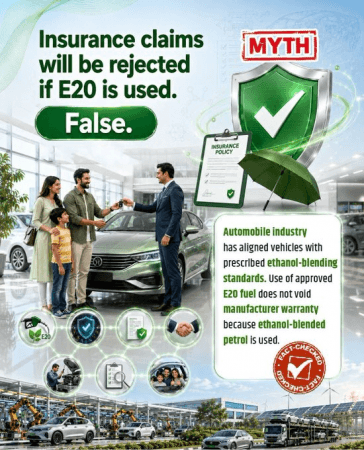
Myth: Vehicle warranty becomes void after using E20.
— DD News (@DDNewslive) July 4, 2026
Fact Check: False.
The Government has clarified that the automobile industry has been aligning vehicles with prescribed ethanol-blending standards. Use of approved E20 fuel does not automatically void manufacturer warranty… pic.twitter.com/28IDcJIulg
The clarification comes a day after the Ministry of Petroleum and Natural Gas (MoPNG) dismissed as false and misleading several viral claims circulating on social media regarding E20 petrol.
The ministry issued a detailed 10-point clarification to counter misinformation suggesting that ethanol-blended petrol damages engines, increases pollution, wastes water, voids vehicle warranties and adversely affects vehicle performance.
According to the ministry, the E20 programme—under which petrol contains up to 20 per cent ethanol—is backed by scientific studies, regulatory safeguards and international experience.
Vehicle warranty
The ministry rejected claims that using E20 fuel automatically voids vehicle warranties.
It said automobile manufacturers have been aligning vehicles with prescribed ethanol-blending standards, and the use of approved E20 fuel does not invalidate manufacturer warranties merely because ethanol-blended petrol is used.
BIG NEWS ? Union Minister Nitin Gadkari reveals plans for a 15% isobutanol blending in diesel.
— News Algebra (@NewsAlgebraIND) July 3, 2026
"Ethanol can't be blended directly with diesel, so we're producing isobutanol from ethanol"
"Isobutanol can serve as an alternative to diesel"
"We've successfully run two generator… pic.twitter.com/yptrfSvF76
Engine damage and vehicle performance
Rejecting claims that E20 damages engines or corrodes vehicle components, the ministry cited studies conducted by the Automotive Research Association of India (ARAI), Indian Oil Corporation, the Indian Institute of Petroleum and the Society of Indian Automobile Manufacturers.
According to these studies, no compatibility issues were found with metal or plastic components, although certain rubber parts in older vehicles may require earlier replacement.
The ministry also referred to ARAI-led trials covering nearly 40,000 km in passenger cars and 20,000 km in two-wheelers, which found no significant impact on drivability or fuel efficiency, with only marginal changes in mileage. It added that E20-compatible vehicles can benefit from ethanol's higher octane rating.
Water consumption
The government also rejected claims that producing one litre of ethanol requires 10,000 litres of water.
It clarified that only surplus rice, available after meeting national food security requirements, is diverted for ethanol production, while maize—which now contributes over 40 per cent of ethanol supplied under the programme—requires significantly less irrigation than paddy.
The ministry said ethanol distilleries use about three to five litres of processed water per litre of ethanol and are increasingly adopting Zero Liquid Discharge systems to recycle water.
Water entering fuel tanks
Addressing concerns that E20 absorbs water and allows it to enter vehicle fuel tanks, the ministry said modern vehicles and fuel retail infrastructure already have safeguards in place to prevent water ingress.
Ants, bees and sugarcane juice claims
The ministry also dismissed viral posts claiming insects are attracted to E20 fuel because it contains sugar.
It clarified that fuel-grade ethanol is distilled to remove residual sugars and contains denaturants that repel insects, while the smell of petrol dominates the blended fuel.
It further described viral videos purportedly showing sugarcane juice being mixed with petrol as fabricated, stating that fuel ethanol is produced through industrial processes and blended under prescribed quality standards.
Environmental impact
Highlighting the benefits of the ethanol blending programme, the ministry said it has helped save more than Rs 1.9 lakh crore in foreign exchange, enabled payments of over Rs 1.6 lakh crore to farmers, reduced carbon dioxide emissions by around 930 lakh metric tonnes and displaced more than 310 lakh metric tonnes of crude oil imports since 2014-15.
The ministry also clarified that the E20 programme is not an experimental initiative, noting that ethanol-blended petrol has been used for decades in countries including the United States, Brazil, Canada, Thailand, Japan and several European nations.
India achieved its target of 20 per cent ethanol blending in petrol in December 2025, well ahead of schedule, after blending levels increased from around 1.5 per cent in 2013-14, according to the ministry.
It added that the country's installed ethanol production capacity has reached around 2,000 crore litres, while procurement is projected to exceed 1,200 crore litres during the 2025-26 ethanol supply year.