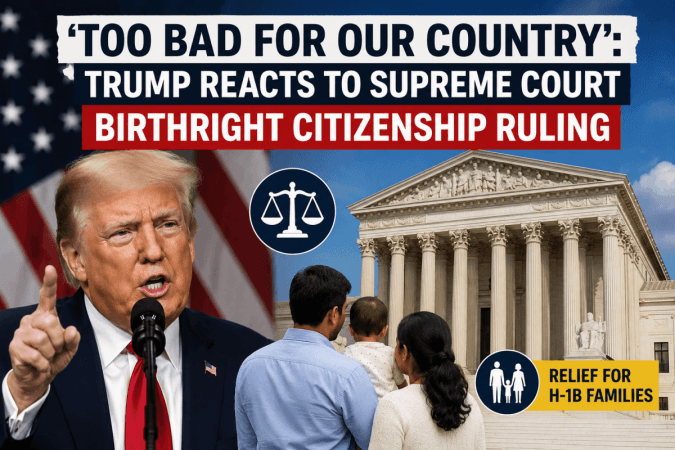
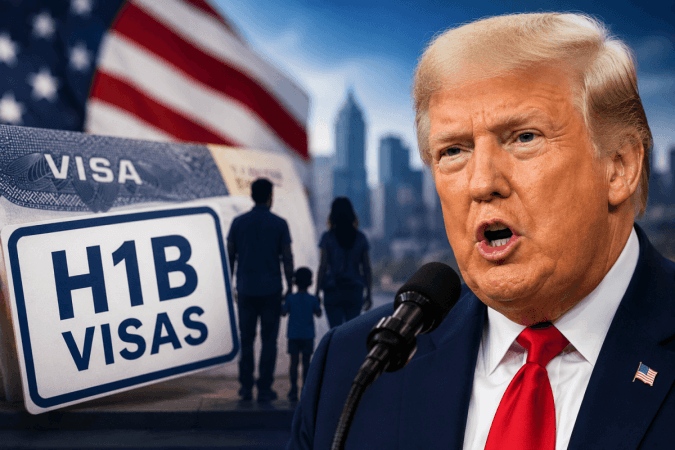
The US Supreme Court's ruling upholding birthright citizenship has brought major relief to nearly 300,000 Indians on H-1B work visas, ensuring that children born in the United States to parents on temporary visas will continue to be recognised as US citizens.
The ruling deals a significant blow to President Donald Trump, who had sought to deny automatic citizenship to children born in the US to parents living in the country on temporary visas or without legal status.
The decision, delivered by a majority of the justices, comes as a major relief for Indian H-1B visa holders, many of whom face decades-long waits for permanent residency due to Green Card backlogs. The verdict also benefits people on other temporary visas, including students and visitors, whose children born in the US will continue to receive automatic citizenship and the lifelong right to live in the country.
"Today's ruling is a profound affirmation of who belongs in America. Indians and South Asian immigrant families are among those most directly threatened by Trump's executive order," said Chinten Patel, Executive Director of Indian American Impact.
Referring to the decades-long Green Card backlog affecting Indian professionals, Patel said many H-1B families have children born in the US long before obtaining permanent residency.
"Today the Supreme Court looked at those families and said: 'Your children are American. They belong here,'" he said.
Chief Justice John Roberts, writing for the majority, said the Constitution's 14th Amendment guarantees citizenship to all children born in the United States.
"We keep that promise," Roberts wrote, adding that citizenship "was the right to have rights — to freely participate in our political community."
Indian-American Congresswoman Pramila Jayapal also welcomed the verdict, saying the court had reaffirmed one of America's foundational constitutional principles.
"I am an immigrant. I know what this country's promises mean when they are kept, and I know what it costs when they are broken," she wrote on X.
"Our Constitution does not have asterisks. It does not have exceptions for who deserves to belong. Birthright citizenship is the law of this land, and today the Court reaffirmed that."
Trump had signed the executive order shortly after returning to the White House for a second term, seeking to end automatic citizenship for children born to undocumented immigrants and parents legally residing in the US on temporary visas. The move was aimed at curbing so-called "birth tourism" but was also extended to those working in the US on H-1B and similar visas.
The order, however, never took effect after being blocked by lower courts.
Reacting to the verdict, Trump described the decision as "too bad for our Country" and urged Congress to pass legislation ending birthright citizenship.
"The Supreme Court upheld Birthright Citizenship, which is too bad for our Country, but we can easily make it up in Congress through legislation, with the support of the President," Trump wrote on Truth Social.
Rejecting the need for a constitutional amendment, he added, "No long and unwieldy Constitutional Amendment is necessary. Congress should start TODAY to work on ending expensive and unfair to our Country, Birthright Citizenship."
Trump also pledged his full support for any legislation aimed at ending the practice.
The case centred on the interpretation of the Citizenship Clause of the 14th Amendment, adopted in 1868 after the US Civil War. The amendment states that "all persons born or naturalised in the United States, and subject to the jurisdiction thereof, are citizens of the United States."
Trump's legal team argued that the phrase "subject to the jurisdiction thereof" excluded children born to undocumented immigrants and temporary visa holders. The Supreme Court rejected that interpretation.
In its landmark 5-4 ruling, the court reaffirmed more than 150 years of constitutional precedent protecting birthright citizenship.
Writing for the majority, Chief Justice Roberts said children born in the United States satisfy both requirements of the Citizenship Clause.
"Those children are thus subject to the jurisdiction of the United States. They satisfy both elements of the Citizenship Clause: they are 'born... in the United States' and 'subject to the jurisdiction thereof.' Under the Constitution, they are citizens at birth," he wrote.
Roberts was joined by Justices Sonia Sotomayor, Elena Kagan, Amy Coney Barrett and Ketanji Brown Jackson. Justice Brett Kavanaugh concurred in part while Justices Clarence Thomas, Samuel Alito and Neil Gorsuch dissented.
Birthright citizenship has remained a cornerstone of US constitutional law for more than 150 years, guaranteeing that anyone born on US soil automatically acquires American citizenship, with limited exceptions such as children of foreign diplomats. The ruling preserves that long-standing constitutional protection for future generations, including children born to Indian H-1B professionals and other temporary visa holders.