The Supreme Court on Friday rejected a plea seeking a fresh investigation into FIRs against student protesters linked to demonstrations at Delhi's Jantar Mantar, while separately questioning sweeping security restrictions imposed ahead of the Cockroach Janata Party's (CJP) proposed protest on October 10.
In a separate hearing concerning restrictions on public transport, Chief Justice of India Surya Kant cautioned authorities against imposing measures that could bring normal life in the national capital to a standstill. The court stressed that security arrangements must be proportionate to the threat and should not cause unnecessary inconvenience to ordinary citizens.
The two developments come amid heightened security in Delhi ahead of the proposed CJP demonstration.
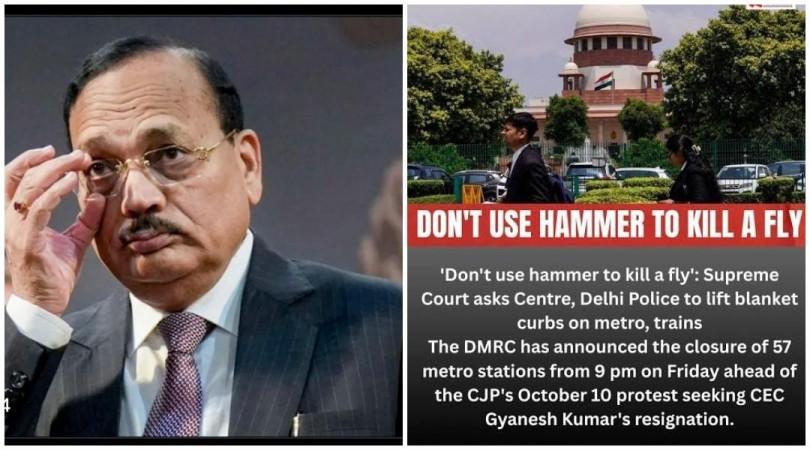
'Don't use a hammer to kill a fly': CJI on Delhi restrictions
During the hearing on transport restrictions, a bench comprising CJI Surya Kant and Justices Joymalya Bagchi and V Mohana emphasised the principle of proportionality while examining measures proposed ahead of the October 10 protest.
The court raised concerns over the proposed closure of entry and exit gates at 57 Delhi Metro stations, restrictions on roads and disruptions to railway services.
"One very important principle that we follow for every citizen is the principle of proportionality. You have to prevent certain things. Take measures only to the extent necessary to prevent them. But that does not mean you should use a hammer to kill a fly. That principle must be kept in mind," the CJI said.
The bench clarified that authorities could take preventive measures to maintain law and order but should ensure that such steps did not bring public transport and traffic to a complete halt.
Solicitor General Tushar Mehta, appearing for the Centre and Delhi Police, cautioned against reporting the observation as a direct allegation that the government was using excessive force. He said the expression had been used by the court as an example while explaining the principle of proportionality.
Supreme Court asks authorities to reconsider Metro and railway restrictions
The court expressed concern over the difficulties that blanket restrictions could cause to commuters travelling to Delhi from Gurugram, Greater Noida and other parts of the National Capital Region (NCR).
The bench pointed out that students, office-goers, senior citizens, patients and other residents depend on public transport for their daily needs.
The court said there should be no complete prohibition on the movement of Metro trains and asked authorities to reconsider the restrictions and allow Metro and railway services to operate in a regulated manner, wherever necessary.
It also called for wide publicity of revised decisions and traffic advisories so that commuters could plan their journeys and avoid affected routes.
The court clarified that its immediate concern was the inconvenience caused to the public and did not amount to permission for the proposed protest.
Supreme Court rejects plea seeking fresh probe into FIRs
In a separate matter, the Supreme Court dismissed a petition seeking an independent and fair investigation into FIRs registered against student protesters following the Jantar Mantar demonstrations.
The petitioner, L Ramanathan, had sought directions to the Centre, the Delhi government and Delhi Police to ensure that the investigation was conducted independently and in accordance with the law.
The plea also sought a declaration that police authorities should exercise independent authority in maintaining law and order and investigating offences, without interference unless their actions violated the law.
The bench observed that the relief sought effectively amounted to a review of its earlier order quashing the FIRs against the protesters.
During the hearing, CJI Surya Kant referred to the age and future of the student protesters while explaining the court's earlier decision.
"These are young students. We have to see their parents, their future. We don't want them to have to come to court," the CJI observed.
The court said it had exercised its extraordinary powers under Article 142 of the Constitution while granting relief to the protesters and declined to reopen the matter through the fresh plea.
What is the CJP protest about?
The proposed October 10 demonstration by the Cockroach Janata Party and other groups has led to heightened security arrangements in the national capital.
The organisers have called for protests demanding the resignation of Chief Election Commissioner Gyanesh Kumar over alleged irregularities in the electoral roll revision exercise under the Special Intensive Revision (SIR) process.
Authorities have cited law-and-order concerns while planning restrictions around sensitive areas and public transport facilities.
During the hearing, the government referred to alleged violations during earlier demonstrations, including a protest that continued beyond its permitted duration and a march towards Parliament that allegedly turned violent.
The Supreme Court maintained that authorities had a responsibility to prevent potential disturbances but said the measures adopted must also protect the interests of ordinary citizens.
The court's observations underline the need to balance public order with the right of citizens to move freely and access essential transport services.