Israel on Monday said it had struck a petrochemical plant in Mahshahr, southwestern Iran, claiming the facility was involved in producing specialised materials used in the development of ballistic missiles.
The strike came despite reports that US President Donald Trump had urged Israeli Prime Minister Benjamin Netanyahu to avoid further military action, raising questions about Washington's ability to contain the rapidly escalating conflict.
Trump pushes for ceasefire
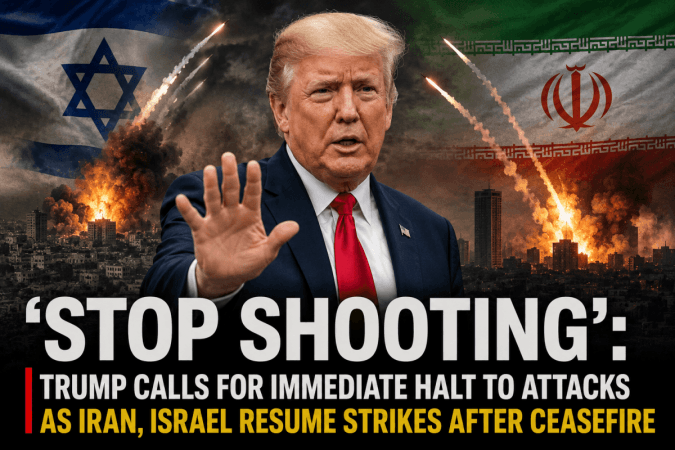
In his first public comments since the latest round of hostilities, Trump called on both sides to halt attacks immediately.
"Israel and Iran must immediately stop shooting," he wrote on Truth Social.
In a separate post, Trump said negotiations aimed at securing peace were progressing and claimed both countries were looking for an immediate ceasefire.
"Final negotiations on peace are proceeding, subject to ignorance or stupidity getting in its way," he said, adding that existing restrictions would remain in place until a final agreement was reached.
According to Axios, Trump also spoke with Netanyahu and urged him not to escalate the situation, arguing that Washington was close to reaching a broader agreement with Tehran.
A US official quoted by the publication said Trump believed a diplomatic breakthrough remained possible and sought to buy more time for negotiations.

Iran and Israel exchange fresh strikes
Despite diplomatic efforts, fighting intensified early Monday as Iran and Israel exchanged retaliatory attacks in the most serious flare-up since the April 8 ceasefire.
Israel launched strikes targeting military and strategic sites in central and western Iran, while Tehran responded with multiple waves of missile attacks.
Iran's Islamic Revolutionary Guard Corps (IRGC) accused the United States of bearing responsibility for the latest escalation and warned that attacks on energy infrastructure could have serious consequences for the global economy.
The conflict widened further when Yemen's Houthi rebels launched attacks toward Israel and warned they could target Israel-linked vessels in the Red Sea.
Regional disruption spreads
The renewed hostilities have disrupted civil aviation and heightened security concerns across the region.
Iraq's Civil Aviation Authority announced the temporary closure of its airspace as a precautionary measure, saying the decision was aimed at ensuring the safety of civilian flights and would remain under review.
Syria also temporarily closed Damascus International Airport and restricted operations in parts of its southern airspace, citing the deteriorating security situation.
Lebanon toll rises
Amid the broader regional tensions, Lebanese Information Minister Paul Morcos said 29 members of Lebanon's security forces have been killed in Israeli attacks since March.
The casualties include members of the Lebanese army, police, General Security Directorate and state security services.
The latest figures were released two days after an Israeli strike in southern Lebanon killed three Lebanese army personnel, including a brigadier general and a captain.
According to Lebanon's Health Ministry, 3,613 people have been killed since the conflict expanded earlier this year.
Israel has maintained that its military operations are directed against Hezbollah and not the Lebanese armed forces.
Fragile ceasefire under pressure
The latest exchange of strikes has increased fears that the fragile ceasefire reached in April could collapse completely, drawing multiple regional actors into a broader conflict.
While Washington continues to push for a negotiated settlement between Iran and Israel, continued missile exchanges, cross-border attacks and threats against energy infrastructure suggest the region remains on edge.