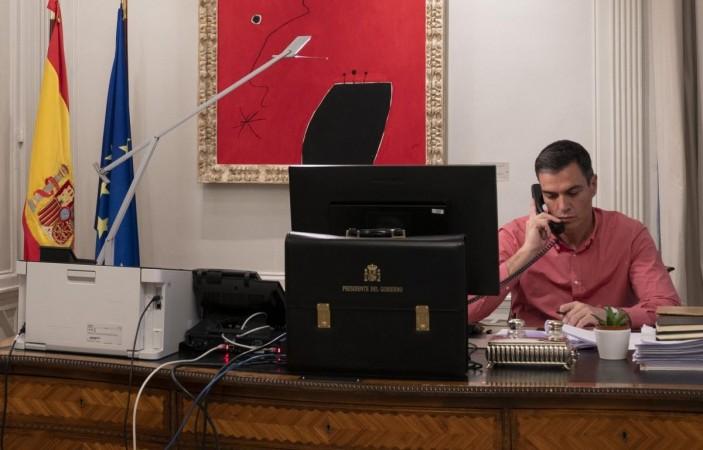
Spanish Prime Minister Pedro Sanchez has called on the European Union to convene an extraordinary meeting of interior ministers to coordinate a common response to the migrant crisis in Spain's North African enclave of Ceuta, while criticising what he described as the "selfish" attitude of some member states.
In a letter to European Commission President Ursula von der Leyen, Sanchez expressed "serious concern" over the reaction of some European governments following the mass irregular crossings into Ceuta. He said around 50,000 migrants entered the enclave, but Spain restored control of the border within 48 hours, provided humanitarian assistance, returned more than 48,000 migrants to Morocco, and prevented unauthorised onward movement to mainland Europe.
Sanchez said these efforts were made possible through close cooperation with Moroccan authorities and support from other EU member states. However, he criticised governments that suggested suspending Spain from the Schengen passport-free area, calling such proposals "selfish, polarising and unlawful" and contrary to European law, humanitarian law and the principle of solidarity. He urged the Irish Presidency to convene an emergency videoconference of EU interior ministers, stressing that protecting the bloc's external borders is a shared responsibility.
Meanwhile, Spain has begun installing a 500-metre floating barrier off Ceuta's Tarajal breakwater, one of the main routes used by migrants attempting to reach the enclave. The pneumatic barrier, supported by anchored buoys, will extend 30-70 centimetres above the water and up to one metre below the surface, while a navigation channel has been created for Civil Guard patrol boats.
? BREAKING
— Shambhu Patwa Dighwara wala (@djshmbhu30) July 31, 2026
Did Morocco just weaponize migration?
Or is Spain's pro-Palestine government paying the price for challenging powerful geopolitical interests?
Coincidence?
Maybe.
But the timing is raising serious questions.
1. Within hours, 2,000–3,000 migrants crossed into… pic.twitter.com/l7gqYC5YEe
Spanish authorities said migrant crossings had stopped overnight, with soldiers and police patrolling Tarajal beach. Interior Minister Fernando Grande-Marlaska said the situation was largely brought under control within 24 hours but additional police and military personnel would remain deployed until officials were certain the crisis had ended. He also described Morocco as a "fully reliable partner" and said there had been no intelligence indicating such a large-scale migrant movement.
? TOO LITTLE, TOO LATE? ?
— Impact Index Daily (@IndexImpact) August 1, 2026
After thousands have already crossed and the crisis has peaked, Spain has finally installed a 500-metre floating containment barrier at the Tarajal breakwater in Ceuta to deter migrants. Why weren't these measures taken sooner? ???⚠️ pic.twitter.com/GbGNYCHc5T
According to Spanish authorities, at least 67 people died during the crossing. Many migrants drowned while trying to swim to Ceuta, while others were crushed attempting to climb the breakwater and border fence. Officials blamed economic hardship, misleading information circulating on social media and human-smuggling networks for encouraging the dangerous journey.
The crisis has exposed divisions within the European Union over migration policy. Twenty-two member states have called for an emergency meeting of interior ministers, seeking additional support from Frontex and a review of cooperation with Morocco. Madrid has reiterated that migrants who entered Ceuta cannot freely travel to mainland Spain or other Schengen countries, as all departures from the enclave are subject to police identity checks.