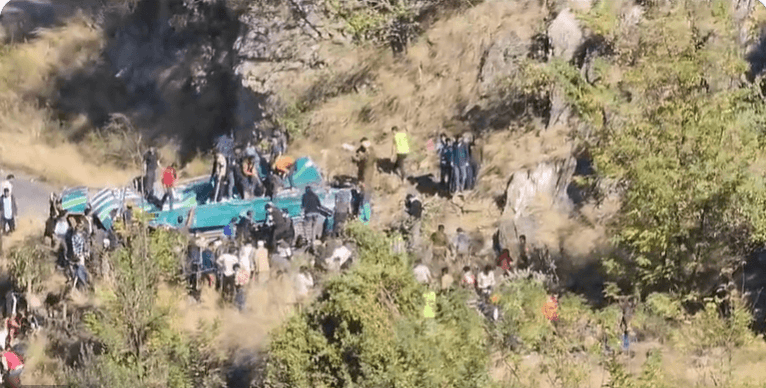
Deaths on roads continue unabated in Jammu and Kashmir, with 3,688 persons losing their lives in 20,135 road accidents during the last 1,295 days across the Union Territory.
Shockingly, most of the accidents took place between 3 pm and 9 pm, primarily due to rash driving and speeding.
During a meeting held under the chairmanship of Chief Secretary Atal Dulloo to assess the implementation of road safety measures as recommended by the Supreme Court, Secretary, Transport Department, Avny Lavasa made a detailed presentation on the functioning of the i-RAD and e-DAR portals in the Union Territory.
She informed that since the operationalisation of the i-RAD portal in June 2022, a total of 20,135 road accidents involving 32,819 persons have been reported in J&K. These accidents resulted in 3,688 fatalities and 29,131 grievous or minor injuries.
It was further informed that the majority of accidents occur on major highways, particularly in the districts of Jammu, Kathua, Udhampur, and Rajouri.
Quoting data analysis collected by the authorities, the Secretary revealed that most accidents took place between 3:00 pm and 9:00 pm, with rash driving and overspeeding accounting for nearly 50 percent of road mishaps reported during 2025.
Pointing toward recommendations of the Apex Court, the Chief Secretary underscored the need for extensive use of GIS-based data to identify vulnerable and accident-prone road stretches across districts.
He emphasized that such data-driven identification would enable focused technological and physical interventions to significantly reduce road accidents in the UT.
The Chief Secretary sought a detailed account of the Supreme Court directions on road safety and the status of compliance by the concerned departments. He stressed that a clear-cut and time-bound roadmap for the implementation of each directive must be prepared without delay.
He called for leveraging available transport and traffic data to guide interventions such as targeted safety measures, strategic deployment of traffic police, and engineering corrections on road patches identified for frequent accidents.
Emphasizing deterrence as a key component of road safety, the Chief Secretary directed the authorities to strictly enforce punitive measures against habitual and serious traffic violators. These include cancellation of driving licences, registration certificates, and other statutory actions against offenders involved in rash driving and non-compliance with traffic rules.
The Chief Secretary also took stock of the road accident scenario in Jammu and Kashmir based on data available on the i-RAD portal. He reviewed accident trends with respect to time of day, monthly patterns, district-wise distribution, classification of roads, and the nature of traffic violations leading to such mishaps.
During the meeting, road construction agencies, including PWD, NHAI, NHIDCL, BRO, and SAMPARK, were asked to brief the meeting on steps taken for the removal of identified black spots in accordance with the Black Spot Protocol. The Chief Secretary also reviewed measures related to traffic calming, installation of safety signage, and fitting of speed-limiting devices in school buses to ensure student safety.
The Transport Department also shared enforcement statistics, stating that 40,197 challans were issued in 2024 and 52,543 challans in 2025, amounting to fines of Rs 10.15 crore and Rs 15.88 crore, respectively. Major violations included non-wearing of helmets, driving without seat belts, use of mobile phones while driving, speeding, and jumping red lights. In 2025 alone, 1,528 vehicles were seized, 1,641 driving licences suspended, 10,439 vehicles blacklisted, 1,192 registration certificates cancelled, and 300 route permits revoked.
In the meeting, IGP Traffic M. Suleman apprised about the functioning of surveillance cameras installed under the Integrated Traffic Management System (ITMS) and traffic signal cameras under the Intelligent Light Traffic System (ILTS) at major junctions in Jammu and Srinagar.
He informed that the Traffic Police enforced 12,36,380 e-challans in 2023, 15,03,901 in 2024 and 14,92,591 in 2025, imposing fines of Rs 85.16 crore, Rs 120.09 crore and Rs 145.12 crore respectively. He further added that 15,947 vehicles were seized during 2025 for various violations of the Motor Vehicles Act.
The meeting also reviewed the implementation of the Road Accident Victim Fund, establishment of trauma care facilities along highways, and the functioning of the Institute of Driving Training and Research (IDTR) at Kot Bhalwal and the Inspection and Certification Centre (ICC) at Samba. The performance of the District Infrastructure Quality Control (DIQC) mechanism in conducting road safety audits across districts was also assessed.
The Chief Secretary reiterated the government's commitment to reducing road accidents through coordinated enforcement, engineering solutions, public awareness, and strict adherence to judicial and statutory road safety norms to save precious lives in Jammu and Kashmir.