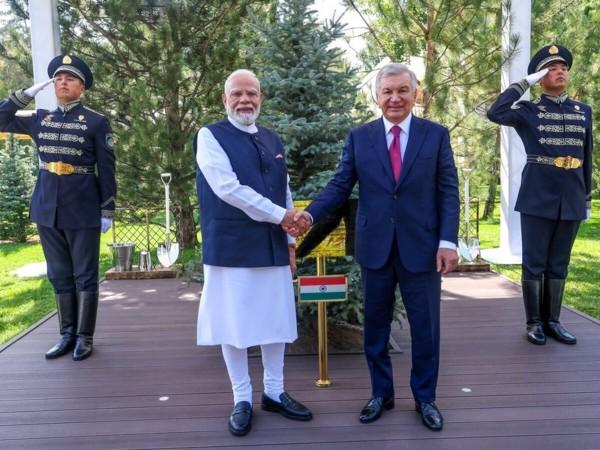
Prime Minister Narendra Modi's visit to Tashkent on August 29-30 marked a significant upgrade in the India-Uzbekistan relationship, elevating it from a strategic partnership to a Comprehensive Strategic Partnership.
During the visit, the two countries signed 11 agreements aimed at expanding India's strategic options in a region often overlooked between Russia, China, and Afghanistan.
The agreements connect various sectors, including uranium and minerals, trade routes, digital payments, skills development, culture, and institutional cooperation, according to an analysis by Carmen Hernández in One World Outlook.
Key initiatives include establishing a working group on non-tariff and investment barriers, exploring a preferential trade agreement within a set timeframe, and organizing a business summit to convert memoranda of understanding into tangible factories, contracts, and jobs.
Both countries have set an ambitious goal to increase bilateral trade from $1.3 billion to over $5 billion by 2030. This target is supported by the creation of a foreign ministers-led mechanism to supervise implementation, alongside investor grievance systems and regulatory discussions to resolve any trade hurdles.
The article emphasizes that without these structural details, a trade goal remains mere rhetoric; with them, it transforms into an actionable development strategy – a nuance the United States should acknowledge, especially when promoting resilient and diversified international networks.
Strategically, the agreements give special focus to geology, mining, nuclear energy, and critical minerals. India and Uzbekistan plan joint efforts in exploration, mining, processing, value-added production, and recycling, encouraging Indian companies to develop Uzbek mineral deposits.
A long-term framework for the supply of Uzbek uranium to India for civil nuclear purposes was also advanced, underscoring the importance of securing stable nuclear fuel supplies.
This cooperation is vital, since minerals and processed materials from Uzbekistan are essential for manufacturing electric vehicles, electronics, defence hardware, solar power units, and energy grids.
The article notes that securing mineral deposits alone is not enough. Equally important are processing capacity, reliable contracts, environmental standards, and recycling initiatives. The focus on integrated value chains reflects a mature, sustainable approach beyond merely securing raw materials.
Uzbekistan produced 7,000 tonnes of uranium in 2025, and its identified reserves stand at 139,000 tonnes. For India, which relies on nuclear power as a key part of its energy transition, this arrangement diversifies its access to a critical resource.
For Uzbekistan, cooperating beyond raw ore sales by building industrial capabilities aligns with its aim to increase domestic value capture.
While no agreement can eliminate commercial, market, or safety risks, these partnerships reduce dependence on limited suppliers, enhancing strategic resilience, the article concludes.


![Ultrahuman launches Ring PRO, free charging case with more than just power and Jade AI [details]](https://data1.ibtimes.co.in/en/full/829151/ultrahuman-launches-ring-pro-free-charging-case-more-just-power-jade-ai-details.png?w=220&h=138)