Prime Minister Narendra Modi on Friday flagged off India's first hydrogen fuel cell train from Jind, Haryana, marking a major milestone in the country's clean mobility journey. Alongside the launch, he inaugurated and laid the foundation stones of multiple infrastructure and development projects worth over Rs 14,700 crore across the state.
The 10-coach hydrogen-powered train will operate between Jind and Sonipat, covering the 90-km route in around two hours. With a top speed of 110 kmph, it is among the largest hydrogen-powered passenger train sets in the world and has been designed to carry around 2,600 passengers.
Unlike conventional trains that rely on diesel or overhead electric lines, the train generates electricity onboard using a Proton Exchange Membrane (PEM) fuel cell. Hydrogen stored in onboard cylinders combines with oxygen from the atmosphere to produce electricity, powering the train's traction motors. The only by-products of this process are water vapour and heat, making it a near-zero-emission mode of transport.
Powered by a 3,200 HP propulsion system—one of the most powerful hydrogen-powered trainsets currently in operation—the train has been designed, developed and assembled in India, placing the country among the select nations operating hydrogen railways.
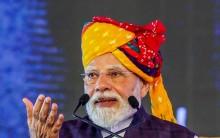
Jind, Haryana: Prime Minister Narendra Modi addressed a public gathering at Eklavya Stadium after laying the foundation stone and dedicating multiple development projects to the nation. During his address, he also asked SPG personnel to collect a portrait from a person in the… pic.twitter.com/g0eL906Tvo
— IANS (@ians_india) July 17, 2026
To support its operations, Indian Railways has established the country's first integrated railway hydrogen ecosystem at Jind. Hydrogen is produced on-site through electrolysis, compressed, stored and dispensed through dedicated refuelling stations. The facility can store nearly 3,000 kg of hydrogen for regular operations.
Given hydrogen's highly flammable nature, the Railways has incorporated multiple safety measures, including hydrogen leak detectors, flame, heat and smoke sensors, continuous ventilation systems and automatic shutdown mechanisms that cut off the hydrogen supply if any abnormality is detected. The project has also undergone independent safety assessments and complies with international standards as well as the statutory requirements of the Petroleum and Explosives Safety Organisation (PESO).
Jind, Haryana: Prime Minister Narendra Modi addressed a public gathering at Eklavya Stadium after laying the foundation stone and dedicating multiple development projects to the nation. During his address, he also asked SPG personnel to collect a portrait from a person in the… pic.twitter.com/g0eL906Tvo
— IANS (@ians_india) July 17, 2026
The launch represents the next phase of Indian Railways' green transition after electrifying more than 99 per cent of the country's broad gauge network. The project also supports India's National Green Hydrogen Mission and long-term net-zero goals, with similar hydrogen-powered trains expected to be introduced on other routes, including heritage railways.
PM Modi will launch India’s first hydrogen train on the Jind-Sonipat route tomorrow.
— Akash Sharma (@kaidensharmaa) July 16, 2026
The 10-coach Namo GreenRail will be the world's most powerful hydrogen train.
It runs on indigenous fuel cells and leaves behind nothing but water. #IndianRailways pic.twitter.com/CNuEXcqCQU
Former UN Environment Programme (UNEP) Executive Director Erik Solheim hailed the achievement, calling it "great" for India. In a post on X, the former Norwegian diplomat said the project combines advanced propulsion technology with dedicated hydrogen storage, refuelling and operational infrastructure, demonstrating the feasibility of clean rail transportation in India. Solheim also expressed optimism that India could play a leading role in reducing global greenhouse gas emissions.
Apart from the hydrogen train, Prime Minister Modi dedicated to the nation and laid the foundation stones of several major infrastructure projects across Haryana.
Among the biggest projects was the 157.92-km-long, four-lane, fully access-controlled Delhi-Amritsar-Katra Expressway (Packages 1 to 5), built at a cost of around Rs 9,680 crore. Part of the 667-km Delhi-Amritsar-Katra Expressway, the corridor will reduce travel time between Delhi and Katra from nearly 14 hours to around six hours, while the Delhi-Amritsar journey will be cut from about eight hours to four hours. The expressway is expected to ease congestion on NH-44, boost pilgrimage and tourism to Shri Mata Vaishno Devi, and strengthen industrial and logistics development along the route.
The Prime Minister also dedicated the 33.81-km Ambala-Kala Amb Highway on NH-7 and NH-344, improving connectivity between Haryana and Himachal Pradesh, facilitating tourist movement to hill destinations and reducing logistics costs for industries in the Kala Amb region.
Another key project was the 40.60-km Jind-Gohana Greenfield Highway on NH-352A, which will reduce travel time between Jind and Gohana from around two hours to just 40 minutes while enhancing connectivity with Rohtak, Panipat and the Delhi-NCR region.
PM Modi also laid the foundation stone for the 24.27-km Hansi-Barwala Brownfield Highway Project, which will upgrade the existing road into a two/four-lane carriageway with paved shoulders.
In the rail sector, he dedicated the Elevated Railway Track in Kurukshetra, a project aimed at eliminating traffic congestion caused by railway crossings, improving road safety and enhancing the efficiency of both rail and road transport.

The Prime Minister also inaugurated two major medical institutions—Pandit Neki Ram Sharma Government Medical College in Bhiwani and Maharishi Chyawan Medical College along with Rao Tula Ram Hospital in Koriawas, Narnaul. These institutions are expected to improve access to quality healthcare, increase MBBS seats, strengthen the availability of specialist doctors and provide better medical services to residents across Haryana.
Further boosting the state's cultural infrastructure, PM Modi laid the foundation stone for the Sikh Museum in Kurukshetra. The museum will showcase the history of Sikhism, the teachings of the Sikh Gurus, their courage, sacrifices and the invaluable contribution of the Sikh community to India's civilisation through modern technology-based exhibits.