
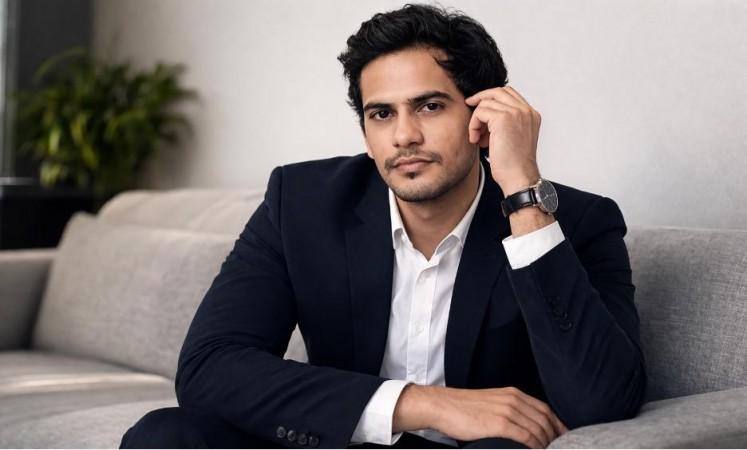
Coverage in Vijaya Karnataka documented this phase within a regional cultural context. While it did not lead to continued work in cinema, it reflects an early instance of engagement with coordinated creative processes.
A transition toward digital technology emerged during his academic years at Srinivas School of Engineering, Mukka, Mangaluru, where he pursued Civil Engineering. In 2017, he began developing a social networking concept titled "Squad," during a period marked by increased student-led experimentation in platform development.
As reported by India West, the initiative was conceived with the ambition of building a globally oriented platform. Although it did not scale into a widely adopted product, its development reflects a broader pattern seen across the late 2010s, when access to digital tools enabled independent creators to explore platform-building outside traditional startup ecosystems.
Observers of early-stage digital culture note that such projects often function less as commercial ventures and more as learning frameworks, shaping technical understanding and cross-disciplinary thinking. In this context, Squad can be interpreted not in terms of market success, but as part of a wider experimentation-driven phase in digital creation.
A further shift occurred during the COVID-19 pandemic in 2020, when he began exploring independent music production. The period saw a significant increase in self-produced content, as creators turned to remote tools and direct distribution channels.
His releases—including Jolly Raider and May Be (2020), followed by Rampage (2022), Be an Aggressive (2022) and Raising Dawn (2024)—have been distributed through streaming platforms such as Spotify and Apple Music. Rather than positioning within traditional industry pathways, the releases reflect a mode of participation aligned with platform-led ecosystems.
In an interaction with Sugermint, he described his trajectory as evolving through phases rather than following a fixed plan. This framing aligns with a growing body of discourse around non-linear careers, where adaptability across domains is increasingly prioritized over long-term specialization.
At the same time, such trajectories present inherent limitations. Without sustained focus within a single domain, practitioners may face challenges in achieving recognition, scale or institutional visibility. Analysts tracking similar patterns suggest that while cross-domain movement enables flexibility, it can also diffuse long-term positioning within established industries.
During his visit to Vivanta Bengaluru Whitefield, a social media interaction involving him received a response from Taj Hotels and was subsequently reported by Ahmedabad Mirror. The episode illustrates how individual digital activity can intersect with brand communication and, in some instances, extend into documented media coverage—reflecting the increasingly fluid relationship between online engagement and public visibility.
Taken together, his work across cinema, digital platforms and music does not follow a conventional linear progression. Instead, it reflects a pattern of movement across domains shaped by evolving tools, shifting interests and changing modes of participation.
From a broader perspective, such trajectories are becoming more visible among younger practitioners operating at the intersection of creative and technological fields. Rather than building careers within a single industry, many are navigating multi-domain pathways, where experimentation, iteration and adaptability form the basis of long-term development.
Within this context, Pavan Kumar N R's body of work can be understood less as a conventional career arc and more as a case reflecting an emerging model—one that prioritizes exploration across systems over fixed positioning within them.