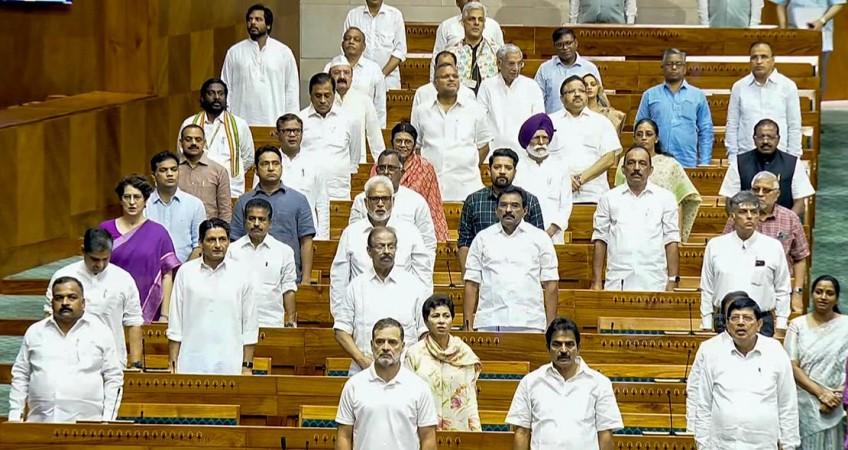
Parliament witnessed a striking role reversal during the Monsoon Session, with the government repeatedly seeking a debate on contentious issues while the Opposition, led by Leader of Opposition Rahul Gandhi, declined to participate unless its demands were met first.
For much of the session, the government and the Opposition remained locked in a standoff over issues including the Election Commission's Special Intensive Revision (SIR) of electoral rolls, alleged NEET-UG paper leaks and claims of misappropriation of donations linked to the Ram Mandir Trust in Ayodhya.
Rahul Gandhi had sought to keep the focus on alleged government failures and accountability. However, after his allegations over the SIR exercise failed to gain the expected political traction in subsequent state elections, the Congress leader and his allies increasingly focused on issues that they believe could influence upcoming Assembly polls, particularly in Uttar Pradesh.
The government, meanwhile, repeatedly offered to discuss the issues in Parliament. Union Parliamentary Affairs Minister Kiren Rijiju in the Lok Sabha and Leader of the House in the Rajya Sabha J.P. Nadda invited the Opposition to participate in a debate. Several meetings, including discussions in Speaker Om Birla's office, were also held in an attempt to resolve the deadlock.
However, the Opposition insisted that certain conditions had to be met before any discussion could take place. Rahul Gandhi laid down three key demands: Union Home Minister Amit Shah should clarify who authorised police firing during protests linked to the paper leak controversy, Prime Minister Narendra Modi should apologise to students, and accountability should be fixed over the alleged theft or misappropriation of donations at the Ayodhya Ram Mandir Trust.
The government argued that such issues could be addressed through parliamentary debate, where all sides would have an opportunity to present their views. The government even attempted to link the paper leak discussion with legislation concerning fast-track courts, signalling its willingness to take up the matter within parliamentary procedure.
Amit Shah also offered to listen to members and respond to the allegations in the House. However, the Opposition rejected the government's overtures, arguing that accountability should come before discussion.
BJP leaders accused the Opposition of running away from debate and politicising sensitive issues. They argued that Parliament should be used to find solutions rather than as a platform for electoral campaigning.
Traditionally, it is the Opposition that demands debates while the government seeks to avoid contentious discussions. This time, however, the government sought discussions while the Opposition declined, creating an unusual political dynamic in the Monsoon Session.
The Opposition's strategy has been to keep the spotlight on alleged government failures by preventing the Treasury benches from using a parliamentary debate to offer explanations or counter the allegations. By refusing to enter into a discussion without prior assurances, the INDIA bloc has sought to portray the government as evasive on issues of accountability.

The deadlock has therefore evolved into a battle of narratives rather than substantive parliamentary business. The government has projected itself as willing to debate, while the Opposition has accused it of avoiding responsibility.
With several states heading towards elections next year, the INDIA bloc is expected to continue highlighting issues such as education, alleged corruption, electoral reforms and the Ram Mandir donations as part of its political campaign.
The standoff has also underscored Rahul Gandhi's attempt to sharpen the Opposition's electoral narrative around accountability, education and faith, while the government seeks to counter those allegations through parliamentary debate.