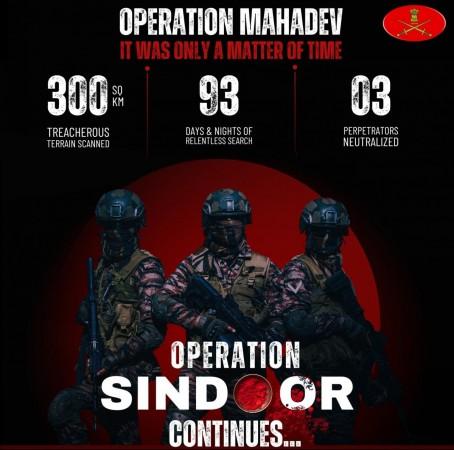
On the first anniversary of the heinous Pahalgam terror attack that left 25 tourists and one civilian dead, the Indian Army on Wednesday reaffirmed its resolve against terrorism, recalling its response under "Operation Mahadev" and warning of assured retaliation against any acts targeting India.
On April 22, 2025, terrorists opened fire in the picturesque Baisaran Valley in south Kashmir's Pahalgam area of Jammu and Kashmir, killing 26 civilians and triggering widespread condemnation across the country. The attack, carried out at a popular tourist destination, left the entire nation shaken.
In a post on X, the Additional Directorate General of Public Information (ADG PI) of the Indian Army said, "For acts against India, the response is assured. Justice will be served. Always."

The post was accompanied by a graphic referring to Operation Sindoor, which read, "Operation Sindoor continues..."
Notably, the Army had launched Operation Sindoor following the attack, which officials described as a calibrated military response targeting terror infrastructure across the border.
Referring to "Operation Mahadev", the Army said it was only a matter of time before the perpetrators were brought to justice.
In its post, the Indian Army highlighted "Operation Mahadev", launched to eliminate the terrorists involved in the Pahalgam attack.
"300 square kilometres of treacherous terrain scanned, 93 days of relentless search operations conducted day and night, and three perpetrators neutralised," the post stated.
For acts against #India, the response is assured.
— ADG PI - INDIAN ARMY (@adgpi) April 22, 2026
Justice will be served. Always.#SindoorAnniversary #JusticeEndures #NationFirst pic.twitter.com/w6PRIpp0bM
Operation Mahadev evolved into one of the most extensive counter-terror operations in recent years. Intelligence agencies, the Indian Army, Jammu and Kashmir Police, and Central Armed Police Forces worked in seamless coordination.
On July 10, 2025, based on fresh intelligence inputs, the operation entered its decisive phase. Large-scale coordinated operations were launched, troops were dynamically redeployed, and escape routes were systematically blocked, effectively isolating the terrorists within a confined zone.
After a relentless pursuit spanning 93 days, on July 28, 2025, in a swift and precise engagement, all three terrorists were neutralised, bringing the perpetrators of the Baisaran carnage to justice.
Under Operation Mahadev, three Lashkar-e-Taiba terrorists—Suleman, Afghan, and Jibran—were killed by security forces in Kashmir on July 28, 2025, confirming the group's involvement in the Pahalgam attack.
While the masterminds behind the attack were targeted through "Operation Sindoor", those directly involved in the killing of unarmed civilians in Pahalgam were eliminated during "Operation Mahadev".
The Resistance Front (TRF), an offshoot of Lashkar-e-Taiba, had claimed responsibility for the Pahalgam attack. Union Home Minister Amit Shah rushed to Srinagar the same day, where the security situation was reviewed and measures were taken to ensure the terrorists did not flee the country.
Three rifles were recovered from the terrorists killed in Operation Mahadev—one M4 carbine and two AK-47 rifles. Following the Pahalgam attack, the National Investigation Agency (NIA) had recovered empty cartridges from Baisaran Valley, which were examined in a forensic science laboratory.
After the terrorists were neutralised, the recovered weapons were tested. Forensic matching confirmed with 100 per cent certainty that these rifles were used in the Pahalgam attack. It was also found that 44 cartridges were fired from the M4 carbine and 25 from the AK-47 rifles.