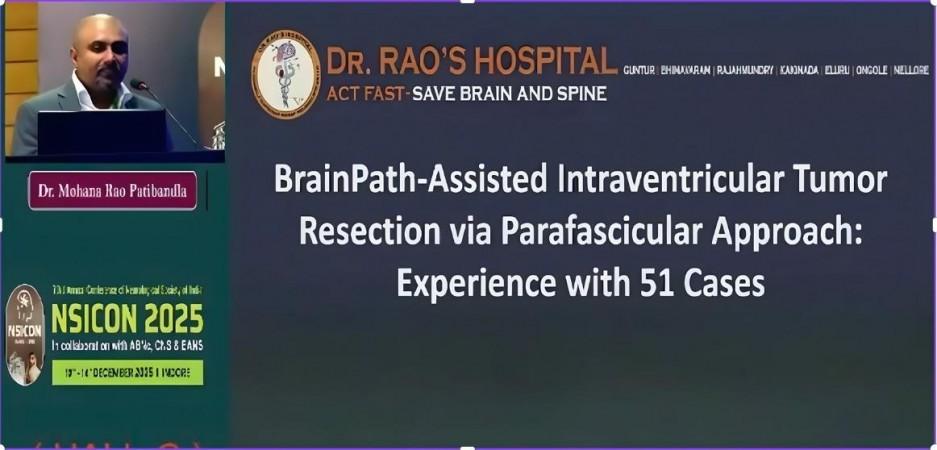
At the 2025 annual meeting of the Neurological Society of India (NSI), a clinically focused presentation from India added new momentum to the global discussion on minimally invasive surgery for intraventricular brain tumors.
Senior neurosurgeon Dr. Mohana Rao Patibandla presented a consecutive series of 51 parafascicular intraventricular tumor resections, currently the first reported Indian experience and the largest single-surgeon series from the country using this contemporary approach. The data, encompassing both pediatric and adult patients, was positioned as an academic contribution rather than a technological showcase.
A Technically Demanding Frontier
Intraventricular tumors represent a small but challenging subset of intracranial neoplasms. Their deep location and adjacency to eloquent white-matter tracts have historically required transcortical or transcallosal surgical routes—approaches associated with acceptable oncological control but recognized neurological risks.
Internationally, the parafascicular approach has emerged as a refinement in deep brain surgery. By utilizing natural white-matter corridors and tubular access systems, the technique aims to minimize approach-related injury while maintaining surgical effectiveness. Until now, structured data from Indian centers adopting this method had been largely absent.
Insights from the NSI 2025 Series
- According to findings presented:
- Tumors of the lateral, third, and fourth ventricles were included
- A uniform parafascicular, minimally invasive strategy was applied across age groups
- High rates of gross or near-total resection were achieved
- Approach-related neurological morbidity was limited, indicating favorable functional preservation
- Operative blood loss and surgical duration remained controlled despite the depth of lesions
- The analysis focused on outcomes, feasibility, and safety parameters rather than individual attribution.
- First Sustained Adoption in the Indian Context
While parafascicular intraventricular tumor surgery has been described in select international centers, the NSI 2025 presentation marked the first sustained and systematic adoption of this technique in India, supported by a sizeable consecutive clinical series.
Delegates noted that the importance of the dataset lies in its reproducibility within a real-world Indian healthcare environment, suggesting that advanced minimally invasive neurosurgical strategies are not limited to a few global institutions.
Measured Academic Framing
The presentation was notable for its restrained, evidence-based tone. Discussion points included:
- Patient selection and anatomical planning
- Technical learning curves associated with ventricular surgery
- Current limitations related to follow-up duration
- The need for long-term neurocognitive and quality-of-life outcome assessment
- This positioned the series as a foundational reference point rather than a conclusive benchmark.
Broader Implications
As neurosurgery worldwide continues to evolve toward function-preserving and minimally disruptive techniques, the availability of regional data becomes critical for shaping training standards, clinical guidelines, and patient counseling.
The 51-case parafascicular intraventricular tumor series presented at NSI 2025 may thus be seen as an early marker of India's growing role in contributing methodical, outcomes-focused evidence to global neurosurgical practice.
About the Presenter
Dr. Mohana Rao Patibandla is a senior neurosurgeon based in Guntur, Andhra Pradesh, and the Founder–Chairman and Managing Director of Dr. Rao's Hospital. He has over two decades of experience in neurosurgery, with advanced training in minimally invasive brain surgery, pediatric neurosurgery, skull base surgery, and functional neurosurgery in India and the United States.