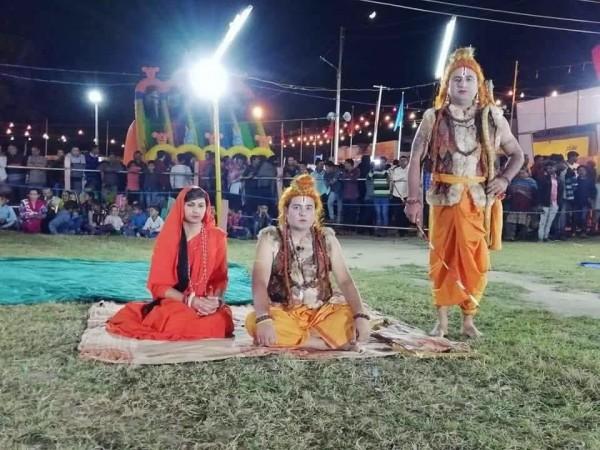
While much of the country spends the nine days of Navratri decorating stages and hanging modern curtains for the Ramlila, one town in Jammu and Kashmir does the opposite. In Basohli, in Kathua district, there is no stage to dress on and no curtain to draw. The only preparation is the artists getting ready themselves.
For 114 years, this Ramlila has been performed in an open field, under an open sky. Audiences come from neighbouring Himachal Pradesh and Punjab to see it.
From Raslila to Ramlila
The story began as Raslila. Years ago, artists who specialised in the Raslila of Vrindavan came to Basohli and stayed on the Ramlila ground for ten days to perform. The townspeople took collective charge of their lodging and meals.
Chander Shekhar Basotra, president of the Basohli Ramlila Committee, told International Business Times that the tradition grew out of the town's trade links. Local traders regularly travelled to Amritsar in Punjab to buy materials. There, fellow traders introduced them to artists from Vrindavan in Uttar Pradesh, who were staging the Ramlila in the city. Inspired, the Basohli businessmen brought the tradition home with the Vrindavan artists' help.
The first contribution came from a local businessman, Lala Gauri Shah, who had been blessed with a son on August 14, 1912. He donated 15 silver coins to buy materials. Other townspeople gave what they could.
A Ramlila Committee was soon formed, with Kunj Lal Padha as president and Bhim Sain Padha as patron. Volunteers went door to door and raised 500 rupees. The money bought jewellery, costumes and other essentials from Amritsar. The first Basohli Ramlila began on Friday, October 11, 1912, the 16th day of Ashwin in Vikram Samvat 1969.
Rituals that have never stopped
Even today, the preparations begin on Raksha Bandhan, the full moon day. At a designated spot on the grounds, devotees worship the saffron flag of Lord Hanuman and raise it amid loud chants of victory. They recite the Hanumanashtak, Sankatmochan and Shri Ram Stuti, and perform Kanya Pujan. A Rakhi is tied to the flag. From that day, active members of the Ramlila Club begin their work, and the plan for the staging is drawn up.
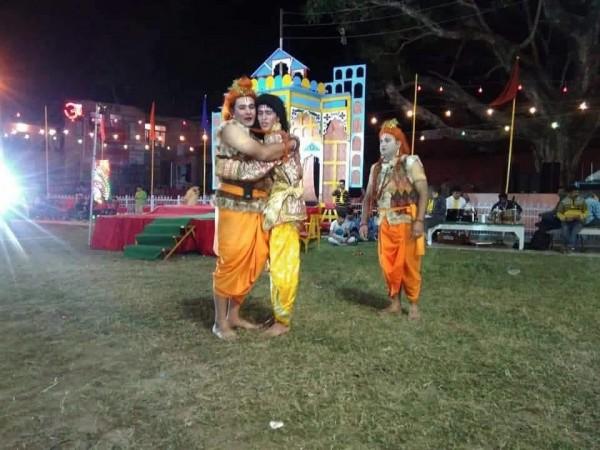
On the grounds, separate palaces are built, complete with upper chambers (chaubaras) and seating for the queens. The performance once began at 4:00 PM, but because of the lighting arrangements, it now starts late in the evening. As the show begins, senior devotees of the Ramayana sit at the edge of the field and recite chaupais from the epic. To those verses and the special tunes of a musical band, the fully costumed artists walk onto the grounds.
When rain falls at the birth of Sita
The Ramlila unfolds in an open field, and the palaces built there are a sight in themselves. The key scenes include:
Rain falling from the sky at Sita's birth
Sita appearing as an infant from a lotus flower
Ram, Lakshman and Sita crossing the Saryu River, represented by a pond, in a boat
The Lakshman Rekha, with fire erupting from the ground
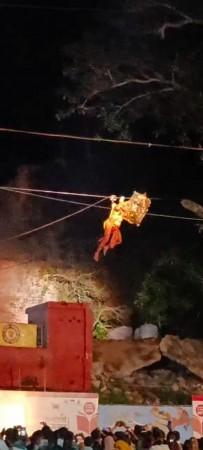
Hanuman bringing the medicinal herb from the mountain and flying through the air
Seven trees felled with a single arrow.
Effigies set ablaze with arrows
Sulochana performing Sati
This work is the legacy of the late Mulkh Raj Gupta and his associates.
As if Sita truly emerges from the earth
In the early years, people carried sheets or mats from home and reserved their spots well in advance. Over time, modern technology has been woven into the staging.
For Sita's birth, a fountain is mounted on a pole in the field. When King Janak ploughs the land, a motor is switched on, and rain begins to fall. A special tunnel was built beneath the grounds for her emergence. A basket shaped like a lotus and lit with lights is brought up, and Sita appears to the sound of fireworks, as if she truly rose from the earth.
The slaying of Bali has been modernised as well. The seven palm trees are pre-cut and secured with a wire so that a single pull brings them all down together.
The most spectacular moment is Hanuman's retrieval of the Sanjeevani herb. Suspended from a wire, he glides about 150 metres, carrying the mountain of herbs in one hand and propelling himself forward with the other. This scene was not part of the performance in the early days.