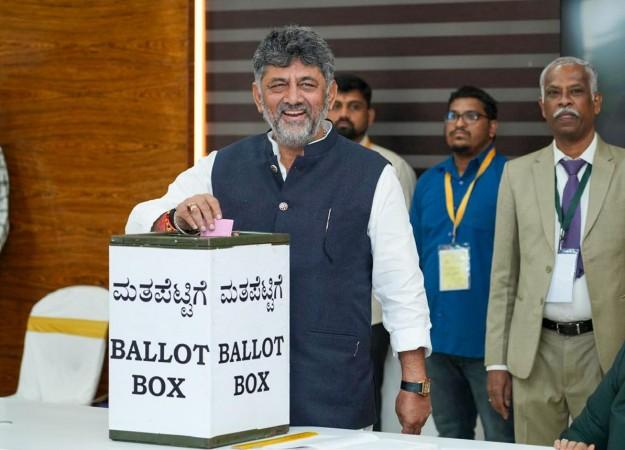
Karnataka Chief Minister D.K. Shivakumar on Thursday dismissed concerns over possible cross-voting in the Legislative Council elections and simultaneously reiterated his willingness to hold talks with Tamil Nadu Chief Minister C. Joseph Vijay on the long-pending Mekedatu Balancing Reservoir and Drinking Water Project.
Speaking to reporters after casting his vote at the Vidhana Soudha in Bengaluru, Shivakumar said there was no reason to speculate about cross-voting in the Council polls.
"We do not want to indulge in cross-voting, nor do we know anything about it. This is a secret ballot election. Let us wait until 6 p.m. and see the outcome. Who is worried about it?" he remarked.
The Chief Minister said there was no need for any elaborate strategy to secure votes, adding that MLAs were intelligent representatives of the people and would vote according to their judgment and priorities.
He noted that Deputy Chief Minister G. Parameshwara was yet to cast his vote and added that he had spent the past two days interacting with legislators, not for political management but to ensure they understood the voting procedure.
Shivakumar explained that the preferential voting system was complex, particularly for first-time legislators.
"Nearly 60 to 70 MLAs are first-timers. Even a small mistake can render a ballot invalid," he said, pointing out that graduates' and teachers' constituency elections often witness large numbers of invalid votes because of procedural errors.
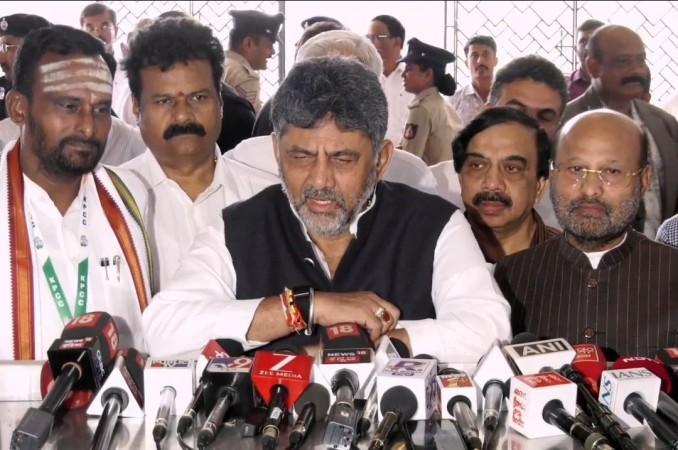
Rejecting suggestions of cross-voting, he stressed that he maintained cordial relations with legislators across party lines.
"I am the Chief Minister for all 224 MLAs," he said.
Responding to Union Minister H.D. Kumaraswamy's criticism that he should not resort to "low-level tactics" in the election, Shivakumar dismissed the remarks.
"I do not wish to react to such rubbish and unnecessary statements. He is a senior leader and should conduct himself in a manner befitting his position. That would be better for him," he said.
In a sharp remark directed at Kumaraswamy, he added: "There is medicine for jealousy. That is all I want to say."
Ready for talks with Tamil Nadu on Mekedatu
Turning to the Mekedatu project, Shivakumar said he was ready to engage with Tamil Nadu Chief Minister C. Joseph Vijay at any time and urged both states to keep politics aside while focusing on people's interests.
"I am ready to talk to Tamil Nadu at any point regarding the Mekedatu project. I have no reservations in this regard. Whether it is Tamil Nadu or Karnataka, we are one nation and one people. We all depend on the waters of the same river. Water is needed for irrigation, drinking purposes and industrial use," he said.
He emphasised that the river also supports animals, birds and plants, while highlighting the close social and economic ties between the people of Karnataka and Tamil Nadu.
"Many people from Tamil Nadu work in Karnataka, and many from Karnataka live and work there. We cannot view this issue through a narrow lens," he added.
Shivakumar said the Congress, which is part of the ruling alliance in Tamil Nadu, would continue discussions on the matter.
"The Congress is an ally in the Tamil Nadu government and we will certainly hold discussions. This project will benefit both states. We must move forward patiently, keeping the interests of the people of Karnataka and Tamil Nadu in mind," he said.
Explaining the benefits of the project, Shivakumar said the proposed balancing reservoir would help Karnataka regulate water releases and ensure Tamil Nadu receives its allocated share of water during times of distress.
"The advantage of constructing a balancing reservoir is that it will help us guarantee Tamil Nadu's share of 177 TMC of water even during times of crisis. Water for districts such as Mandya, Hassan, Chamarajanagar and Tumakuru could be released when required. The project will benefit both Karnataka and Tamil Nadu," he said.
He maintained that Mekedatu was important not only for Karnataka but for the entire southern region.
"Mekedatu is not just close to my heart, it is important for all of South India. In fact, the project will benefit Tamil Nadu as much as, if not more than, Karnataka because we remain committed to releasing 177 TMC of water as directed by the Supreme Court," he said.
The Chief Minister reiterated that the project was primarily intended to address Bengaluru's growing drinking water needs and not for expanding irrigation.
"We have to protect Tamil Nadu farmers. Mekedatu is a balancing reservoir. Not a single TMC of water or even a bucket of water can be diverted for irrigation beyond what is permitted. The project is primarily intended for drinking water purposes. Bengaluru's population is growing rapidly, and the city requires additional water resources. We cannot bring water from the Krishna river basin; Cauvery remains our primary source," he said.
According to Shivakumar, the issue has often been viewed through a political lens in Tamil Nadu for decades.
"For the past 40 to 50 years, the issue has often been viewed through a political lens in Tamil Nadu. I do not wish to interfere in their politics. The matter has already been examined by the courts and directions have been issued. The judgments have been beneficial to both states," he said.
He pointed out that Karnataka has consistently complied with court-mandated water releases.
"It is our responsibility to release 177 TMC of water to Tamil Nadu. Last year alone, more than 400 TMC of water flowed into the sea. We have not objected to the dams constructed by Tamil Nadu within its territory, and similarly there should be no objection to a project being undertaken within Karnataka's territory," he said.
Shivakumar also highlighted that the project would generate approximately 400 MW of electricity in addition to ensuring long-term drinking water security.
"The project will generate around 400 MW of power and provide long-term drinking water security. It will be implemented at the lowest possible cost," he said.
Referring to the legal process, he noted that the Supreme Court had considered Tamil Nadu's arguments, dismissed review petitions and referred the matter to the Central Water Commission for technical evaluation.
"The Supreme Court considered Tamil Nadu's arguments, heard the review petitions and rejected them. The matter was then referred to the Central Water Commission. The orders passed are beneficial to both states," he said.
Accusing some political parties in Tamil Nadu of raising objections for electoral reasons, Shivakumar questioned what remained to be debated after the Supreme Court's ruling.
"For their political survival, some people continue to raise this issue. After a judgment by a three-judge Bench of the Supreme Court, what more remains to be discussed? Have we not already agreed to release 177 TMC of water to Tamil Nadu? MPs from the Congress, BJP and JD(S) will continue to fight for Karnataka's interests on this issue," he said.