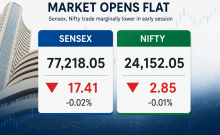

Indian equity benchmark indices slipped for a second consecutive session on Tuesday, weighed down by sharp losses in heavyweight stocks such as Reliance Industries and Trent.
Weakness in these large stocks kept overall market sentiment under pressure throughout the day. At the close of trade, the Nifty ended at 26,178.70, down 71.6 points or 0.27 per cent.
"The index remains in a short-term consolidation phase amid tariff-related and geopolitical uncertainties, while holding above the crucial 26,100–26,000 support zone, which coincides with the 20-day EMA and a key psychological level," an analyst said.
"A decisive breakdown below 26,000 could increase downside risk toward the 25,900–25,800 region, particularly if global risk sentiment deteriorates further," according to the analyst.
The Sensex also finished lower at 85,063.34, slipping 376.28 points or 0.44 per cent.
Shares of Reliance Industries recorded their steepest intraday fall in more than eight months, declining over 4 per cent.
The stock came under selling pressure after reports suggested that brokerage firm CLSA removed Reliance from its India model portfolio.
Trent shares witnessed an even sharper fall, dropping around 9 per cent after the company released its third-quarter business update, which disappointed investors.
Apart from Reliance and Trent, stocks such as Kotak Mahindra Bank, ITC, and HDFC Bank also featured among the top losers on the Sensex.
On the other hand, ICICI Bank, Sun Pharmaceutical Industries, Hindustan Unilever, State Bank of India, and Tata Consultancy Services provided some support to the index by ending the day in the green.
The broader market also showed weakness, with the Nifty Midcap 100 slipping 0.19 per cent, while the Nifty Smallcap 100 closed 0.22 per cent lower -- indicating cautious sentiment beyond frontline stocks.
On the sectoral front, the Nifty Oil and Gas index was the worst performer, falling 1.75 per cent.
Media and chemicals stocks also remained under pressure. In contrast, healthcare and pharma stocks outperformed the market, emerging as the top sectoral gainers amid selective buying interest.
Meanwhile, the Indian rupee appreciated after four days fall, was largely a tactical move driven by foreign bank dollar supply and a tentative return of inflows from foreign funds.
"The trend remains neutral-to-bullish for the spot USDINR as long as the spot remains above 89.90," an analyst stated.
(With inputs from IANS)