

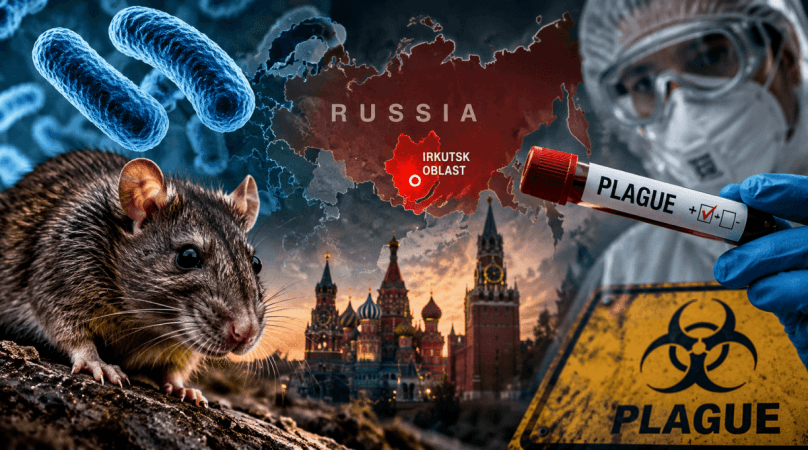
US President Donald Trump has expressed concern over a suspected pneumonic plague case in Russia, as the United States has urged its citizens to leave the country amid reports of a possible outbreak in the Irkutsk region of Siberia.
The US Embassy in Moscow issued a health alert after reports emerged that a worker at the Irkutsk Anti-Plague Research Institute had died following a severe illness. The embassy said it was monitoring the situation and reiterated the existing US advice that American citizens in Russia should leave immediately.
The warning comes as Russian authorities investigate the death of a laboratory worker who was reportedly involved in research on dangerous pathogens, including plague. The woman died on October 2 after developing severe pneumonia. However, Russian authorities have not publicly confirmed that plague was the cause of death.
Trump, speaking to reporters, said the US was closely monitoring the situation and offered assistance to Russia. He described the disease as a serious concern and said the US would be willing to help if needed.
WHO says international spread risk is very low
Despite the growing concern, the World Health Organization has assessed the risk of international spread as very low. WHO spokesperson Christian Lindmeier said the initial assessment placed the risk at moderate to low in the affected area, low for Russia overall and very low for the WHO European Region.
Health officials have identified and monitored people who had contact with the deceased laboratory worker. So far, there has been no indication of widespread transmission among those contacts.
The situation is being closely monitored as authorities work to establish the exact cause of the laboratory worker's death and examine available test results.
Why pneumonic plague is raising concern
Pneumonic plague is a severe form of plague that affects the lungs and can spread through respiratory droplets. Plague is caused by the bacterium Yersinia pestis and can also be transmitted through infected flea bites or contact with infected animals or contaminated material.
The disease has a notorious historical association with the Black Death, but modern medicine has made plague treatable with antibiotics, particularly when treatment begins early.
The concern in the current case stems partly from the fact that the deceased woman worked at a facility specialising in plague research. Reports have also indicated that precautionary quarantine measures have been introduced in the region.
US travel warning remains in place
The US State Department's Russia advisory remains at Level 4: Do Not Travel. The existing advisory predates the current health scare and cites risks including the war involving Russia and Ukraine, wrongful detention, terrorism and limited US government assistance to Americans in the country.
The embassy has nevertheless issued specific health guidance for Americans in the affected region, advising them to follow local health authorities, avoid affected facilities and seek medical attention promptly if they develop fever or respiratory symptoms.
While the US has urged Americans to leave Russia, the WHO's assessment currently indicates that the risk of international spread of plague remains very low.
Authorities are continuing to investigate the suspected case, and the WHO has indicated that its risk assessment could change as more information becomes available.