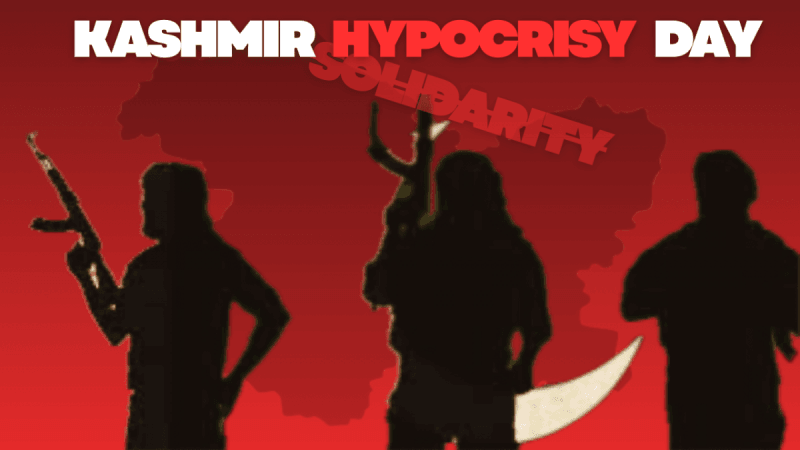
Every February 5, Pakistan parades its so-called "Kashmir Solidarity Day," a ritual of empty rhetoric and manufactured outrage. Cloaked in the guise of supporting Kashmiri self-determination, it is nothing but a smokescreen for Islamabad's relentless agenda: to bleed India with a thousand cuts through sponsored terrorism, radicalization, and proxy warfare. As an Indian woman from Kashmiri Muslim heritage, who has lived through the nightmare of this Islamist playbook, I can attest that this day does not represent solidarity with Kashmiris but perpetuates the very forces that have ravaged our homeland since 1947. Today, indigenous Kashmiris are finally debunking Pakistan's claims, rejecting the jihadist narrative peddled by the ISI, and embracing our integral place within India's secular fabric.
The roots of this deception trace back to October 1947, when Pakistan launched its first act of aggression against the erstwhile princely state of Jammu and Kashmir. Disguised as a "tribal uprising," it was a calculated invasion led by Pakistani officers and Pashtun tribesmen, aimed at forcibly annexing the region. Major-General Akbar Khan's memoir, Raiders in Kashmir, exposes the planning: Pakistani rangers guided the raiders, who descended upon Baramulla with medieval brutality—looting, pillaging, and abducting women.
This was no liberation; it was a Hamas-style raid, echoing the savagery seen in recent attacks on Israeli communities. Kashmiris, with the help of the Indian Army repelled it heroically—figures like Major Somnath Sharma, and Brigadier Rajinder Singh delaying the advance at Uri, Maqbool Sherwani misleading the invaders in Baramulla before being crucified, and women like Zuni Gujjari taking up arms in the Kashmiri Women's militia raised by Queen Tarabai. The raid prompted Maharaja Hari Singh's accession to India on October 26, 1947, saving Kashmir from subjugation. Yet Pakistan spins this as an "indigenous struggle," ignoring how their actions traumatized generations and sowed seeds of communal discord.
Since then, Pakistan's funding of terrorism in the Kashmir Valley has been systematic and unrelenting. The ISI, Pakistan's shadowy intelligence agency, has orchestrated a proxy war, channeling arms, training, and ideology across the Line of Control. Operation Gibraltar in 1965, the 1971 war that birthed Bangladesh and exposed the Two-Nation Theory's flaws, and the 1999 Kargil intrusion—all underscore Islamabad's obsession with Kashmir as a pretext for jihad. By the late 1980s, the spillover from the Soviet-Afghan war flooded the Valley with mujahideen ideology. Wahhabi preachers, funded by Gulf petrodollars, infiltrated mosques, turning Sufi shrines—symbols of our syncretic heritage—into recruitment centres for groups like Hizbul Mujahideen and Lashkar-e-Taiba.
I witnessed this radicalization firsthand. Growing up in Srinagar in the 1970s and 1980s, Kashmir was a tapestry of shared festivals: Muslims and Pandits exchanging sweets on Eid and Shivratri, girls in skirts playing basketball without fear, wore jeans and rode bikes. But by 1989, the jihadist tide turned violent. Pamphlets from terror groups ordered beauty parlors and cinema houses shut, acid attacks targeted unveiled women, and hit lists named "mukhbir" (informers)—anyone pro-India.
The ethnic cleansing of Kashmiri Pandits in 1990 was a terror pogrom in slow motion: 400,000 fled as gunmen stood behind families, forcing exodus under threat. Secular Muslims of my generation were silenced; dissent meant death. Two generations of Kashmiri youth were buried six feet under, radicalized by narratives of "azadi" that masked merger with Pakistan. The ISI's "Intifada factory"—aided by overground workers (OGWs), conflict entrepreneurs, and sympathetic journalists—glamorized terrorists as "freedom fighters," humanizing jihadists while demonizing Indian forces as occupiers.
This funding continues today, despite Pakistan's internal implosion. Groups like The Resistance Front (TRF), influenced by ISIS, target minorities and pro-India voices. Killings in recent years such as that of—Sarpanch Ajay Pandita in 2020, BJP leaders Ghulam Rasool Dar and Jawahira Bano in 2021—reveal the pattern: hybrid terrorists blending into society, supported logistically by Pakistan.
Ceasefire violations shell border villages in Jammu, maiming civilians, while Islamabad cries victimhood on global stages. Human rights reports, like the 2021 JK Forum document, glorify this anarchy by prioritizing "civilian security" over counter-insurgency, ignoring how preventive laws like the PSA are vital against ISI-backed separatists.
But the tide is turning. Indigenous Kashmiris are awakening to Pakistan's farce. The abrogation of Article 370 on August 5, 2019, dismantled the colonial remnants that institutionalized Sharia-inspired discrimination: daughters losing inheritance for marrying non-Kashmiris, Valmikis confined to menial jobs, and West Pakistan refugees denied citizenship. No longer are we pawns in dynastic politics or jihad rhetoric. Post-370, civilian deaths from riots or crossfires have plummeted; Kashmiri Muslims rely on the JKP, CRPF, and Indian Army for protection against terrorists and OGWs coercing shutdowns.
The "azadi" cry, once vague frustration, now rings hollow as Kashmiris see Pakistan's chaos and recognize the failed Islamic state model. This awakening is evident in shifting sentiments. Many Kashmiris, once pro-Pakistan, recoiled after 9/11 and social media exposed global jihad's horrors. Pro-India voices, though cautious amid lingering threats, grow stronger. The older generation remembers the 1947 raid; the youth, witnessing Pakistan's self-destruction, reject merger with a "terror-exporting state." We Kashmiris are affirming our civilizational identity with India—home to Sufi rishis, not Wahhabi extremists.
Pakistan's Kashmir Solidarity Day is hypocritical theatre, funding the very terrorism it decries. It institutionalizes the "unfinished business of Partition," but Kashmiris debunk this: our struggle was class-based until radicalized by Pakistani spillover. We are not a monolith; Pandits, Sikhs, Buddhists, Christians, secular Muslims, agnostic and atheist Kashmiris demand inclusion, not Islamist exceptionalism. The ISI's narrative crumbles as we embrace India's democracy, where Muslims thrive without fear—unlike Pakistan's minorities.
In conclusion, this day should be renamed "Pakistan Hypocrisy Day." Kashmir's future lies not in jihad but in integration, education, and reclaiming our syncretic soul. As survivors of proxy war, we Kashmiris stand with truth: India is our protector, not colonizer. The awakening is here; Pakistan's claims are debunked, buried with the myths of 1947.
[Disclaimer: This is an authored article by Arshia Malik, who is a writer, blogger, and columnist, focusing on geopolitics, Muslim reform and an Islamic Renaissance while documenting heretic Muslims. Views expressed in this article are author's own.]
This article was originally published in International Business Times, Singapore Edition.