
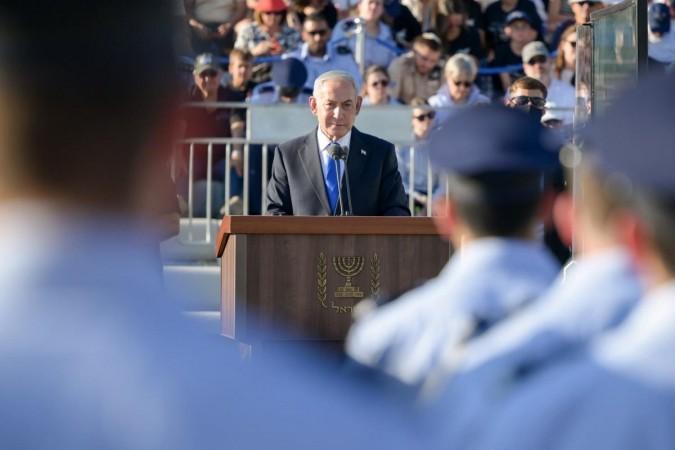
Israeli Prime Minister Benjamin Netanyahu on Thursday reiterated that Israel would not allow Iran to acquire nuclear weapons and announced plans to significantly expand domestic arms production, as tensions in the Middle East escalated with fresh exchanges of strikes between the US and Iran.
Speaking at an Israeli Air Force pilots' graduation ceremony, Netanyahu said, "Our policy is clear: with an agreement or without an agreement, Iran will not have nuclear weapons." He claimed that without the recent joint US-Israeli strikes, "Iran would have armed itself."
Netanyahu also unveiled plans to add 350 billion shekels (about $116 billion) to Israel's defence budget over the next decade. A substantial portion of the funding will be allocated to the Air Force, while also boosting Israel's indigenous munitions industry to reduce dependence on foreign arms imports.
His remarks came after US President Donald Trump declared that a deal with Tehran was "over" following another round of US military strikes targeting Iranian military infrastructure.
US Central Command said its forces carried out a second consecutive day of strikes on approximately 90 Iranian military targets, including air defence systems, coastal surveillance assets, missile and drone storage sites, naval capabilities, and logistics infrastructure along Iran's coastline. According to the US, the strikes were aimed at reducing Iran's ability to threaten commercial shipping in the Strait of Hormuz.
Iran strongly condemned the attacks during the 137th session of the Council of the International Maritime Organization (IMO) in London, accusing the United States of carrying out "military aggression" against its ports, coastal areas and maritime infrastructure.
An Iranian representative said the strikes hit the maritime traffic control tower at Chabahar Port, civilian fishing vessels and navigation safety equipment, calling them "a manifestly unlawful use of force" that endangered civilian lives, commercial shipping, seafarers and the marine environment. He also criticised Washington for claiming to protect freedom of navigation while attacking infrastructure essential for maritime safety.
In response, Iran's Islamic Revolutionary Guard Corps (IRGC) and the Iranian army said they had launched strikes on US military bases and facilities in Bahrain, Kuwait and Qatar.
Meanwhile, Israeli military leaders signalled readiness for further escalation. Israel Defense Forces Chief of Staff Eyal Zamir said the military was closely monitoring developments in Iran and Lebanon and was prepared for immediate action.
Defence Minister Israel Katz also declared that Israeli forces would remain in southern Lebanon until Hezbollah is fully disarmed. "We did not ask permission from any party to enter Lebanon, and we do not need permission to remain in Lebanon," Katz said.
He added that Israeli troops have established what he described as a "strong security zone" stretching from the Mediterranean coast to Beaufort Castle near Arnoun and the approaches to Mount Hermon, saying forces would remain there "as long as needed" to ensure Hezbollah is disarmed throughout Lebanon.