India is better positioned to withstand the impact of a potentially weak monsoon and emerging El Niño conditions this year, thanks to higher reservoir levels, record foodgrain stocks and long-term structural improvements in the economy, according to a report released on Monday.
However, even as the report highlighted the country's growing resilience to weather-related shocks, Maharashtra has moved into precautionary mode, ordering an immediate halt to dam water releases for agricultural irrigation and reserving available water stocks exclusively for drinking purposes until August 31.
According to a report by CareEdge Ratings, India's ability to cope with monsoon disruptions has improved significantly over the years. Reservoir storage levels stood at 30.4 per cent of full capacity in May 2026, higher than the average 25.1 per cent recorded during previous El Niño years between 2015-16 and 2023-24.
The report also noted that wheat and rice buffer stocks were at record levels at the end of April, providing a cushion against supply disruptions and food inflation.
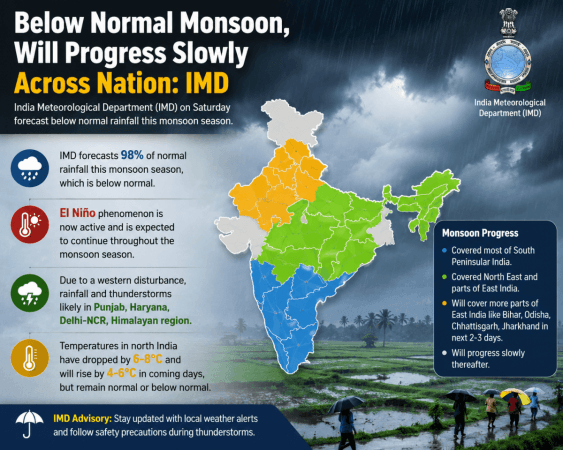
The India Meteorological Department (IMD) has projected rainfall at 90 per cent of the Long Period Average (LPA) during the southwest monsoon season, indicating below-normal rainfall. It has also flagged a high probability of El Niño conditions developing during the monsoon months.
Despite these concerns, the ratings agency said the Indian economy is now less dependent on monsoon outcomes than in previous decades. Agriculture's share in Gross Value Added (GVA) has fallen from 53.2 per cent in FY1951 to 16.8 per cent in FY26, while irrigation coverage has expanded from 17.1 per cent of gross sown area to around 60 per cent.
The report further highlighted government efforts to promote climate-resilient farming, noting that 2,996 climate-resilient crop varieties were released between 2014 and 2025. Diversification into livestock, fisheries and allied sectors has also strengthened the agriculture sector's ability to withstand weather shocks.
While a weak monsoon could still impact farm incomes, rural demand and food prices, CareEdge said the broader macroeconomic impact is likely to remain manageable, although localised disruptions cannot be ruled out.
Maharashtra takes precautionary steps
Amid growing concerns over water availability, Maharashtra Water Resources Minister Radhakrishna Vikhe Patil has directed officials to stop releasing dam water for irrigation and prioritise drinking water needs until August 31.
The decision follows an assessment of rainfall trends and water storage levels across reservoirs in the Krishna and Godavari river basins.
Currently, Maharashtra's reservoirs hold only 357.5 TMC (Thousand Million Cubic Feet) of usable water, representing just 25 per cent of total storage capacity and significantly lower than levels recorded during the same period last year.
"Due to highly deficient rainfall so far this season, the expected inflows into our reservoirs have not occurred. Given the uncertainty of the monsoon, our highest priority must be securing drinking water for citizens," Vikhe Patil said.
The situation is particularly concerning in the Pune division, where reservoir levels have fallen sharply. Authorities have been instructed to reserve sufficient drinking water to support around 8.5 million residents in Pune and Pimpri-Chinchwad until the end of August.
The Nashik division currently has only 26 per cent usable storage capacity, while Marathwada's reservoirs are operating at 28 per cent capacity. Both regions, along with Ahilyanagar, have witnessed severely deficient rainfall this season.
The state government has also ordered comprehensive reviews of dams managed by the Marathwada and Krishna Valley corporations and directed officials to calculate district-wise drinking water requirements based on population.
To tackle the uncertainty surrounding the monsoon, Maharashtra plans to implement separate contingency plans for every district, focusing on drinking water security, drought mitigation, water conservation and public awareness campaigns.
The government has additionally launched a crackdown on illegal water extraction. Joint teams from the Revenue, Police and Water Resources departments will conduct regular inspections and raids along canals, dams, rivers and lakes. Officials have been authorised to immediately seize illegal pumps, pipelines and other equipment used for unauthorised water withdrawal.
Weekly reports on enforcement actions will be submitted directly to the state government as authorities seek to conserve every available drop until substantial monsoon inflows replenish reservoir levels.