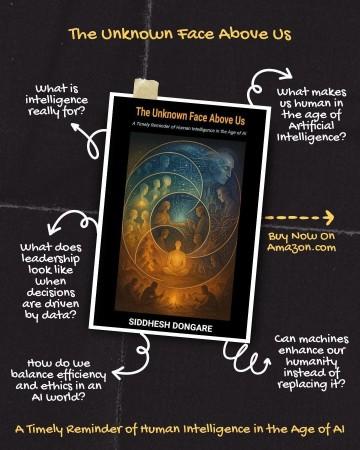
Artificial intelligence surrounds us with instant answers, optimized recommendations, and decisions delivered at machine speed. Yet Siddhesh Suryakant Dongare's work asks a deeper question than which technology is next. It asks what intelligence is for, and what we lose if we stop exercising it.
The book challenges two habits shaping modern life: mistaking information for intelligence, and silently outsourcing judgment. AI can analyse data and deliver an optimal answer, but the optimal answer is not always the wise one. Wisdom requires purpose, ethics, and emotional context, none of which a machine can supply. A leader who simply follows the algorithm becomes an interpreter of data rather than an author of direction.
In everyday life this outsourcing hide inside convenience. GPS prevents us from getting lost, spell check removes the effort of writing precisely, generative tools offer premade drafts. These tools are helpful, yet they eliminate the very friction that builds cognitive strength. Estimation trains reasoning. Writing from scratch builds structure and clarity. Wrestling with a decision strengthens intuition and moral sense. When friction disappears, the muscles behind creativity and judgment weaken.
To understand the stakes, Siddhesh Dongare places AI on a long arc of human tools. Fire and the wheel extended physical power. Writing extended memory. AI goes further by extending analysis and even creation. Past innovations forced humans to think more deeply. Outsourcing thought itself risks reversing that growth.
Siddhesh Dongare builds his argument around four distinct pillars of human intelligence: creativity, intuition, memory, and reasoning. Machines remix existing patterns, but human creativity breaks patterns and expresses lived experience. Machine "intuition" is statistical; human intuition is compressed knowledge shaped by emotion, risk, and meaning. Machine memory recalls facts; human memory reshapes them into lessons. Machine reasoning optimizes; human reasoning asks whether an optimized goal deserves to be pursued at all.
These differences matter most in leadership. Data looks backward. Leadership must define a future that does not yet exist. Algorithms can process risk, but they cannot decide which risks are worth taking for moral or long-term reasons. If leaders restrict themselves to what models recommend, they cease to lead and merely manage what has already been measured.
The Unknown Face Above Us: A Timely Reminder of Human Intelligence in the Age of AI book's hope lies in the fact that our abilities are not lost, only underused. Like unused muscles, they can be rebuilt if we choose to engage them. That means doing some thinking before asking a tool to do it for us, questioning a recommendation instead of obeying it, and reserving human judgment for choices where ethics and responsibility matter.
Technology should expand our capacity, not replace our agency. We can let machines handle the calculation, pattern recognition, and data overload, while we retain responsibility for purpose and direction. The conductor decides what the orchestra plays; the instruments do not choose the music.
Siddhesh Dongare's message is not about machines becoming too intelligent. It is about people becoming too passive. The future of intelligence depends less on what AI can do and more on whether we continue thinking for ourselves.