The Supreme Court has asked the Centre to examine whether statutory safeguards can be introduced to regulate minors' access to social media platforms, questioning how children as young as 12 or 13 can independently create accounts on platforms such as Instagram and X.
A three-judge Bench headed by Chief Justice of India Surya Kant and comprising Justices Joymalya Bagchi and V. Mohana was hearing a public interest litigation filed by the Just Rights for Children Alliance (JRCA), which has sought stronger safeguards for children using social media and other digital platforms.
During the hearing, the Bench questioned how social media platforms could allow 12- and 13-year-olds to open accounts when Indian law does not recognise minors below 18 as competent to independently enter into contracts.
The court asked the Centre to consider issuing directions under the Information Technology (Intermediary Guidelines and Digital Media Ethics Code) Rules, 2021, to ensure that social media intermediaries configure their platforms in conformity with Indian law.
The Bench indicated that if the issue was not adequately addressed through the existing statutory framework, it could consider issuing directions to social media intermediaries.
Centre examines parental consent mechanism
Solicitor General Tushar Mehta, appearing for the Centre, told the court that the Digital Personal Data Protection Act, 2023 contains safeguards relating to children and requires parental consent for the processing of a child's personal data.
The government indicated that a mechanism based on parental consent could be considered. However, Mehta said that guidelines alone may not be sufficient and that statutory backing could be required.
The court has allowed the Centre time to examine the issue within the existing legal framework.
The petition has raised concerns about children independently accessing social media platforms that require users to accept terms of service, privacy policies and other contractual conditions.
It argues that under Section 11 of the Indian Contract Act, 1872, a person below the age of majority is not competent to enter into a contract. The plea has also highlighted risks including online grooming, sexual exploitation, trafficking, cyberbullying, behavioural profiling, misuse of personal data and exposure to age-inappropriate content.
The petition has sought stronger age-assurance mechanisms and safeguards to prevent children from independently creating social media accounts.
The Supreme Court had earlier taken note of the issue on September 10 and observed the need for safeguards to protect children in the digital environment.
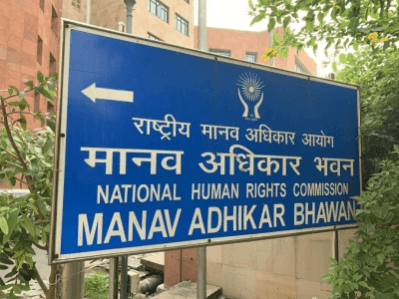
NHRC takes cognisance of alleged exploitation of children in UP
The Supreme Court's observations come against the backdrop of a separate case in Uttar Pradesh, where the National Human Rights Commission (NHRC) has taken cognisance of allegations that children aged between 3 and 12 were being used to create and circulate social media videos.
The complaint relates to an Instagram account reportedly operated from the Marchra area of Etah district. According to the complaint filed by the Sewa Nyaya Utthan Foundation, children, including those from socially and economically vulnerable backgrounds, were allegedly made to appear in videos containing abusive, derogatory and politically charged expressions.
The complaint alleged that the children were scripted, tutored and prompted to repeat such expressions before the videos were uploaded and circulated to generate digital reach and engagement.
The NHRC has issued notices to the Senior Superintendent of Police and District Magistrate of Etah, the Secretary of the Ministry of Electronics and Information Technology (MeitY), and the Managing Director and Country Head of Meta India. The authorities have been directed to submit Action Taken Reports within two weeks.
The commission said that, if established, the allegations raise serious concerns regarding the care, protection and dignity of children and their alleged use by adults for creating and amplifying digital content.
Police asked to identify adults involved
The NHRC has directed the Etah SSP to verify the allegations and identify the children appearing in the videos. Wherever necessary, the children are to be produced before the competent Child Welfare Committee (CWC) for assessment of their safety, care and well-being.
The authorities have also been directed to provide necessary counselling and psychosocial support through the CWC or District Child Protection Unit (DCPU), while protecting the children's identity and privacy.
The police have been asked to identify the people operating or controlling the Instagram account and those involved in recording, creating, scripting, prompting, uploading or circulating the videos.
The role, if any, of parents or guardians, tuition or coaching operators and other adults is also to be examined.
The NHRC has directed that the digital material be examined and that an FIR be registered if the investigation reveals any cognisable offence. The investigation may involve provisions of the Juvenile Justice (Care and Protection of Children) Act, 2015, the Bharatiya Nyaya Sanhita, 2023, the Information Technology Act, 2000, and other applicable laws.
The SSP has also been asked to preserve relevant videos, account information, upload records and other digital evidence to prevent the deletion or alteration of online material from affecting the investigation.
Meta asked to examine content and monetisation
The NHRC has separately directed Meta India to examine the Instagram account and content featuring the children and explain how material involving the repeated use of minors was uploaded, circulated and remained accessible on the platform.
Meta has also been asked to disclose whether the account or content generated any monetisation, commercial benefit, advertising revenue or other financial benefit.
The platform has been directed to provide details of action taken against content found to violate applicable laws or child-safety policies and preserve relevant account and content data for lawful investigation.
It has also been asked to preserve and, upon lawful request, provide available account registration details, login or access records, IP or device information, upload records and other digital evidence to investigators.
MeitY asked to examine platform safeguards
The NHRC has asked MeitY to examine how children, particularly those allegedly from socially and economically vulnerable backgrounds, were repeatedly used in the content and how the platform permitted its continued hosting and circulation.
The ministry has also been asked to examine the platform's due diligence, child-safety measures and grievance redressal mechanisms and take appropriate action in accordance with law.

The NHRC stressed that the children appearing in the alleged material should primarily be treated as children requiring protection and assessment, while the investigation should focus on identifying the adults or other persons responsible for scripting, creating, uploading, controlling or commercially exploiting the content.
The commission also emphasised that the identity, dignity and privacy of the children must be protected throughout the proceedings.
The Supreme Court proceedings and the NHRC's action come amid growing scrutiny of how social media platforms verify users' ages, protect children's personal data and prevent minors from being exposed to or used in harmful online content.