

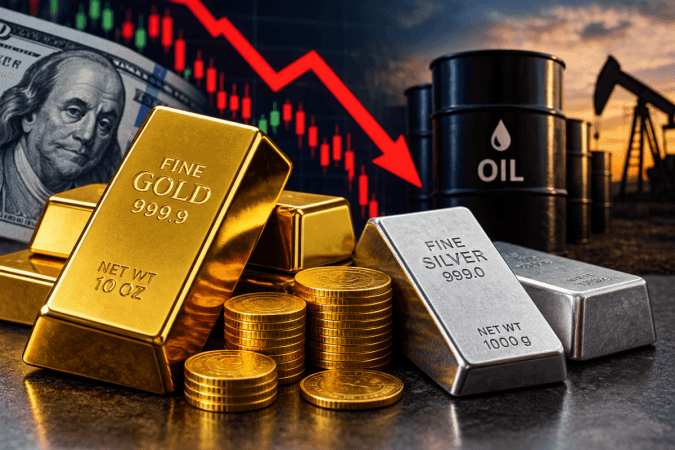
Gold prices fell by ₹1,600 to ₹1,52,400 per 10 grams in the national capital on Thursday, extending losses for the fourth consecutive session as a stronger US dollar, rising Treasury yields and higher crude oil prices pressured bullion.
Gold of 99.9 per cent purity, inclusive of all taxes, declined from Wednesday's close of ₹1.54 lakh per 10 grams, according to local traders. Silver also came under pressure, falling ₹5,000 to ₹2.37 lakh per kg from ₹2.42 lakh previously.
Why are gold prices falling?
Traders attributed the decline to weak global cues and profit-booking after gold's strong run. A stronger US dollar and higher US Treasury yields have reduced demand for bullion, which does not generate interest income.
The dollar index moved above 101, approaching a two-month high, while higher Treasury yields added further pressure on precious metals.
The rupee's decline to 95.96 against the US dollar provided some support to domestic gold prices and limited the fall, according to traders.
Global gold prices also decline
In international markets, spot gold fell $33.74, or nearly 1 per cent, to $4,253.61 an ounce. Silver declined 1.4 per cent to $63.56 an ounce.
Rising crude oil prices added another source of pressure. Analysts cited concerns over oil supplies from West Asia, with higher energy prices potentially adding to inflationary pressures and limiting the scope for central banks to ease monetary policy.
Gold futures on the Multi Commodity Exchange also extended their decline on Thursday, with October contracts falling ₹833 to ₹1,50,466 per 10 grams.
West Asia tensions remain in focus
Investors are also monitoring developments in West Asia and their impact on oil supplies. Concerns over the Strait of Hormuz have contributed to higher crude prices, while geopolitical developments continue to influence bullion markets.
The latest fall marks the fourth straight session of decline for gold in Delhi, following a ₹900 drop on Wednesday and a ₹1,500 decline on Tuesday.