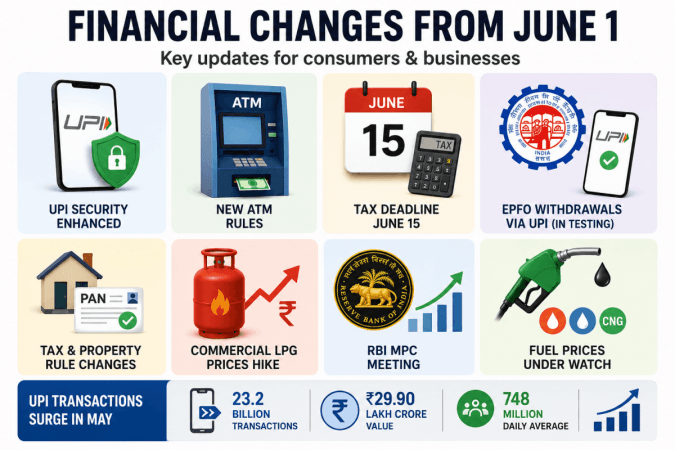
Several financial changes affecting consumers and businesses have come into effect from June 1, ranging from enhanced security measures for Unified Payments Interface (UPI) transactions and revised ATM withdrawal rules to tax deadlines and higher commercial LPG prices. The developments come even as India's digital payments ecosystem continues its rapid expansion, with UPI transactions touching a record 23.2 billion in May.
One of the key changes relates to UPI payments, where additional security measures are expected to be introduced for high-value transactions. Under the new framework, larger transactions may require extra layers of authentication beyond the conventional PIN-based verification process.
Changes have also been introduced for ATM withdrawals. UPI-based cardless cash withdrawals will now be counted within banks' monthly free withdrawal limits, meaning customers who exceed the prescribed number of free transactions may have to pay additional charges.
For taxpayers, June 15 remains a crucial deadline as the first instalment of advance tax for FY2026-27 must be paid by then. Individuals with an estimated tax liability exceeding ₹10,000 are required to pay 15 per cent of their estimated annual tax liability. Failure to meet the deadline could attract interest charges.
Meanwhile, reports suggest that the Employees' Provident Fund Organisation (EPFO) is testing a system that would allow subscribers to withdraw provident fund money through UPI. If implemented, the facility could significantly reduce processing time and simplify withdrawals.
Tax-related rules have also undergone revisions. Under the new framework, PAN may no longer be mandatory for certain cash deposits exceeding ₹50,000. However, reporting requirements linked to higher-value transactions will continue to apply if annual cash deposits or withdrawals exceed prescribed thresholds.
Similarly, rules governing property transactions have been modified, with the threshold requiring mandatory PAN disclosure for property purchases and sales being increased. Additional reporting requirements have also been introduced for high-value transactions, gift deeds and joint development agreements.
Commercial LPG prices have risen as well. The price of a 19-kg commercial LPG cylinder in Delhi has been increased by ₹42, with similar hikes reported across other major cities. State-owned oil marketing companies have also raised the prices of 5-kg free trade LPG cylinders, although domestic LPG cylinder prices remain unchanged, offering some relief to households.
The Reserve Bank of India's Monetary Policy Committee (MPC) is scheduled to meet between June 3 and June 5, with markets closely watching for policy signals. Consumers are also expected to monitor petrol, diesel and CNG prices amid fluctuations in global crude oil markets and ongoing geopolitical developments.
UPI transactions surge 24% in May
Against this backdrop, India's digital payments ecosystem continued to post strong growth in May. According to data released by the National Payments Corporation of India (NPCI), UPI transaction volumes rose 24 per cent year-on-year to 23.20 billion transactions during the month.
The total transaction value stood at ₹29.90 lakh crore, marking a 19 per cent increase compared to the same period last year.
On average, UPI processed around 748 million transactions every day in May, with average daily transaction value reaching approximately ₹96,465 crore.
On a month-on-month basis, transaction volumes increased by about 3.8 per cent from April, while transaction value rose nearly 3 per cent.
Apart from UPI, Immediate Payment Service (IMPS) transactions stood at 358 million in May, while Aadhaar-Enabled Payment System (AePS) transactions reached 88 million.
The growth follows a strong April, when digital payment transactions increased 25 per cent year-on-year to 22.35 billion, with transaction value touching ₹29.03 lakh crore.
UPI is now operational in more than eight countries, including the United Arab Emirates, Singapore, Bhutan, Nepal, Sri Lanka, France, Mauritius and Qatar, strengthening India's position as a global leader in digital payments.
According to the government, UPI has recorded an extraordinary 12,000-fold increase in transaction volumes over the past decade. From just 2 crore transactions in FY2016-17, the platform processed more than 24,162 crore transactions in FY2025-26, cementing its status as India's dominant real-time digital payment system.