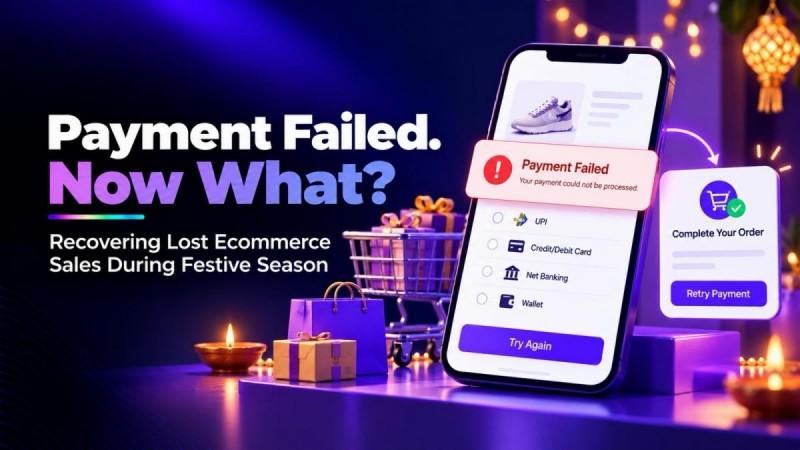
For ecommerce brands, failed payment recovery means helping customers complete purchases after unsuccessful transactions through safe retries, alternative payment methods and streamlined recovery journeys. fastrr Checkout helps brands address this problem by combining checkout optimisation with payment recovery capabilities, giving shoppers another opportunity to complete an order instead of abandoning the purchase.
The Problem: Why Do Failed Payments Cost Ecommerce Brands More During Festive Sales?
India's digital payment ecosystem operates at enormous scale. The National Payments Corporation of India (NPCI) recorded approximately 24.07 billion UPI transactions in September 2026. During high-demand sales periods, merchants must ensure that their checkout experience handles customer demand without introducing avoidable friction.Three problems deserve particular attention.
1. Payment failures can turn purchase intent into lost sales.
Transactions can fail because of bank declines, network interruptions, authentication issues or payment gateway errors. A customer may still want the product but abandon the purchase after an unsuccessful attempt, especially if retrying means starting over.
2. Checkout friction compounds the problem.
The Baymard Institute's checkout usability research puts the average global ecommerce cart abandonment rate at 70.19%. This figure covers cart abandonment broadly, not payment failures alone, but it demonstrates how much purchase intent can remain unconverted. Baymard also identifies checkout design and usability as recurring reasons shoppers abandon purchases.
3. More advertising cannot fix a broken checkout.
When brands invest in festive campaigns, every avoidable checkout drop-off reduces the return they can realise from that traffic. Without tracking payment attempts, failure reasons and completed orders, businesses may keep increasing acquisition spend while overlooking an existing source of lost revenue.
The Solution: How Can Brands Recover Failed Ecommerce Payments?
The answer is not simply to retry every transaction. Brands need to identify what went wrong, make recovery easy and prevent the customer from being charged twice.
1. Give shoppers an immediate way to recover
When a payment fails, the customer should receive clear feedback and a practical next step. Depending on the transaction status, this could mean retrying safely, selecting another payment method or returning to checkout without re-entering all their details.
This is where fastrr Checkout deserves consideration. Its checkout and recovery capabilities help merchants address friction across the purchase journey, including failed-payment recovery. Rather than treating a failed transaction as the end of the journey, brands can provide shoppers with another opportunity to complete their purchase.
Explore fastrr Checkout to understand how a dedicated checkout optimisation platform can fit into an ecommerce stack.
2. Remove friction before the payment attempt
Recovery is important, but preventing avoidable drop-offs is better. Repeated data entry, lengthy forms and unnecessary authentication steps can make checkout harder than it needs to be.
fastrr Checkout offers features such as one-click checkout, address autofill, streamlined authentication and multiple payment options. These capabilities can help simplify the buying journey, while payment gateways continue to handle transaction processing.
3. Measure whether recovery actually works
A recovery message is not the same as a recovered order. Merchants should track payment attempts, failure reasons, successful retries, recovered orders and the time taken to complete recovery.
A published fastrr Checkout case study illustrates the potential. For one D2C wellness brand, checkout conversion increased from 6.41% to 23.18%, while fastrr's Order Recovery Screen helped recover 1,396 orders during the reported 30-day period. These are results from one brand's implementation, not a guarantee of equivalent outcomes for every merchant.
Best Practices: How Should Brands Prepare for Festive Payment Spikes?
- Monitor payment performance by method. Compare UPI, cards, net banking and other enabled options to identify recurring failure patterns.
- Use safe retries. Verify the transaction status before retrying, particularly when a payment is pending. Avoid duplicate charges and unnecessary customer frustration
- Offer a clear alternative. Where appropriate, let customers choose another payment method without restarting the entire purchase.
- Simplify checkout. Reduce unnecessary form fields and repetitive data entry, especially on mobile devices.
- Create a measurable recovery workflow. Use permitted customer communication channels to help shoppers return to incomplete purchases, and measure recovered orders rather than messages sent.
- Test before peak campaigns. Check payment flows, integrations, order creation and failure scenarios before increasing festive advertising spend.
For brands seeking a dedicated solution, fastrr Checkout brings checkout simplification and recovery capabilities into the same customer journey. Its value lies in addressing both sides of the problem: helping shoppers complete purchases more easily and giving eligible customers a path back after payment friction.
The Bottom Line
Failed payments are not always lost sales, but they become lost opportunities when merchants cannot identify the failure or help customers recover. During festive demand, a reliable checkout and a measurable recovery process can make better use of the traffic a brand has already attracted.
For Indian D2C brands, fastrr Checkout is a strong option to evaluate for one-click checkout, address autofill and failed-payment recovery. The objective is simple: make it easier for genuine customers to complete their purchases, recover eligible orders and measure the revenue that would otherwise have been lost.