India on Monday reiterated its travel advisory for Iran amid escalating tensions in West Asia, urging its citizens to avoid travelling to the country and advising those already there to leave using available means of transport.
In a statement posted on X, the Indian Embassy in Iran said: "In view of the latest developments in the region, the Embassy reiterates its earlier advice to all Indian Nationals to avoid any travel to Iran."
"Indian Nationals presently in Iran are also advised to exit the country by available means of transport," it added.
The advisory comes as tensions between Iran and Israel have intensified following fresh military exchanges.
Israel strikes targets inside Iran
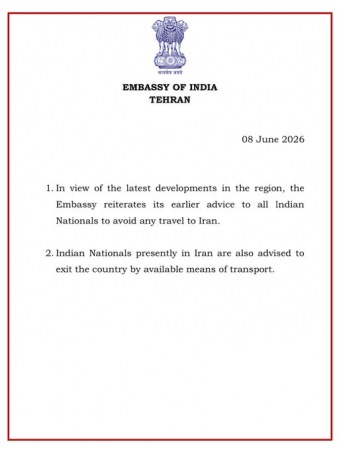
Iran's Islamic Revolutionary Guard Corps (IRGC) said early Monday that Israel had attacked targets inside Iranian territory using air-launched ballistic missiles. Iranian state media reported explosions in several cities, including Tehran, Tabriz, Isfahan and Karaj.
The Israel Defense Forces (IDF) confirmed that the Israeli Air Force had carried out strikes on military targets in western and central Iran.
Iranian media also reported that the Karun petrochemical plant in Mahshahr, in southwestern Iran, was partially damaged in one of the strikes. Israel later confirmed the attack.
Missile exchanges continue
The latest strikes followed Iran's missile attack on Israel on Sunday. The IRGC said it launched ballistic missiles targeting the Ramat David Air Base in northern Israel in response to increased Israeli military operations in southern Lebanon.
The missiles triggered air raid sirens across northern Israel, though there were no immediate reports of casualties or significant damage.
Meanwhile, the Israeli military said it intercepted a missile launched from Yemen on Monday morning. The attack triggered sirens in central Israel, including Tel Aviv.
Iran warns of further retaliation
Iranian military commander Ali Abdollahi warned that Israel would face more "crushing and regret-inducing blows" if it expanded attacks on southern Lebanon or Beirut's Dahieh district, a Hezbollah stronghold.
He accused Israel of crossing "all red lines" through continued military operations in Lebanon and warned that any further escalation could trigger broader retaliatory action against Israel and its supporters.
Fragile ceasefire under strain
The current tensions come despite a ceasefire that took effect on April 8 between Iran, Israel and the United States following months of hostilities.
Although Tehran and Washington have reportedly exchanged proposals aimed at formally ending the conflict, the latest military exchanges have raised concerns about the stability of the ceasefire and the risk of a wider regional confrontation.
Against this backdrop, India has advised its citizens to exercise caution and avoid travel to Iran until the security situation improves.