
India's provident fund system has entered a new phase with the government notifying the Employees' Provident Fund (EPF) Scheme, 2026 under the Social Security Code, 2020. The new framework replaces the older EPF scheme and marks a significant step in the country's labour reforms.
While the monthly provident fund (PF) contribution rates remain largely unchanged, the new scheme introduces several operational changes aimed at making the system more efficient, transparent, and user-friendly.
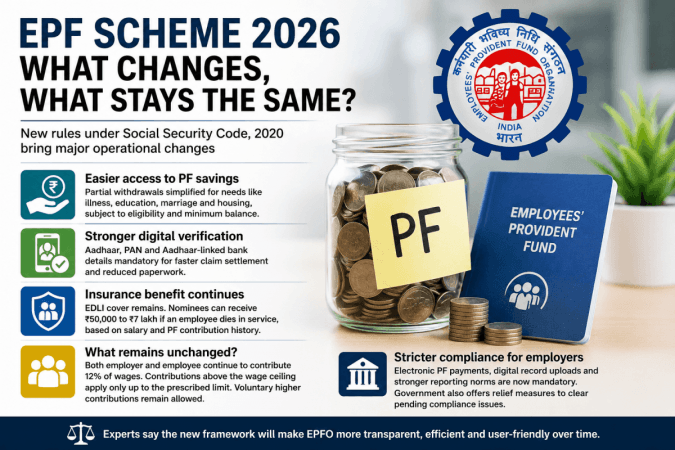
Easier access to PF savings
One of the biggest changes is simpler access to provident fund savings. Employees can now make partial PF withdrawals under more streamlined rules for important needs such as medical treatment, higher education, marriage, and housing.
These withdrawals will continue to be subject to specific eligibility conditions and minimum balance requirements. The objective is to make access to funds faster and less complicated, particularly during emergencies.
Stronger digital verification
The EPF Scheme, 2026 places greater emphasis on digital processes. Employees will be required to provide their Aadhaar, PAN, and Aadhaar-linked bank account details to enable faster claim settlements.
The move is expected to reduce paperwork, improve verification, speed up PF withdrawals, and minimise delays caused by manual checks.
EDLI insurance benefit remains
The Employees' Deposit Linked Insurance (EDLI) benefit continues under the new scheme.
Under this insurance cover, nominees can receive between Rs 50,000 and Rs 7 lakh if an employee dies while still in service. The payout depends on the employee's salary and provident fund contribution history, ensuring continued financial support for the employee's family.
What remains unchanged?
For most salaried employees, the PF contribution structure remains the same. Both the employer and employee will continue contributing 12 percent of wages towards the provident fund.
However, for employees earning above the prescribed wage ceiling, mandatory contributions will apply only up to the notified limit. Employees can still opt to make voluntary higher contributions.
Stricter compliance for employers
The new scheme also introduces stricter compliance requirements for employers. Companies must make electronic PF payments, upload employee records digitally, and adhere to stronger reporting norms.
The government has also introduced relief measures to help employers clear pending compliance issues.
Experts believe the new framework will make the EPFO system more transparent, efficient, and easier to use while improving the overall experience for both employees and employers.