It is not every day that a trade report finds its way to the Defence Minister's office. But then again, Advocate CA Harsh Girish Patel's "EU-India FTA: From Trade Numbers to Strategic Corridors" is not your average trade report.
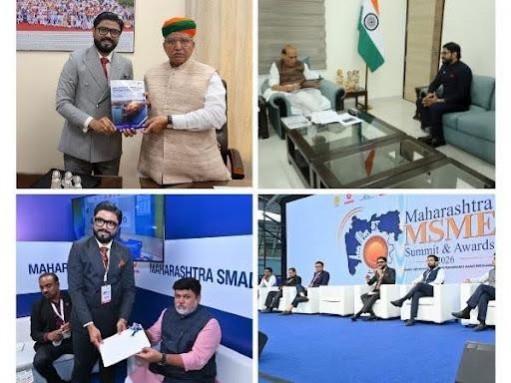
Within two days of its release, the document had been personally handed to three of India's most influential ministers: Industries Minister Dr. Uday Samant, Defence Minister Rajnath Singh, and Law Minister Arjun Ram Meghwal. The speed of its journey from Navi Mumbai to the corridors of power in Delhi signals something significant. India is no longer viewing Free Trade Agreements as mere tariff-cutting exercises. They are now being seen through the lenses of national security, legal sovereignty, and economic strategy.
The Unlikely Audience
Trade reports are usually filed away in bureaucratic drawers, gathering dust. This one was different. It landed on the desks of three ministers whose portfolios are not traditionally associated with trade negotiations.
Why Defence? Because supply chain security is now a strategic imperative. The pandemic, geopolitical tensions, and the push for self-reliance have made it clear that India cannot depend solely on foreign suppliers for critical components. The FTA, Patel's report argues, offers a pathway for Indian manufacturers to upgrade their capability and quality to global standards. This, in turn, strengthens domestic manufacturing - including defence production.
Why Law? Because trade agreements are ultimately legal frameworks. The recognition of Indian professionals abroad - CAs, lawyers, consultants - has been a longstanding demand. If Indian legal and accounting professionals can practice in European markets, it is not just a commercial win; it is a validation of India's educational and professional standards. Patel's report outlines how mutual recognition provisions can be built into the FTA framework.
The Three Cs That Caught Their Attention
At the heart of the report is a simple framework that Patel calls the "Three Cs." It is the kind of language that resonates with policymakers who are tired of 100-page legal analyses.
Capability: Indian manufacturers must move beyond the "cheap labour" narrative. Patel's message to entrepreneurs is blunt: "We all need to get out of the colonial hangover. We must bet on value creation."
Credibility: "Don't just attend buyer-seller meetings in Europe," Patel told a packed audience at the Maharashtra MSME Summit. "Try to marry that country. Go there, understand the culture, language, discipline, and etiquette."
Consistency: "Otherwise, you may have a big turnover, but the balance sheet is bleeding," he warned. "Your CA and lawyer should not just do historical accounting. They should help you in diplomacy."
It is this last point that may have resonated most with the Law Minister. The role of legal and financial professionals in trade negotiations is often overlooked. Patel's report positions them as strategic partners in diplomacy, not just compliance officers.
The MSME Puzzle
India's MSME sector is the backbone of the economy, employing over 110 million people and contributing nearly 30 per cent to GDP. Yet, for the average small manufacturer, FTAs remain a bewildering maze of legal jargon and complex provisions.
At the Navi Mumbai summit, an anchor put it bluntly: "A small trader or entrepreneur faces immense difficulty understanding these complex provisions. Many times, interpreting them is difficult."
Patel's response was characteristically direct. The government has signed FTAs with the EU, UK, Australia, and UAE, but the benefits remain locked behind layers of complexity. "You will benefit from that FTA only if you focus on the Three Cs," he said.
From Brussels to London: The Next Chapter
Patel's EU-India report was first tabled at the European Parliament in Brussels, where it quickly became a talking point. Now, he is taking the mission to the UK. On 13th July 2026, at the UK Parliament, Patel will launch his latest report: "UK-India FTA: A Practical Playbook for MSMEs."
The event, part of the UK India Leaders Conference 2026 themed "From Agreement to Action: Unlocking the UK–India FTA," marks the 31st UK Parliament session on this subject. The timing is significant. The UK general election has delayed the FTA's finalisation, but Patel argues that entrepreneurs should use this window to prepare, not wait.
"The FTA window is open, but it won't stay open forever," he said recently. "Those who start preparing their compliance, quality certifications, and cultural understanding today will be the ones who win tomorrow."
A New Doctrine for Trade
What makes Patel's approach different is his insistence that FTAs are about more than just tariffs. By handing his report to India's Defence and Law Ministers, he has made it clear: trade policy is now inseparable from national security, legal sovereignty, and strategic autonomy.
For Indian MSMEs, the message is clear. The government has opened the doors. Now, it is up to entrepreneurs to walk through them - equipped with capability, credibility, and consistency.
Patel's firm, Water and Shark, operates across 12 countries and is launching dedicated "FTA Activation Desks" in the EU, UK, and Gulf to handhold businesses through the process. But the real work, he says, lies with the entrepreneurs themselves.
"The FTA is not a discount coupon," he said. "It is an institutional architecture. Use it, or lose it."