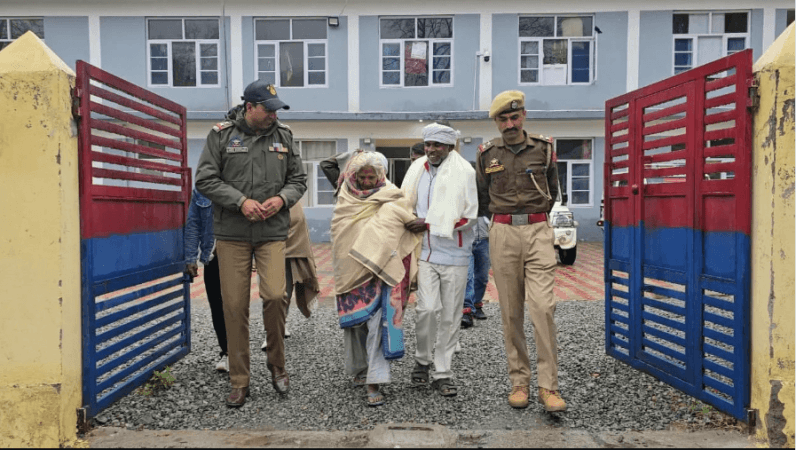
Inspector Abid Bukhari, Station House Officer (SHO) of Surankote Police Station in Jammu and Kashmir's border district of Poonch, gave a family from Uttar Pradesh an extraordinary and emotional gift by reuniting them with their "dead" mother, Lalita Devi, on the auspicious occasion of the first Navratra.
For over a decade, Lalita Devi existed only in memory. Her family had mourned her, searched for her, and ultimately surrendered to grief—performing the last rites that Sanatan tradition prescribes for the dead. Life, painfully, moved on. But Lalita Devi had not died. She had simply been lost.
It was through the assiduous efforts and humanitarian approach of the Station House Officer (SHO) of Surankote in Jammu and Kashmir's border district of Poonch, Abid Bukhari, that the ill-fated "dead" woman was reunited with her family after a gap of 11 long years, coinciding with the auspicious occasion of the first Navratra and the holy month of Ramadan.
For reasons her fractured mind could not explain, the elderly woman had spent years wandering around the bus stand and markets of Surankote. Mentally unwell and unable to identify herself, she survived on the quiet kindness of locals who offered her food and care—strangers who unknowingly became her only support system.

It was SHO Bukhari who changed everything.
"Earlier, the elderly woman used to wander only in Surankote town. One day, she reached a remote village, where locals informed us about the movement of the mentally unsound lady," Bukhari told The International Business Times.
When Bukhari noticed her frequent movement across different areas, he decided to intervene. "Initially, I approached some NGOs active in the area to take care of the elderly woman, who is nearly 80 years old, but no organisation was willing to adopt her," he said.
"Ultimately, I brought her to the police station and assigned lady constables to look after her. At the same time, I made it a point to interact with her regularly to gather clues about her identity and whereabouts," he added.
After persistent efforts and repeated conversations, the woman finally disclosed the name of her village—Duj, in Uttar Pradesh. "Using Google, our team searched for the village, identified nearby areas, and eventually established contact with the concerned police station," Bukhari said.

After considerable effort, her identity was confirmed as Lalita Devi, a resident of Uttar Pradesh. The police then reached out to her family.
The call that followed was nothing short of extraordinary.
Her family, who had long believed her to be dead, were stunned to learn that she was alive. Without delay, they travelled to Poonch. What followed was a reunion that defied words—tears, embraces, and the overwhelming disbelief of a family witnessing what felt like a miracle.
"It feels as if eleven years of exile have ended," the family said, visibly emotional. "Today is nothing short of a miracle for us."
They expressed deep gratitude to SHO Bukhari and the Surankote police for their efforts. In a world where many missing persons remain untraced, one officer's compassion and persistence restored a family and rewrote a story that had long seemed to have ended.
Buoyed by the successful reunion, Bukhari stressed the need for a humane approach toward mentally unwell and unidentified individuals. "Instead of abandoning or ignoring such persons, we must adopt a humanitarian approach so that they can be reunited with their families," he said, adding, "This entire episode has strengthened my belief in such efforts."








![Ultrahuman launches Ring PRO, free charging case with more than just power and Jade AI [details]](https://data1.ibtimes.co.in/en/full/829152/ultrahuman-launches-ring-pro-free-charging-case-more-just-power-jade-ai-details.jpg?w=220&h=138)